The Accidental Digital Mirror
I woke up one morning and saw Indigo had shared an article link. Feeling lazy, I asked my agent to see how this investor might evaluate it.
Instead of searching Twitter directly, the agent first invoked the Indigo knowledge base — something I had built months ago. Honestly, I had almost forgotten it existed.
Free API “Hacking”
There are quite a few free speech-to-text APIs out there (Deepgram, AssemblyAI), each with generous free tiers. I built a YouTube Transcriber skill: give it a video URL, and it automatically downloads the audio, transcribes it, and generates a readable HTML transcript. When I don’t feel like watching a video, I just read instead — and I can ask the agent follow-up questions.
Why Not Transcribe the Entire Channel?
Indigo Talk (Digital Mirror) is a podcast run by an investor with a wide network and high-quality interviews. I follow his Twitter and have watched almost every episode.
One day it hit me: if I can transcribe any video, why not transcribe the entire channel, have agents summarize everything, and store it as a knowledge base I can query anytime?
So I did it. Batch transcription, parallel knowledge extraction with sub-agents, structured storage. The result: 58 episodes, 726 knowledge points, 9 domains, 41 guests — all turned into an agent skill.
Then It Started Running on Its Own
Back to that morning. I asked the agent to evaluate an article about macro AI trends, expecting it to search Twitter for discussions. But the agent’s approach was more systematic than mine — it first read the full article, then loaded 4 core domain reference files from the Indigo knowledge base, and produced a structured evaluation based on 58 episodes of interviews and monthly livestreams:
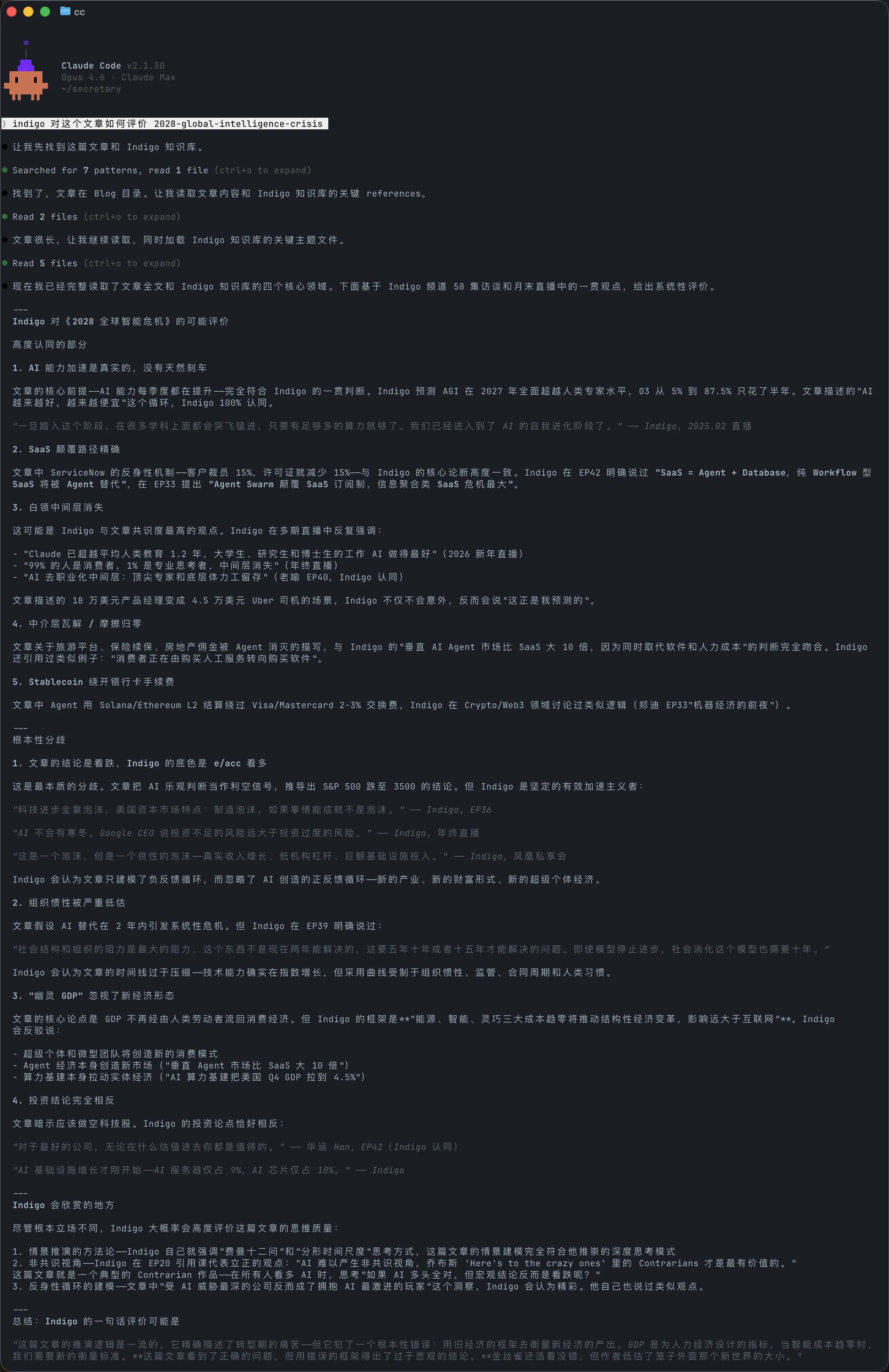
It analyzed “areas of high agreement” — AI capability acceleration, SaaS disruption paths, white-collar middle layer disappearing. It also identified “fundamental disagreements” — the article’s conclusion was bearish, while Indigo is fundamentally e/acc bullish. It even cited specific episode numbers and guest perspectives as evidence.
Only after I followed up with “I want actual tweets” did it go search Twitter.
The key insight: the agent’s reasoning was correct. Check local knowledge base for deep context first, then verify against external sources. Did I teach it this? No. It simply chose the most logical execution path based on available tools.
Tools Compose Themselves
The analysis may not be perfectly accurate — the knowledge base was extracted from video transcriptions, so there’s information loss. But the workflow itself is what I find fascinating.
I built the transcriber to avoid watching videos. I batch-transcribed the channel just for fun. I stored it as a skill for future convenience. Each step was an independent small decision, no grand plan.
But when these tools accumulated to a certain point, they composed themselves into capabilities I never anticipated — essentially creating a “digital mirror” I can consult anytime.
You plant willows for shade, and they grow into a forest.
If you found this helpful, consider buying me a coffee to support more content like this.
Buy me a coffee