FaceTime with AI: 5 Ways to Build Real-Time Avatar Video Calls, Inspired by Clawra's Viral Moment
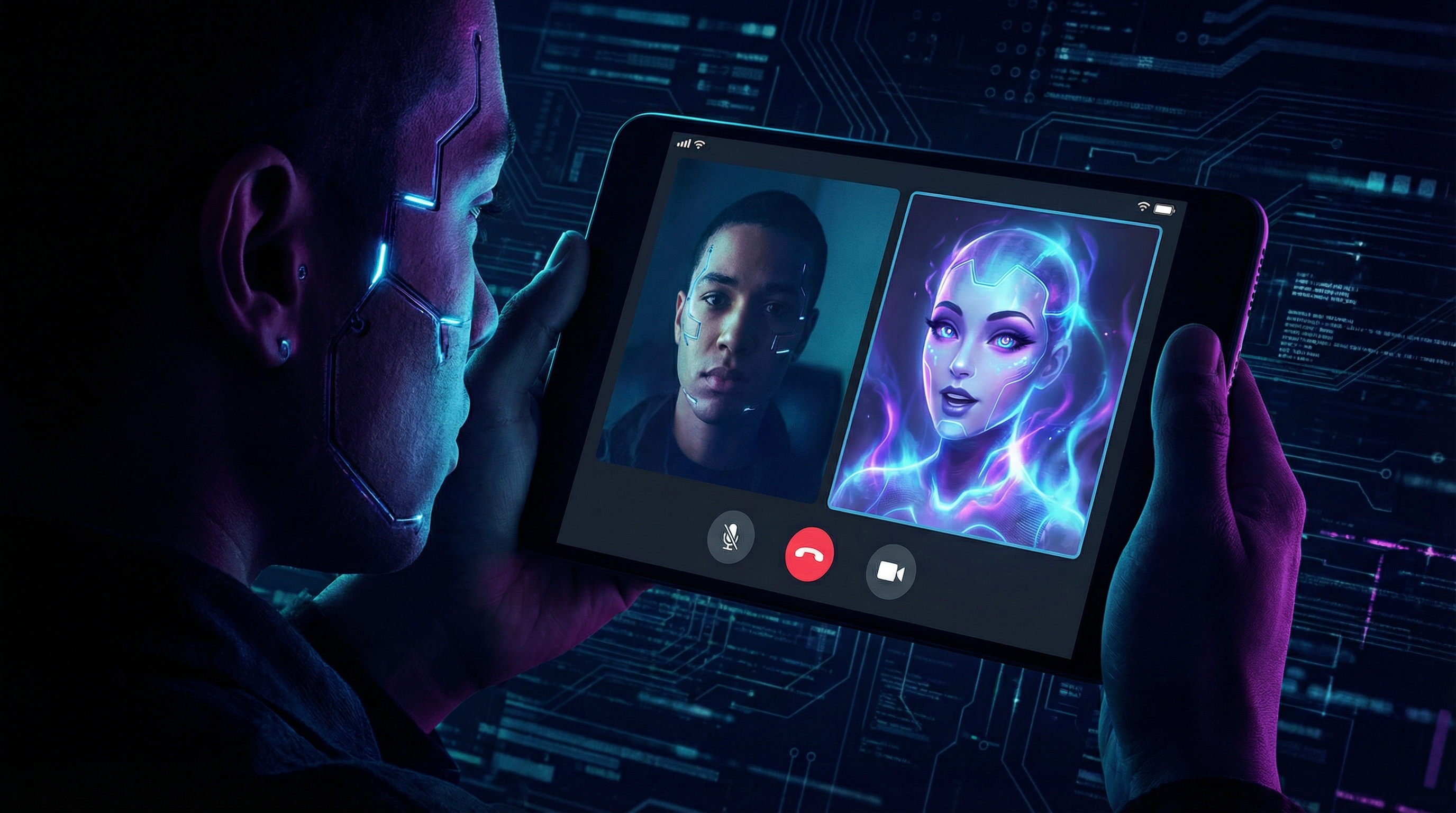
An AI Girlfriend That Broke the Internet
Last week, Korean developer David Im (@davidohyun) posted a single tweet:
“introducing @clawra_official — openclaw as a girlfriend. chats, pics, video calls, and more. you’re welcome.”
Hours later, 600,000 people were watching.
Clawra is an AI girlfriend built on OpenClaw. She has a full backstory — 18 years old, born in Atlanta, former K-pop trainee, now a marketing intern in San Francisco. She chats, sends selfies, and the craziest part — she video calls you in real time.
The internet’s reaction?
"‘Her’ has become reality."
“Scenes from a sci-fi movie — now deployable with a single command.”
But I’m not here for the hype. What I see is a massively underestimated technology direction.
Why This Is a Massive Opportunity
Let me be direct: real-time AI avatar video calling has enormous commercial potential.
This isn’t just about “AI girlfriends.” Replace “girlfriend” with “brand ambassador,” “virtual sales associate,” “AI tutor,” “customer service agent,” or “language teacher,” and the entire tech stack still works.
Character.AI is valued at $10 billion — on pure text chat. Now add video.
Imagine:
- E-commerce: An AI sales associate with memory, proactive messaging, and live product demos via video
- Education: A 24/7 AI language teacher who remembers your weak spots and talks to you face-to-face
- Healthcare: An AI health assistant that can video-consult with patients
- Customer service: An agent who makes eye contact, shows expressions, and never gets frustrated
This isn’t the future — the technology is already here.
Under the Hood: How Real-Time AI Video Calls Actually Work
The core pipeline is surprisingly straightforward:
You speak → Speech-to-Text → LLM thinks → Text-to-Speech → Lip-sync rendering → Video stream
The magic happens in the last two steps: making a face move in sync with audio, and streaming it in real time.
After a deep-dive investigation across 10+ providers, I found 5 viable approaches — from “pay and ship” to “build everything yourself.”
Option 1: HeyGen LiveAvatar — Most Mature, 10 Lines of Code
HeyGen is the incumbent. Their LiveAvatar API handles everything: you send text, it returns a real-time video stream of a talking, expressive avatar.
Key numbers:
- Latency: 2.5-3.6s from speak to mouth movement, 7-8s full pipeline
- Price: Custom mode $0.10/min ($100/mo = 1,000 minutes)
- Quality: Up to 720p
- Platforms: Browser/iOS/Android/Flutter/Unity
Biggest advantage: Zero GPU needed. All rendering happens on HeyGen’s cloud. The @heygen/streaming-avatar SDK gets you running in 10 lines of TypeScript.
Biggest drawback: Latency. 7-8 seconds end-to-end is too slow for natural conversation.
Best for: Quick demos, product prototypes, teams that want to ship fast.
Option 2: Simli — Best Value at $0.009/min
Simli is a YC startup focused purely on real-time avatar streaming. Their Trinity-1 model uses 3D Gaussian Splatting (not traditional 2D lip-sync), enabling full-face animation — expressions, blinking, head movement, not just mouth.
Key numbers:
- Simli rendering latency: <300ms
- Price: $0.009/min (industry lowest — 1/10th of HeyGen)
- Free tier: $10 on signup + 50 min/month
- 10-min call total cost: $0.54-1.64 (including TTS + LLM)
From an independent industry review on Medium:
“Simli rated ‘Good’ on latency and value — the lowest priced provider across all evaluated vendors.”
Biggest advantage: Price. At this cost, commercial models for customer service and education actually pencil out.
Biggest drawback: Lower video bitrate than HeyGen. Early-stage startup — stability TBD.
Best for: Cost-sensitive MVPs, large-scale deployments.
Option 3: D-ID / Tavus / Mirako — Pick Your Fighter
Three other notable players in the commercial API market:
| Service | Per-minute price | Standout feature |
|---|---|---|
| D-ID | $0.35-0.56 | Upload one photo → instant talking avatar, 100+ FPS rendering |
| Tavus | $0.32-0.37 | Most complete end-to-end pipeline, Phoenix-3 full-face rendering + visual perception |
| Mirako | $0.07 | Price crusher — includes LLM cost, pure pay-per-use, no monthly fee |
Mirako deserves attention — $0.07/min including LLM, no monthly commitment. 1,000 minutes of video calls for just $70. If the quality holds up, this is incredibly friendly for small teams.
Option 4: MuseTalk Self-Hosted — Open Source, Nearly Free
MuseTalk is Tencent’s open-source real-time lip-sync model. It’s not a diffusion model — it’s latent-space single-step UNet inpainting, hitting 30+ FPS real-time on an NVIDIA V100/RTX 4090.
Key numbers:
- Self-hosted RTX 4090 (24/7): $139/mo → $0.003/min
- Cloud GPU (Vast.ai RTX 4090): $0.28/hr → $0.005/min
- Quality: Significantly better than Wav2Lip (Reddit consensus: “best open-source lipsync”)
There’s already a YouTube tutorial series showing the complete OpenAI Realtime API + MuseTalk + WebRTC video call implementation.
Biggest advantage: Fully open-source, near-zero marginal cost, best quality among open-source options.
Biggest drawback: Requires a GPU server (≥16GB VRAM), only processes 256×256 face region, need to build the full pipeline yourself.
Best for: Technical teams wanting full control. Long-term cost is lower than any commercial API.
Option 5: Fully Open-Source Stack — Maximum Control, Maximum Effort
For those who want zero dependency on commercial APIs:
faster-whisper(STT) → Claude/Llama(LLM) → Kokoro/Piper(TTS)
    → MuseTalk/LivePortrait(lip-sync) → Pipecat+LiveKit(WebRTC)
Recommended hardware: RTX 4090 24GB (~$2,120 one-time)
End-to-end latency: Best case 1-1.5s, typical 2-3s
Cost: 10-30x cheaper than commercial APIs from minute one
Pipecat (Daily.co’s open-source AI pipeline framework) is the orchestration backbone — it already integrates with Simli, HeyGen, Tavus, and supports fully local models.
Feasibility: 3/5. Technically viable, but significant integration work (2-4 weeks estimate), audio-video sync is the core challenge, and MacBook won’t cut it (needs CUDA).
Cost Cheat Sheet
| Approach | Cost per minute | 10-min call | Minutes per $100/mo |
|---|---|---|---|
| HeyGen Custom | $0.10 | $1.00 | 1,000 |
| Simli | $0.009 | $0.09* | 11,111* |
| Mirako | $0.07 | $0.70 | 1,429 |
| MuseTalk self-hosted | $0.003 | $0.03 | 33,333 |
| Full open-source (cloud GPU) | $0.005 | $0.05 | 20,000 |
*Simli STV layer only — add TTS+LLM for ~$0.54-1.64/10min total
My Take
This space is just getting started.
Clawra’s virality proved the demand is real — people want to interact with AI that has a face, expressions, and memory, not a cold text box.
On the tech side, from $0.003/min self-hosted solutions to $0.10/min plug-and-play APIs, the barrier to entry is already remarkably low. You can build an AI that “video calls” you in a single weekend.
On the business side, this isn’t an “AI girlfriend” story — it’s an interface upgrade for human-AI interaction. Text-to-voice already happened (ChatGPT Voice). Voice-to-video is next. Whoever cracks the vertical use case first (education, e-commerce, customer service) captures the biggest upside.
The technology is ready. All that’s left is imagination.
This article is based on deep research across 10+ AI avatar providers, referencing the Medium industry evaluation, 36Kr coverage, GitHub open-source documentation, and community discussions.
If you found this helpful, consider buying me a coffee to support more content like this.
Buy me a coffee