Uber CEO Dara Khosrowshahi: AI Will Disrupt 9.4 Million Jobs, But That's Not the End
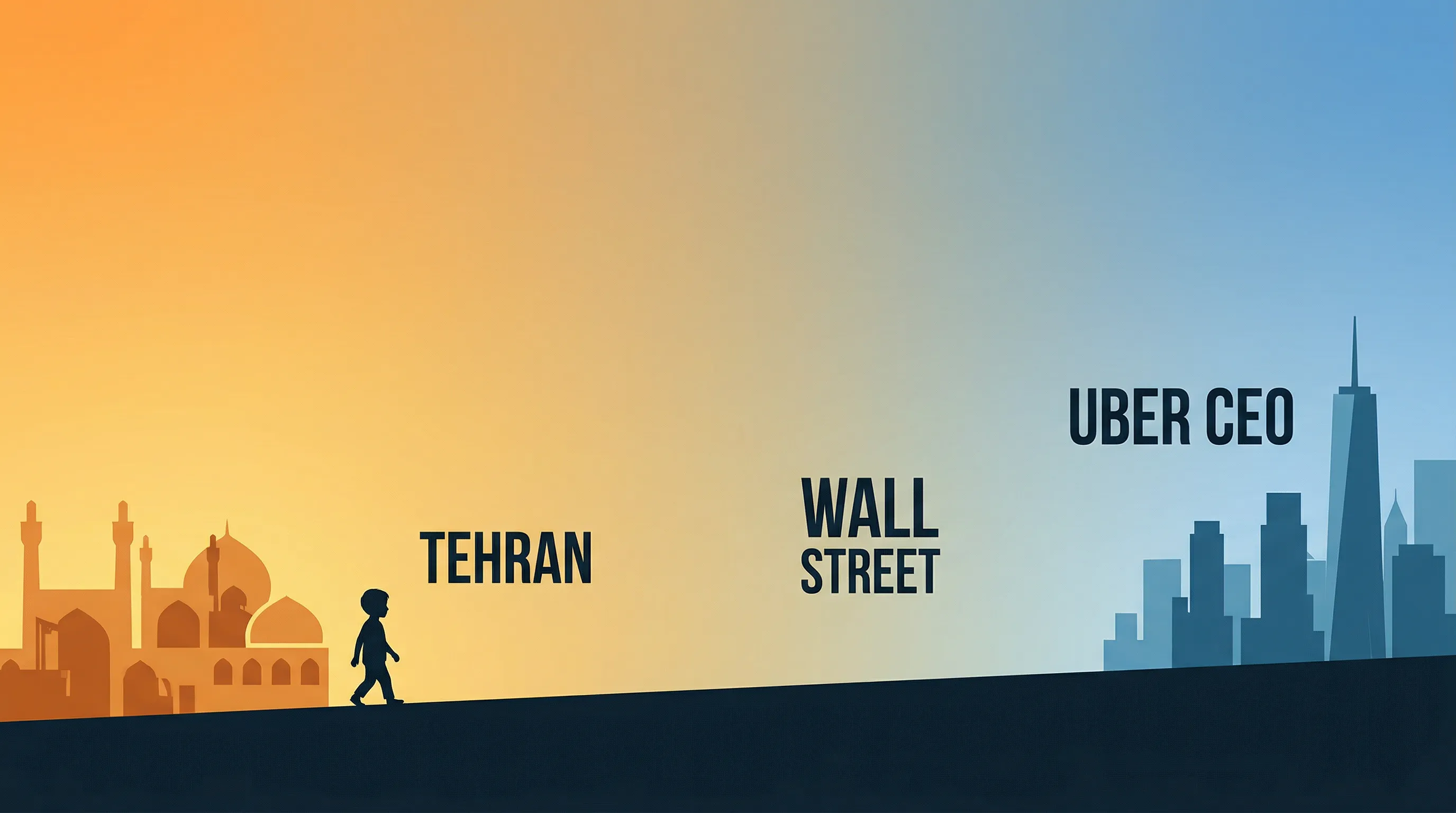
Dara Khosrowshahi was born in Tehran, Iran in 1969. At age 9, his family fled to America following the Islamic Revolution. He studied engineering at Brown University, then spent 8 years in M&A at Allen & Co on Wall Street. He later followed Barry Diller into the internet industry, rising from CFO to CEO of Expedia, growing its revenue from $2.1 billion to $8.8 billion over 12 years. In 2017, he left everything behind to take over Uber — a company losing £3 billion a year, mired in scandal. Seven years later, Uber’s annual free cash flow reached $10 billion.
In this 103-minute conversation, Dara discussed three things: how he used transparency and a hard work culture to reshape Uber, how AI will disrupt most jobs — including Uber’s own 9.4 million drivers, and what a CEO should and shouldn’t say when facing that kind of disruption.
Guest: Dara Khosrowshahi — Uber CEO (2017–present), former Expedia CEO Host: Steven Bartlett — The Diary Of A CEO Duration: 103 minutes Source: YouTube Full transcript: Full transcript with speaker identification
From Tehran to Wall Street: The Insecurity Forged by Revolution
When the Iranian Revolution broke out in 1978, Dara’s family ran a sizable industrial enterprise in Iran. The revolution toppled the Pahlavi dynasty; one of his uncles had been a member of the former cabinet. One night, Revolutionary Guards stormed into the neighbor’s backyard. Gunshots rang out, and a bullet passed through the glass of his family’s living room. His mother said: We’re not safe.
The family emigrated to Tarrytown, a 45-minute drive north of New York City. His mother, who had never worked, started selling to support the family. His father was stranded in Iran, unable to get an exit visa, and didn’t return to America until six years later. He had a heart attack on the plane home. Dara said that when his father left, he was “like a giant,” but when he came back, he was a “diminished person.”
“At my core, I’ve never felt safe. When you’ve been through losing everything, that feeling of having the rug pulled out from under you never leaves.”
Dara said this insecurity shaped his drive: always rebuilding, always making his family proud, never taking anything for granted.
After college, he joined Allen & Co in investment banking. The firm’s founder, Herbert Allen, taught him one principle: “Always bet on people. Companies come and go, but good people are always good.” At Allen, he met Barry Diller — then the chairman of IAC. After Barry lost a bidding war for Paramount, he issued a press release that was three words in spirit: “They won, we lost. Next.”
Dara said: “That’s the person I want to work for.”
He followed Barry into IAC, first doing M&A, then becoming CFO. When the CEO of Expedia.com resigned, Barry had no backup candidate. Dara raised his hand and said he’d give it a try. Barry agreed — not out of confidence in him, but because there was nobody else. Dara set himself a condition: if his third attempt at hiring the head of Expedia’s largest business line failed, Barry should fire him. He ended up doing the job himself, for five or six years.
He said: “That experience taught me operations. Before that, my entire career had been in finance. Operations, leadership, building teams — that’s what I truly fell in love with.”
“We Overpaid for Every Good Company”
During his time in IAC’s M&A department, Dara and Barry acquired a string of companies: Ticketmaster, Match.com, Expedia, Hotels.com. They spotted a common pattern: all these businesses were fundamentally electronic transactions that required no physical delivery.
Travel is a virtual good — you’re buying a plane ticket, a hotel room. Ticketing is the same. Dating even more so. In an era when Amazon had already dominated physical e-commerce, they deliberately chose sectors that didn’t need warehouses or trucks.
Dara said they never won by buying cheap.
“Every good company we bought, we overpaid. But we overpaid relative to market expectations at the time, not relative to how things actually turned out.”
His explanation: humans make predictions with linear thinking because time itself is linear — you sleep 7 hours a night, your schedule is linear. But technological change is exponential. When a technology in the virtual world is genuinely superior to the old way, “there is absolutely no friction that can hold it back.” The growth curve isn’t a straight line — it’s a hockey stick.
This pattern later defined Uber. Uber started as a black car service — Garrett Camp couldn’t get a taxi on a snowy Parisian night and thought, “How cool would it be to summon a black car with your phone?” Nobody anticipated it would become a global transportation platform. Dara used the Jevons Paradox to explain: when you make something extremely cheap or convenient, the market doesn’t grow linearly — it expands exponentially. Today, Uber’s scale far exceeds the combined total of the original black car and taxi markets.
Uber’s Cultural Surgery: From “Toe-Stepping” to “Do the Right Thing”
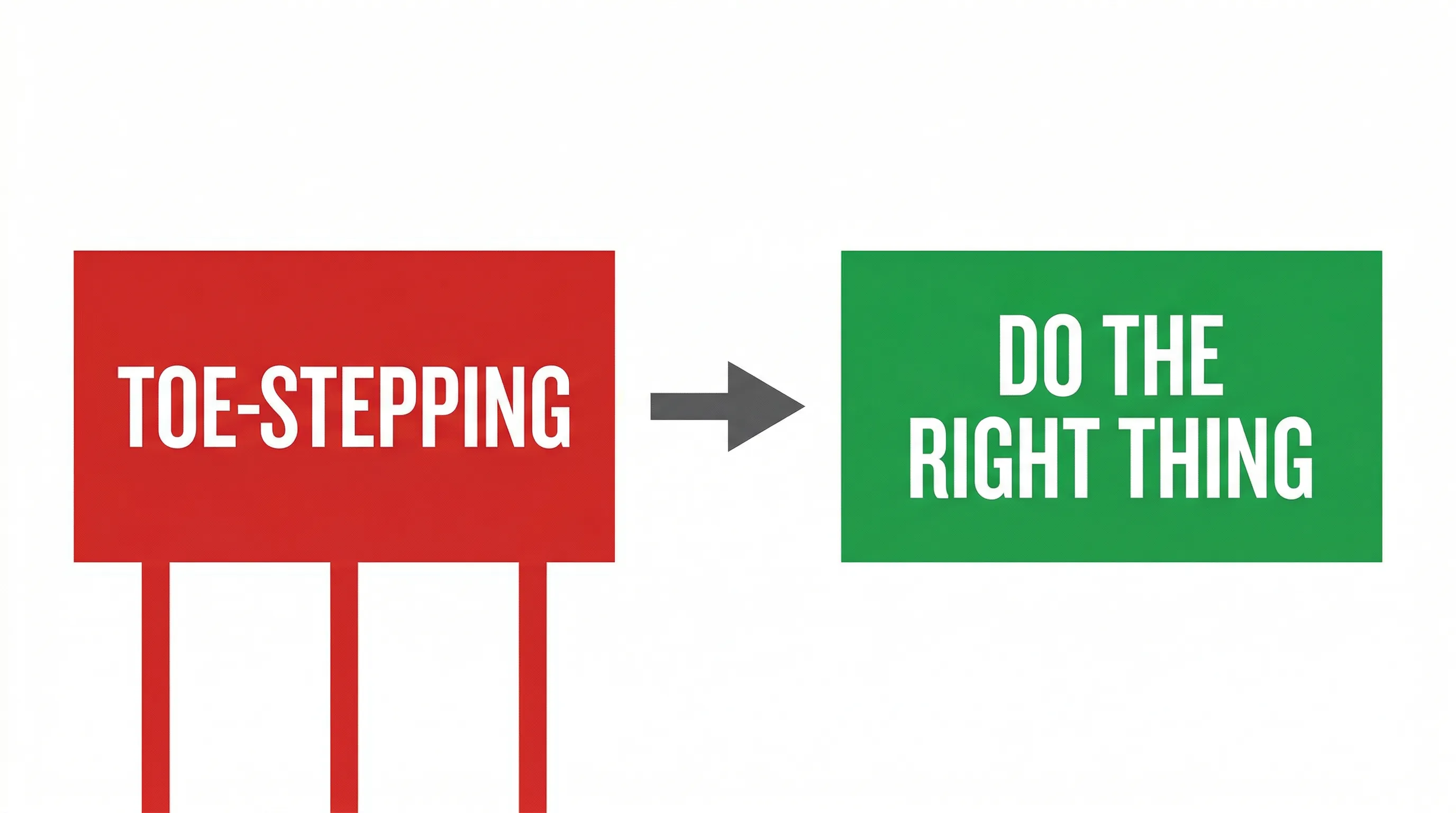
When Dara took over Uber in 2017, the company was at its historical nadir. Among the cultural artifacts left by Travis Kalanick was a company value called “toe-stepping” — originally intended to encourage internal challenge and candor, but in practice weaponized into “a license to be an asshole.”
Dara said: “Values themselves can be great or terrible, depending on how you execute them.”
For the first values rewrite, he used a company-wide vote — asking all employees to submit what they thought the new Uber’s values should be. The result was a pile of mediocrity: passion, teamwork, ambition. “What company doesn’t believe in teamwork? Forget it.”
Only one was written by him, without crowdsourcing: Do the right thing, period.
He didn’t explain what this value meant. When people asked “What does ‘do the right thing’ actually mean?”, his answer was: “You figure it out.”
Five years later, he had his head of HR drive a second values rewrite. This time he felt he’d earned the right to express opinions. The new values had more personality: Go Get It, Great Minds Don’t Think Alike. “Do the right thing” was the only one that survived.
Dara gave a counterintuitive internal example: the taxi business. Uber was born as the taxi industry’s enemy, yet after he took over, he had the team integrate taxis into the Uber platform. The founding team’s reaction was “this is the stupidest idea in the world” — they’d tried it years ago, it was a total failure, taxi drivers hated Uber, acceptance rates would be terrible. But the current product lead, Sachin, had built a similar product in the industry before, and combined with Dara’s “ignorance is bliss” attitude, they tried it anyway. The result: taxis became Uber’s fastest-growing business line. “I want to put every single taxi in the world on Uber.”
In day-to-day management, Dara lives by a simple exchange: if you want truth from your team, give them truth first.
He said: “Humans are pretty good BS detectors. When you as a CEO stand on stage spouting business jargon, your team can tell you’re bullshitting. So why would they tell you the truth?”
Three months into his time at Expedia, the head of HR told him: you’re scaring people off. His response: “If he or she doesn’t want to face the truth, then go somewhere else.”
“The Most Important Skill Is Hard Work”
“If people ask me what advice I’d give to young people, for me, the most important skill in life is hard work.”
Dara was dead serious when he said this. He used Ronaldo and Michael Jordan as examples — of course the talent is world-class, but what truly separates the top from the not-quite-top is that they “work their asses off.”
At Uber, the culture he promotes is blunt: you come here to work your ass off; if you’re not performing, we’ll tell you; if you don’t improve, you’re out. But you’ll have real impact. “Don’t come here to coast.”
At Expedia, he wasn’t this direct — “We were selling vacations; it felt wrong to be too harsh.” At Uber, no more niceties. Emails to his team on Saturday getting no responses? He’d send another on Sunday with a question mark.
“I will not let anybody outwork me. They may be smarter, more talented. But I will not let anybody beat me on effort.”
Then Steven asked a pointed question: Have you ever seen someone who isn’t hardworking become truly hardworking?
Dara thought for a moment, then said: “No.”
Steven said: “Neither have I.”
This created a subtle tension with Dara’s earlier claim that “hard work is a learnable skill.” He acknowledged it himself — “Maybe part of it is innate” — but attributed more of it to his early shaping: that boy in childhood photos from Iran, forged by revolution and exile into someone who “never stops.”
He mentioned that Jeff Bezos originally wanted to name Amazon “Relentless.” Internally, Uber has a value called “Embrace the Grind.” Every team — payments, anti-fraud, mobile — has its own optimization metrics, improving daily. Dara said: “It’s not enough to get better. We have to get better faster than the competition. If you get two shots and I only get one, you have twice the information and twice the odds.”
He distilled the culture of continuous improvement into two factors: the speed of change, and the ability to spot opportunity. Speed itself is a competitive advantage — “If you can work faster, you’re actually accelerating time.”
70-80% of Jobs Will Be Disrupted by AI
Uber completes 40 million trips every day. Pricing, route planning, driver matching, courier delivery batching — all the underlying systems are AI-driven. It’s not one large model running everything, but a multitude of small AI models trained separately for localized problems, then stitched together. The matching logic on New York streets differs from Lagos. Dara said this AI orchestration capability is Uber’s core: heuristic rules could never handle 40 million trips per day.
But what concerns him more isn’t Uber internally — it’s society as a whole.
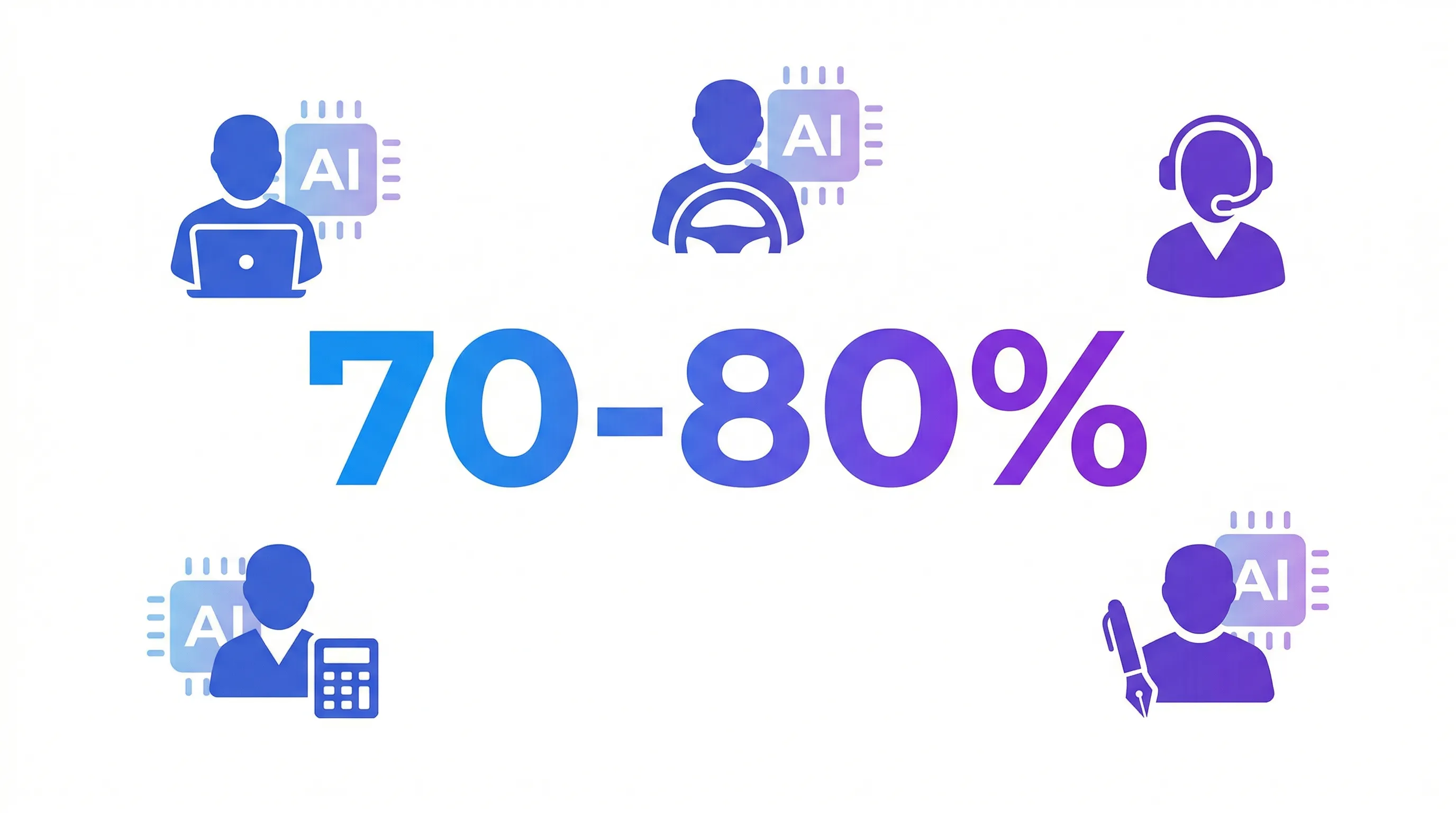
“AI will replace 70-80% of what humans can do in the next 10 years.”
He distinguished two timelines: knowledge work within 10 years, physical work within 15-20 years. Physical AI is harder — robots and cars require hardware, capital, and must contend with an unpredictable physical world, making progress inherently slower. He cited Ray Kurzweil (Google’s futurist) and the “Law of Accelerating Returns”: if you’re 10 years old today, by the time you’re 60, you’ll experience what takes a full year today in just 11 days.
Within Uber, 90% of engineers are already using AI tools. Among them, 30% are heavy users, and their diff volumes (the amount of code change per commit) have shown clear divergence. Dara believes programmers’ work is shifting from “writing code” to “orchestrating agents” — not laying bricks yourself, but directing the construction crew. He said Uber is essentially a massive codebase, and engineers are both bricklayers and architects. AI tools make bricklaying faster, but architectural design — what the system should look like — still requires humans.
He revealed an interesting detail: a team built a “Dara AI” to rehearse presentations before officially presenting to him. Every deck that reaches the CEO has been polished through layers, and this AI version of Dara lets the team know in advance what the real Dara would ask. “I said, can I see the Dara AI code? She said no, you can’t see it.” Steven pressed: Aren’t you worried they’ll show the Dara AI to the board?
But Dara believes current AI still lacks one critical capability: real-time learning. His conversation with Steven was changing both their behaviors by 0.1% every moment. Large language models don’t work that way — GPT-3.5 didn’t learn; engineers trained GPT-3.8 with new data. Once a model ships, it’s static. While post-training and RAG are bridging this gap, Dara stated: “The day models can learn in real time, that’s when I’ll truly feel all of us are replaceable.”
Steven pressed: So what happens to the 70-80%? Historically, society has always adjusted — agricultural workers were once the majority of the labor force, now less than 1%. But this time, the speed is unprecedented.
Dara offered an honest answer:
“I don’t have the answer either.”
He added: AI might help people retrain. But can the speed of retraining keep up with the speed of replacement? That’s “a genuine question.” Steven said he hadn’t gotten a convincing answer from any of the AI experts he’d interviewed — “What happens to the 70-80%?” remains unanswered.
Then Dara made a noteworthy observation: if his engineers’ average productivity improves by 25%, his current choice is to hire more engineers — because there are still too many unsolved problems. But in five years, adding headcount might no longer make sense; instead, you’d buy more GPUs. “Not hire an engineer, but add a few agents, buy some Nvidia GPUs. That might be the investment model of the future.”
The Autonomous Driving Paradox: Safer, But What Can a CEO Say?
Steven mentioned driving his Tesla in Los Angeles — FSD let him go hands-free for two and a half hours to Joshua Tree. Statistically, autonomous driving is safer than humans. He drew a distinction: Tesla’s current system is “autonomous driving + human backup” — occasional disengagements require human takeover. So more precisely, “autonomous driving with human backup” is clearly superior to purely human driving.
Dara said Waymo has gone further. Uber partners with Waymo in Austin and Atlanta, where Waymo vehicles are fully driverless. “By all accounts, Waymo drivers are safer than humans.” As of September 2025, Waymo had accumulated 127 million miles of fully autonomous driving, with serious injury crashes reduced by 90% and pedestrian injury crashes reduced by 92%. Globally, one million people die in traffic accidents every year; in the U.S., 35,000 to 40,000 annually. If autonomous driving can bring those numbers down, “that’s real lives being saved.”
Then Steven said what everyone was thinking:
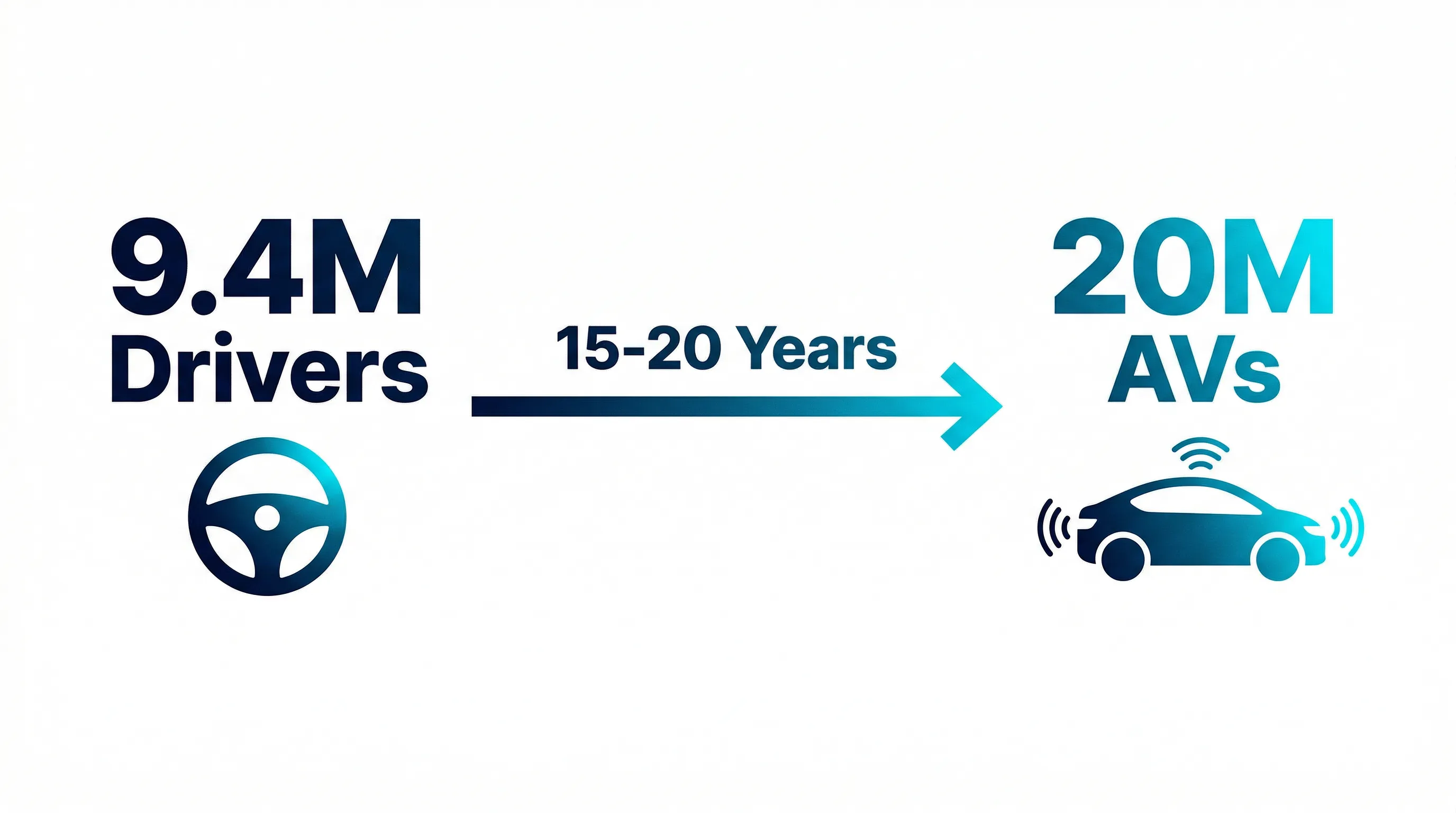
“Your 9 million drivers on the platform will lose their jobs.”
Dara’s response was measured. He said it’s “conceivable” that in 20 years, 9 million human drivers become 20 million autonomous vehicles — Jevons Paradox again: cheaper transportation means demand explodes. But there’s time in between — the physical world requires regulatory approval, manufacturing vehicles, building sensors. “Probably not 10 years out, but 15-20 years out, you start getting there.”
Uber is expanding the types of work available on its platform: from just driving, to delivery, grocery shopping, to a new business called “Uber AI Solutions” — enabling people on the platform to train AI models, label data, and perform various knowledge tasks from their phones. Dara said this is about “extending the kinds of work we can offer humans.”
But which is faster — the speed of automation or the speed of platform expansion? Dara admitted he doesn’t know.
“Honestly, heart on my sleeve, a meaningful rise in unemployment seems inevitable,” Steven said. Dara didn’t push back.
When the topic turned to Universal Basic Income (UBI), Dara said “every experiment has failed” — groups receiving money performed worse across all metrics. He attributed this to the sense of self-worth that work provides: when market forces compel someone to work, the success that follows brings not just income, but a deep satisfaction of “I’m creating value.” Government payments can’t replace that.
Here, he brought up his father. After his father lost his business in Iran, what he lost wasn’t just wealth — it was “his sense of value in the world.” Dara was visibly emotional saying this — it was the second time in the conversation he’d mentioned his father, having nearly choked up earlier when recalling his childhood. Steven added a study from Australia: the most common sentiment in male suicide notes isn’t pain, but “believing my family would be better off without me.”
Steven’s assessment of Dara: while most CEOs discuss massive disruption in private but say “everything will be fine” on CNBC and at Davos, Dara at least was willing to publicly say “I don’t know the answer.” He mentioned hearing some CEOs’ private conversations, where their expectations of AI disruption were far more severe than anything they’d say publicly.
Dara shared a detail: a CNBC anchor told him after an interview, “I really quite like you — you’re actually answering my questions.” He said he’d made himself a vow — no matter how pointed the question, answer it directly, no PR-speak. “The anchor knows you’re bullshitting, the audience knows. So I just answer directly.”
Asked about slowing AI development, Dara’s response was blunt: no. Because “China won’t slow down.” He believes the only meaningful response is for society to build massive retraining capacity. But he admitted he hasn’t seen this kind of investment in any country. Anthropic’s Dario Amodei is one of the few tech leaders publicly discussing this — “He’s pissed off some people, but I think he’s driving a meaningful conversation.”
Editor’s Analysis
Positional Bias
Dara’s identity determines his narrative framing. As Uber CEO, he’s naturally inclined to portray autonomous driving and AI as “safer,” “cheaper,” and “the market will expand exponentially” opportunities. This doesn’t mean he’s lying — the data does support the claim that Waymo is safer — but he’s incentivized to downplay the pain of job displacement, since Uber’s business model directly benefits from autonomous driving.
His championing of hard work culture also deserves contextual reading. Uber currently faces California’s AB 1340 bill — since January 2026, California rideshare drivers gained the right to unionize and collectively bargain. A 2024 study found that after costs, California rideshare drivers earned a median hourly wage of just $5.97 (before tips). Dara didn’t mention driver rights, algorithmic transparency, or the independent contractor classification debate at any point during the conversation.
Selective Argumentation
“Disrupted” vs. “Replaced”: Dara said 70-80% of jobs will be “disrupted” by AI, but the narrative gravitates toward mass unemployment. “Disrupted” could mean task transformation rather than job elimination — an accountant whose work changes by 60% due to AI isn’t necessarily unemployed. He didn’t make this distinction.
Timeline vagueness: Twenty years is an extremely wide window. For investors, it means “plenty of time to transition”; for a 55-year-old truck driver, it means “my career is over.” A CEO uses the same number to serve different audiences.
UBI data inaccuracy: Dara claimed “every UBI experiment has failed.” This is inaccurate. The largest UBI study in 2024 ($1,000/month for 3 years) showed employment impact was indeed modest, but participants obtained better jobs, some returned to school, and some started businesses. A Minneapolis pilot showed $500/month improved financial stability and mental health. Saying “all failed” is an oversimplification of complex data.
Counterpoints
Academic research on autonomous driving’s employment impact is more cautious than Dara described. One study on truck driver displacement found that when replacement rates exceed 35%, existing alternative career options become insufficient; and alternative careers generally pay less than driving. Another analysis estimated direct job losses between 1.3 and 2.3 million, primarily occurring from the late 2030s to the 2050s — more conservative than Dara’s 15-20 year timeline.
AI coding tools’ impact on programmers also cuts both ways. Dara said 30% of heavy AI users show significantly increased diff volumes, but diff count doesn’t equal code quality. Faster code output may mean more technical debt. And “orchestrating agents” may sound like an upgrade, but in practice could mean large numbers of mid-level engineers are no longer needed.
Fact-Check Results
| Claim | Verification | Source |
|---|---|---|
| Uber annual FCF of $8.5B (later corrected to $9.8B) | 2024 FCF $6.9B, 2025 FCF $10B | Uber IR, MacroTrends |
| Waymo is safer than humans | 127M miles, 90% fewer serious injury crashes | Waymo Safety, PubMed |
| 9.4 million drivers and couriers | 2025 data approximately 8.8M-9.4M | DemandSage |
| 1 million traffic deaths globally per year | WHO data approximately 1.19M/year | WHO Global Status Report |
| 35,000-40,000 U.S. traffic deaths per year | NHTSA 2023 data: 40,990 | NHTSA |
| All UBI experiments failed | Inaccurate; results are complex | 19th News, Minneapolis Fed |
Epilogue
Dara went to Uber because of something Daniel Ek (Spotify founder) told him. At the time, Dara had just received a generous equity package at Expedia and had no reason to leave. Ek looked at him with his “cold Scandinavian stare” and said:
“Dara, since when is life about being happy? It’s about making impact.”
The next day, Dara called the recruiter back.
He also asked his father for advice. His father’s answer was simple: “When a company that’s become a verb asks you to run it, you just say yes.”
Dara’s core advice:
- Always bet on people, not companies
- Linear thinking makes you underestimate exponential change — when you see a hockey stick, jump in
- Transparency is a two-way transaction — give your team the truth, and you’ll get the truth back
- Don’t make overly clear career plans — plans make you only see signals that support the plan
- Work hard, then let the world change you first
What sticks most from this conversation may not be any specific piece of advice, but a CEO willing to say “I don’t have the answer either” on camera. As for whether that honesty is genuine courage or carefully calculated brand strategy — like the autonomous driving timeline itself, it probably depends on where you’re standing.
If you found this helpful, consider buying me a coffee to support more content like this.
Buy me a coffee