David Senra: Extreme Winner Principles from 400+ Founder Biographies
David Senra: Extreme Winner Principles from 400+ Founder Biographies
Guest: David Senra, Founders Podcast host, studied 400+ founder biographies Source: Tim Ferriss Show | Duration: 02:42:17 Full transcript: Complete transcript with speaker identification
Introduction
David Senra spent ten years doing one thing: reading one founder biography per week and recording one podcast episode. For the first 5.5 years, almost nobody noticed. He recorded in the kitchen of his Miami apartment with a $100 microphone, and his download numbers never reached the minimum threshold for ad networks.
Today, Founders Podcast subscribers include Michael Dell (who had a five-hour dinner with him), Daniel Ek (multiple deep conversations in Stockholm), and Brad Jacobs (arguably the only person in history to have founded 8 separate billion-dollar companies). David doesn’t think of himself as building a media company. In his own words: “I’m not building a media company. I’m building relationships at scale.”
This Tim Ferriss Show episode runs 162 minutes and covers David’s core findings from studying 400+ founders – from the light and dark sides of drive, to a deliberately inefficient reading system, to the full story of how he emerged from a deeply troubled family.
Clean Fuel vs Dirty Fuel: Only 5 Out of 400+ Founders Were Driven by Love
Tim Ferriss asked a pointed question: of the 400+ founders you’ve studied, how many achieved business excellence without leaving a trail of “collateral damage” in their personal lives?
David’s answer: about 5.
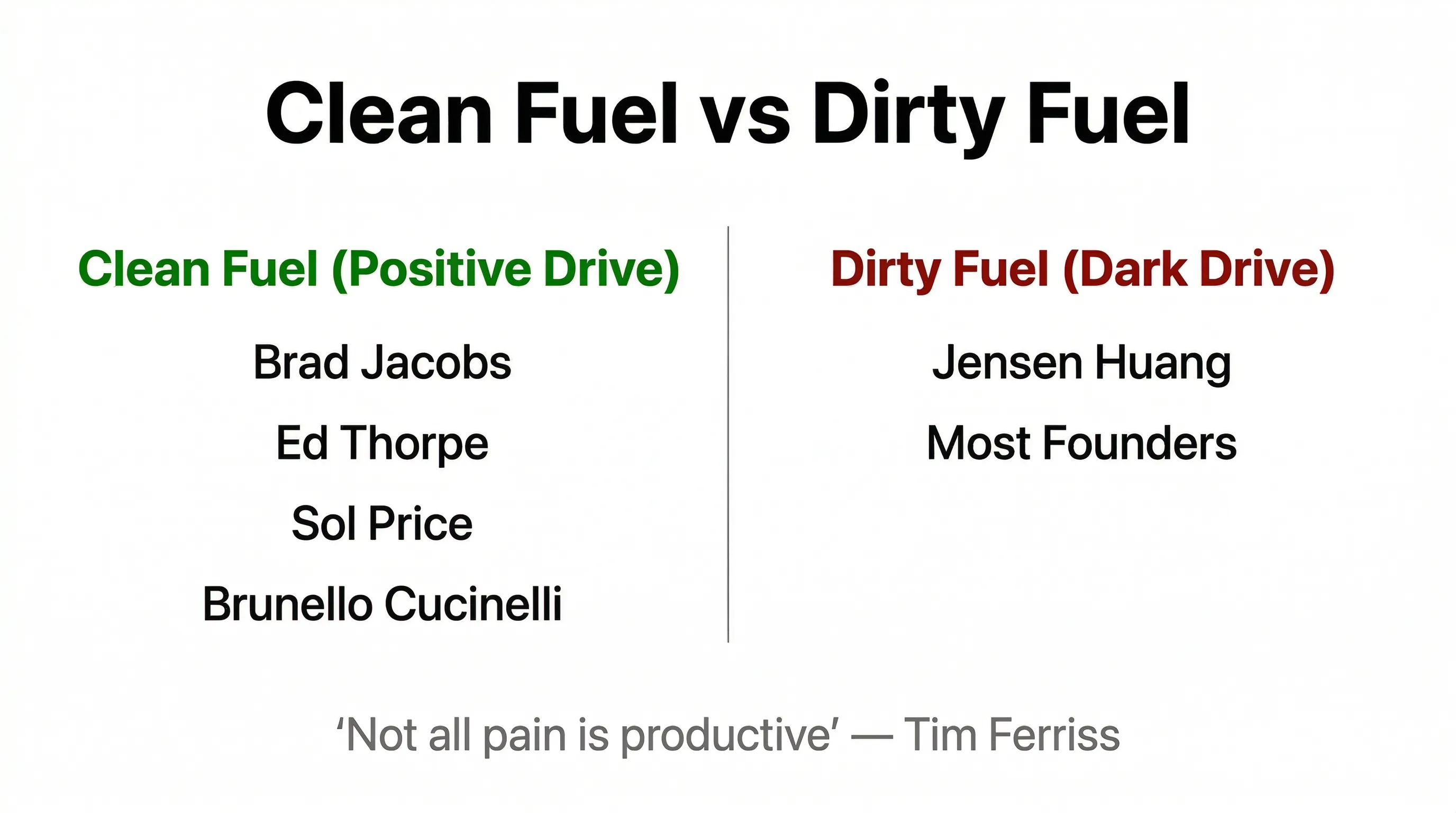
Brad Jacobs ranked first. Now 68, he founded his first company at 23 and has since built 8 billion-dollar enterprises (primarily through roll-up acquisitions in logistics and building materials). David considers him “by far the most energetic person I have ever been around,” and his drive is purely positive – no childhood trauma, nothing to prove.
The others: Ed Thorpe (first beat the roulette wheel, then beat Wall Street, and still lives a balanced life in his nineties), Sol Price (inventor of the warehouse retail model; Costco founder Jim Sinegal said “I learned everything from him”), and Brunello Cucinelli (Italian luxury brand founder – $5,000 sweaters, 70% profit margins, but the company runs 9-to-5 and sending emails after hours is forbidden).
What about the other 396? David used Jensen Huang as an example: right after Nvidia delivered its best quarter in history, Jensen opened the meeting by saying –
“I woke up this morning, looked in the mirror and said, why do you suck so much?”
Tim Ferriss expressed reservations about this. He noted that he also tends toward negative self-talk, but “not all pain is productive.” If you naturally believe that the absence of pain means you’re not working hard enough, you can easily become “a hammer looking for nails” – and this kind of inner dialogue is contagious to the people around you.
The Gap from Information to Action
Tim quoted his longtime friend Derek Sivers to introduce the next topic:
“If more information were the answer, we’d all be billionaires with six pack abs.”
After 400+ episodes and millions of downloads, David’s answer to this question was concise:
“Learning is not memorizing information. Learning is changing your behavior.”
He said he didn’t initially realize what he was doing. It wasn’t until his friend Jeremy Gaffon casually said during a walk on Miami Beach: “Oh, it’s pretty obvious what this whole thing is. You never had any positive influences, you didn’t have any mentors. So you’re reading book after book after book to try to find the path, to try to find the way out.”
David said the moment felt “like naked” – but admitted Jeremy was right. The ideas he extracted from biographies were applied directly to running the podcast itself, and the podcast’s improving quality attracted top founders who shared a love for studying their predecessors. This created a self-reinforcing loop: Caesar studied Alexander, Steve Jobs studied Edwin Land, Edwin Land studied Alexander Graham Bell. David believes this impulse to trace backward is part of human nature, “going to happen a thousand years from now.”
A Deliberately Inefficient Reading System
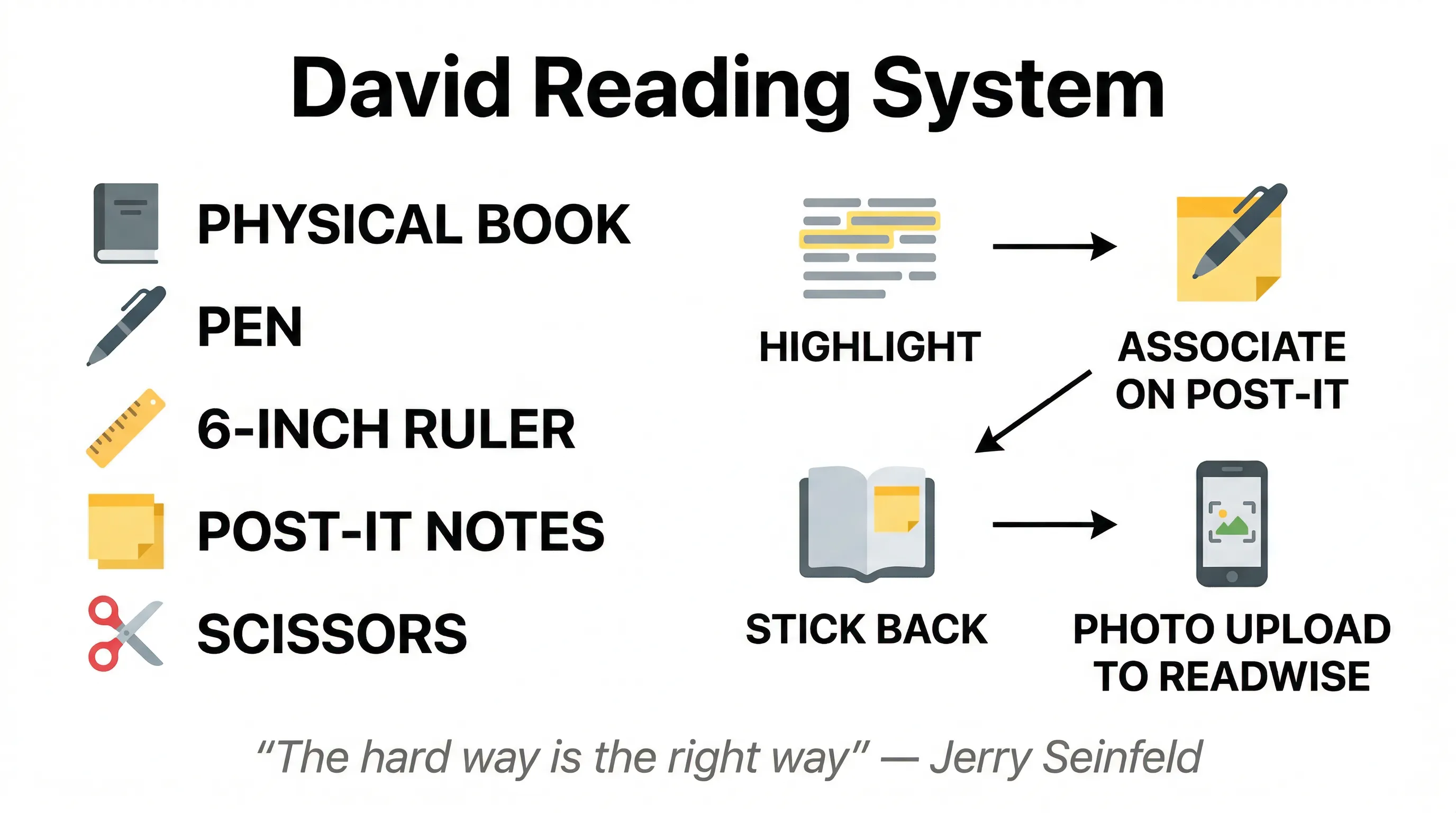
David’s reading toolkit: a physical book, a pen, a 6-inch ruler, Post-it notes, and a pair of scissors.
When he sits down to read, he makes no advance judgments. If a sentence jumps out, he underlines it with the ruler (the line must be straight – he has moderate to severe OCD). Then he writes whatever association flashes through his mind on a Post-it, such as “this is kind of like James J. Hill when he was building the only profitable American railroad.” The note gets stuck to the corresponding page, but first it must be trimmed with the scissors to the right size – “it has to be clean, it has to look good.”
After finishing the book, he photographs all annotations and uploads them to Readwise. Because he uses physical books, this process is far slower than Kindle’s automatic sync. But he quoted Jerry Seinfeld:
“The hard way is the right way.”
He manually edits his own transcripts, refusing to outsource to AI or offshore teams. “I have to touch it. I have to feel it.”
Tim Ferriss’s system is equally meticulous but different in direction. When rereading, he marks passages that still resonate with T2, T3 – “I want to see what sticks on a second or third reading.” He creates an index in the book’s blank pages and draws a small box in the bottom-right corner labeled Next Steps (at least one physical next action – a phone call, an email, looking up a person).
David reads 25 pages per hour. At that pace, plus recording and editing, he can produce a maximum of 52 episodes per year.
Dark Fuel: OCD, Family Trauma, and Extreme Focus
David’s family history is the heaviest part of this interview.
His mother’s side of the family had a severe history of mental illness. His grandfather sexually abused all of his own daughters and granddaughters. The family lived in a two-bedroom house in Indiana with a single bathroom – located inside the grandfather’s bedroom. To avoid crossing through that room at night, the children would urinate into cups and pour them out the window.
David’s mother likely had undiagnosed bipolar disorder (her sister was a diagnosed schizophrenic). One day, after an argument David can no longer remember the substance of, his mother threw him out of the house. He was 18, had nothing, and moved into university dorms.
Six months later, his mother was diagnosed with breast cancer. She refused medical treatment for two years, trying to cure the cancer through prayer. By the time the family convinced her to see an oncologist, the doctor’s words were “the horse’s out of the barn.” The cancer had spread to her bones. She lived about two more years.
David said the moment his daughter was born changed his understanding of his family. He quoted Ryan Reynolds: he thought he loved Blake Lively more than anything, until his daughter was born and he realized, “if we were ever under attack, I would use Blake as a human shield to protect that baby.” This made childhood memories even more painful – “How did you do this to your children?” – but it also helped him begin to understand: if you yourself grew up in that kind of environment, the choices available to you are limited.
He did not use the word “forgiveness.”
From a $100 Microphone to a Relationship Empire: The Business Logic of Podcasting
David was studying at UCF (a Florida state university) when he discovered The 4-Hour Workweek on a girl’s MySpace profile page – that was his entry point to Tim Ferriss. He consumed all of Tim’s work and discovered podcasting as a medium in 2010.
Founders Podcast launched in 2016. The business model inspiration was unexpected – a socialist podcast. David saw it running a “free episodes + paid subscription” model successfully and copied it directly.
For the first 5.5 years, he “didn’t do anything differently,” but nobody listened. The turning point came from a business model shift: when he launched paid subscriptions, he noticed founders’ and VCs’ email addresses among the subscribers. He realized that while traditional podcasting chases download numbers, his most valuable asset was “trust.”
“People chase numbers. You’re chasing trust and relationships.”
The pivotal moment was a phone call with Patrick O’Shaughnessy (host of the Invest Like the Best podcast). David said “one call with Patrick changed everything.” Through Patrick’s network, he began connecting with top-tier founders – who themselves were already Founders Podcast listeners.
After a two-and-a-half-hour conversation with Spotify executive Alex, he delivered the line that summarized everything: “I’m not building a media company. I’m building relationships at scale.” The essence of a podcast episode is building trust with hundreds of thousands of people simultaneously.
Entrepreneur Archetypes: Jobs-Type, Bezos-Type, and Daniel Ek’s “Wise Man” Style
Tim Ferriss posed a framework question about entrepreneur archetypes: in the “pantheon” of successful people, are there identifiable distinct types?
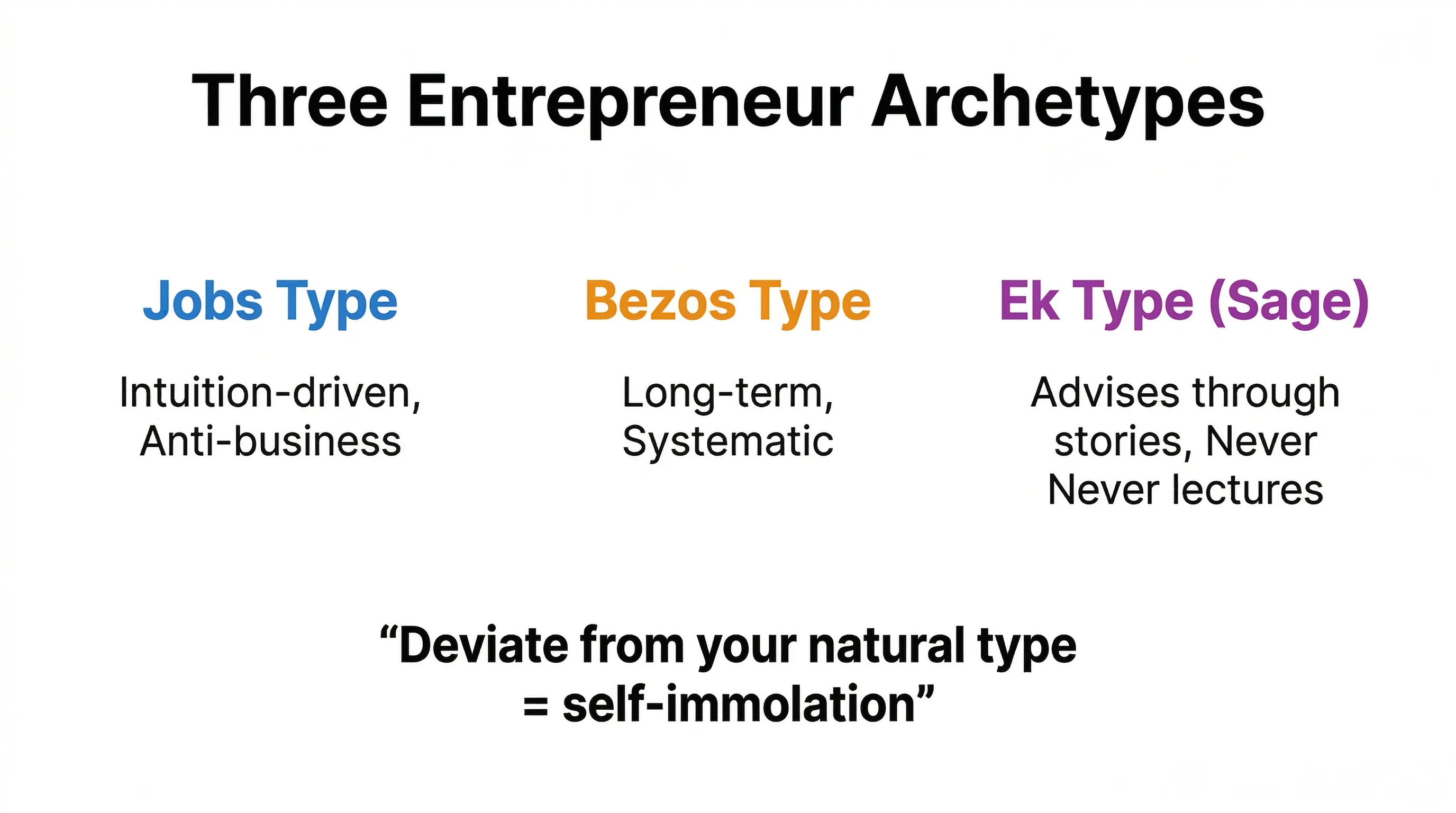
Tim himself identified at least two: a longer time-horizon, systems-thinking type (like Jeff Bezos), and another that relies more on intuition and tends toward the “anti-business billionaire” path. David added that if you deviate from your natural type, “it’s incredibly easy to self-immolate.”
“You’re grabbing habits from mutants that are in entirely different spheres or have different bodies entirely, and then trying to cobble it together. It may not work.”
They spent considerable time discussing Daniel Ek. Both David and Tim have personal relationships with the Spotify founder. David described Ek as a “wise old man” – someone who gives advice through stories and never lectures directly. Ek only began learning about investing in 2018, through listening to Patrick O’Shaughnessy’s podcast. Patrick’s assessment: “Out of anybody, Daniel has the ability to apply what he’s learning faster than anybody else and at a grander scale.”
David anchored this discussion with Charlie Munger’s advice: “Find a simple idea and take it seriously.” His podcast is exactly that – sharing lessons from great founder biographies, an extremely simple idea that he has spent ten years taking seriously.
Michael Ovitz (once the most powerful person in Hollywood) provided a contrasting perspective. Ovitz’s advice was: “Just spend all the time with the handful that really matter.” But David also pointed out Ovitz’s lesson – “the most successful people surround themselves with people that don’t tell them the truth” – which was one of the reasons Ovitz eventually fell.
Mentor Chains: From Claude Hopkins to Charlie Munger
A concept David repeatedly emphasized in the interview is “who influences the influencers” – tracing knowledge back to its source.
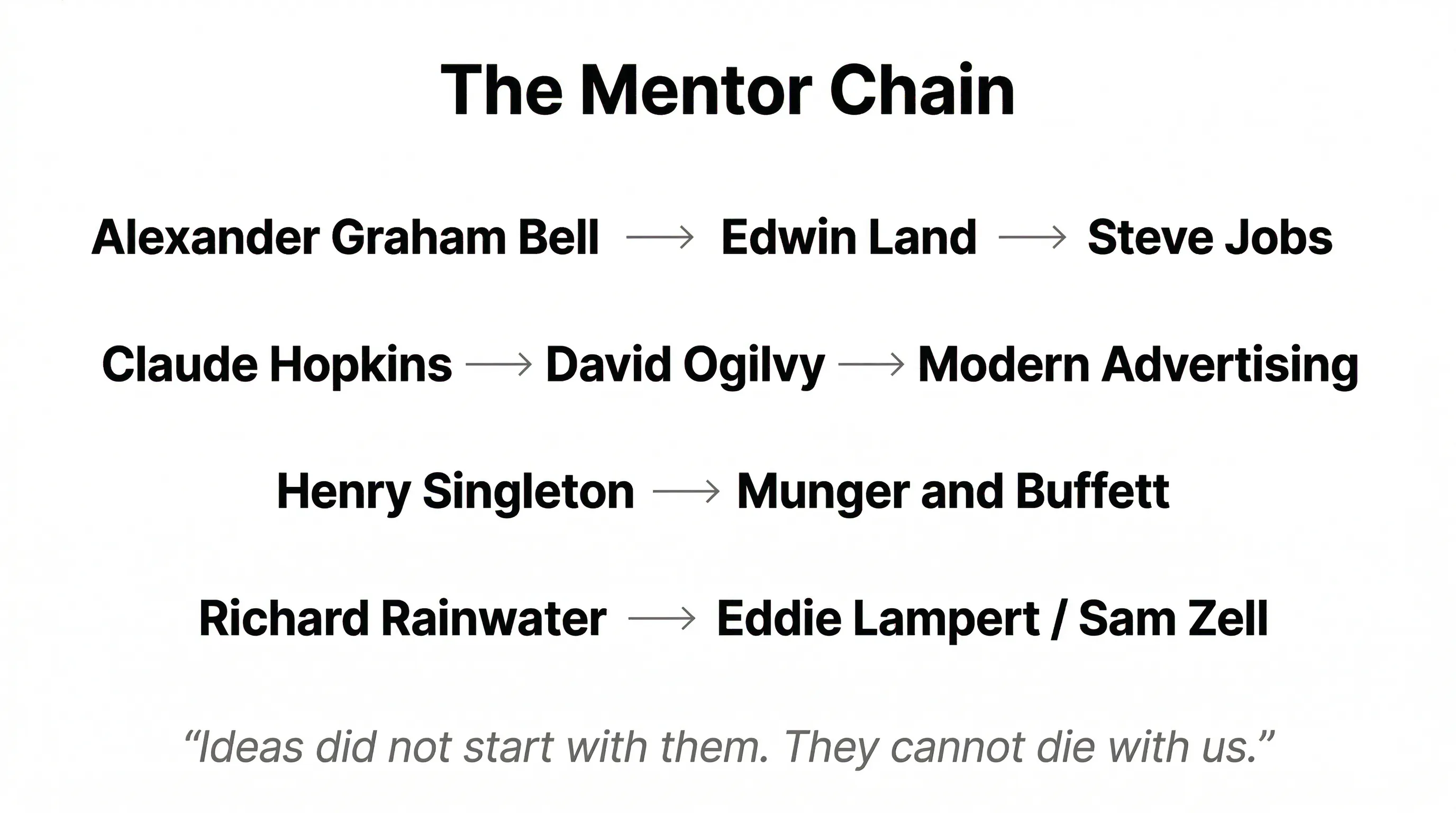
He used a specific example: when reading Buffett and Munger’s ideas, he found they repeatedly mentioned Henry Singleton. Munger called Singleton “the smartest person he ever met.” Buffett said “it’s a crime that business schools don’t study Singleton.” David traced it back and discovered that many ideas he had attributed to Buffett and Munger actually originated with Singleton.
The advertising industry has a similar chain. Buffett admired David Ogilvy. Ogilvy himself said “I’m not the genius. I’m just regurgitating Claude Hopkins’ work.” Hopkins was the greatest advertising copywriter of the early 1900s, working for Albert Lasker (the most profitable ad agency owner of that era). Hopkins wrote the industry’s secrets into a book called Scientific Advertising, but Lasker locked the manuscript in a safe for 20 years and refused to let it be published.
The investment world’s mentor chain is equally clear: Richard Rainwater mentored Eddie Lampert, a hedge fund legend. David believes Rainwater “probably created more billionaire investors in America than any other person.” Rainwater also recruited Sam Zell to Texas.
“The ideas didn’t start with them. They don’t start with us. They can’t die with us either. You have to push them forward, down the generations.”
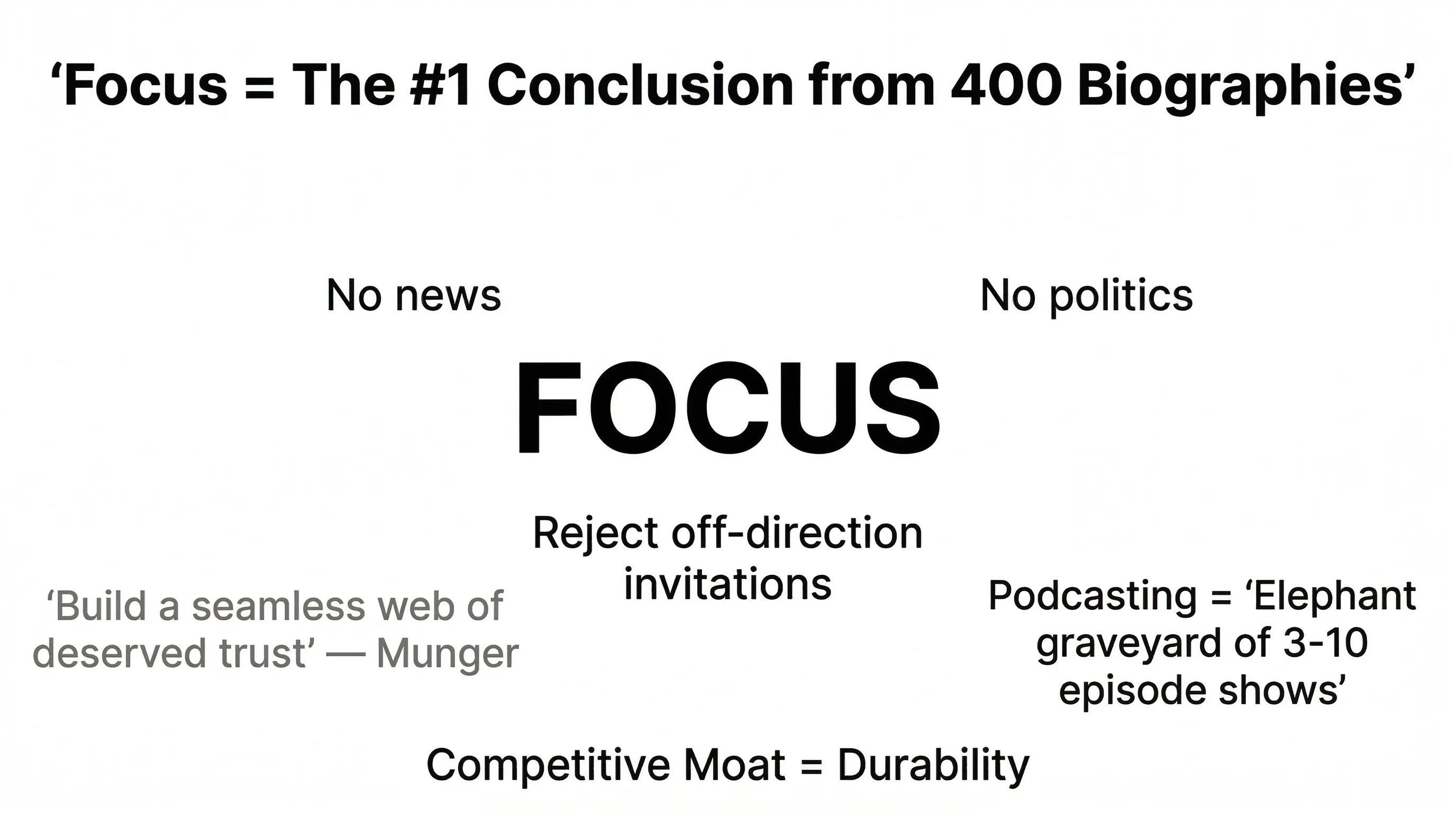
Focus Is the Number One Conclusion from 400 Biographies
Tim asked a summarizing question: if you could use only one word to capture the common trait of 400+ founders, what would it be?
David didn’t hesitate:
“Focus is excessively important.”
He used his own life as evidence. He doesn’t watch the news, doesn’t follow politics – “purposely aloof.” If there’s a pandemic or a war, he’ll hear about it naturally; beyond that, “no idea what’s going on.” He spends half his time in solitude.
Charlie Munger’s advice to David was:
“Your job at your age is to build a seamless web of deserved trust with other people who are like you.”
David’s interpretation: don’t pursue breadth, pursue depth. Both Rob Moore and Andrew Huberman tried to recruit him to larger platforms; he turned them all down. The direction of his new podcast is his own decision – “I am going to pick the direction. I will never take from anybody.”
He also noted that the podcast industry itself is a footnote to this point: “Podcasting as a whole is just an elephant graveyard of three-to-ten episode shows.” Most people can’t even make it to episode ten. If you choose a topic you truly love and are willing to do it year after year, “the competitive advantage of durability” is itself a moat.
Editorial Analysis
This interview is extraordinarily information-dense, and David Senra demonstrates a remarkable ability to recall and connect insights across hundreds of biographies. However, several dimensions warrant the reader’s scrutiny.
Survivorship bias is the most obvious issue. David’s sample consists of 400+ biographies of successful founders. Equally focused, equally obsessive, equally trauma-driven entrepreneurs who ultimately failed never make it onto his bookshelf. When he says “focus is the number one trait,” he cannot rule out the possibility that equally focused people failed at a 10:1 ratio – they simply don’t have biographies.
Selection bias deserves attention. The cases mentioned in the interview skew heavily toward American, white, male entrepreneurs (Brad Jacobs, Ed Thorpe, Sam Walton, Jensen Huang, Michael Dell, etc.). Female founders are almost entirely absent. The only non-American example is Brunello Cucinelli (Italy). This doesn’t invalidate David’s conclusions, but their scope of applicability may be narrower than stated.
The correlation between suffering and success is heavily presented, with a risk of romanticization. The interview devotes considerable time to David’s family trauma and links it to his “extreme drive.” This could send listeners an implicit message: you need sufficient pain to generate sufficient drive. In fact, extensive research shows that adverse childhood experiences (ACEs) are positively correlated with multiple health and social problems. Survivorship bias is especially pronounced here – we’re hearing from the one who survived and succeeded.
Conflicts of business interest cannot be ignored. David’s entire business model rests on the premise that studying great founders can help you become a better entrepreneur. This premise may not be wrong, but he has a strong economic incentive to maintain and promote it. When he says “learning is changing your behavior,” that statement simultaneously serves as the best ad copy for his product.
Facts to verify: The exact definition of Brad Jacobs’s “8 billion-dollar companies” (QXO recently went public; whether it has reached a billion-dollar market cap is debatable); Ed Thorpe’s age (David said approximately 89, but he should be 93-94); the exact sales figures of the Musashi novel in Japan.
Key Takeaways
- Trace knowledge to its source – Who does the person you admire admire? Finding Singleton behind Munger, Hopkins behind Ogilvy, often yields more original, less diluted insights.
- Audit your fuel – Ask yourself whether you run on Clean Fuel or Dirty Fuel. Both can drive success, but Dirty Fuel has “collateral damage.” Tim Ferriss’s warning is worth heeding: negative self-talk is contagious to the people around you.
- Set a behavior checkpoint for reading – After finishing a book, ask yourself: what behavior did I change as a result? If the answer is “nothing,” it was entertainment, not learning.
- The concrete practice of focus – Not abstract “be more focused,” but specific actions like David’s: don’t watch the news, don’t follow politics, decline invitations that don’t align with your core direction.
- The underlying logic of podcasting and content creation – Trust > traffic, durability > virality. Most podcasts die by episode ten. If you choose a direction you truly love, time itself becomes the greatest competitive advantage.
If you found this helpful, consider buying me a coffee to support more content like this.
Buy me a coffee