[Interview] Superintelligence Emerging from the Edge: A Safer Path to AGI
Tian Hongfei worked as a security engineer at Oracle, wrote his MIT thesis on grid computing, and has spent 25 years focused on decentralized technology. His latest project, Olaris, is an edge operating system designed for AI Agents. This podcast revolves around three core questions: Where should data be processed? Do we need smarter AI or AI that is more like ourselves? And where will superintelligence come from?
Guest: Tian Hongfei (Co-founder of Olaris) Host: Jedi Lu (Indigo Talk) Source: YouTube - Indigo Talk EP 41
Apple Proved Something
Tian Hongfei said: “Apple has the best privacy practices of any company, and yet it’s also one of the most profitable companies.”
This is no coincidence. Apple makes money selling hardware – it doesn’t need to sell user data. A company’s business model determines its attitude toward privacy.
“The more secure your device is, the more you trust it.”
Jedi Lu has previously ranked companies on privacy and security during a live stream: Apple is the most secure, followed by Google, and then Meta. The criterion is simple – look at the business model. Companies like ByteDance and Toutiao treat all user privacy and behavioral data as business leverage.
Apple’s Apple Intelligence architecture reinforces this point: the local device handles whatever it can, and only sends tasks to the cloud when local processing isn’t enough. In the cloud, an independent containerized server is spun up for each user, fully auditable – no one other than the user themselves can view the access logs.
Tian Hongfei believes this proves that privacy protection and user experience are not contradictory: “It’s not that you have to jump through hoops for privacy. Being secure doesn’t mean you have to memorize 12 English words.”

98% of Data Is Private
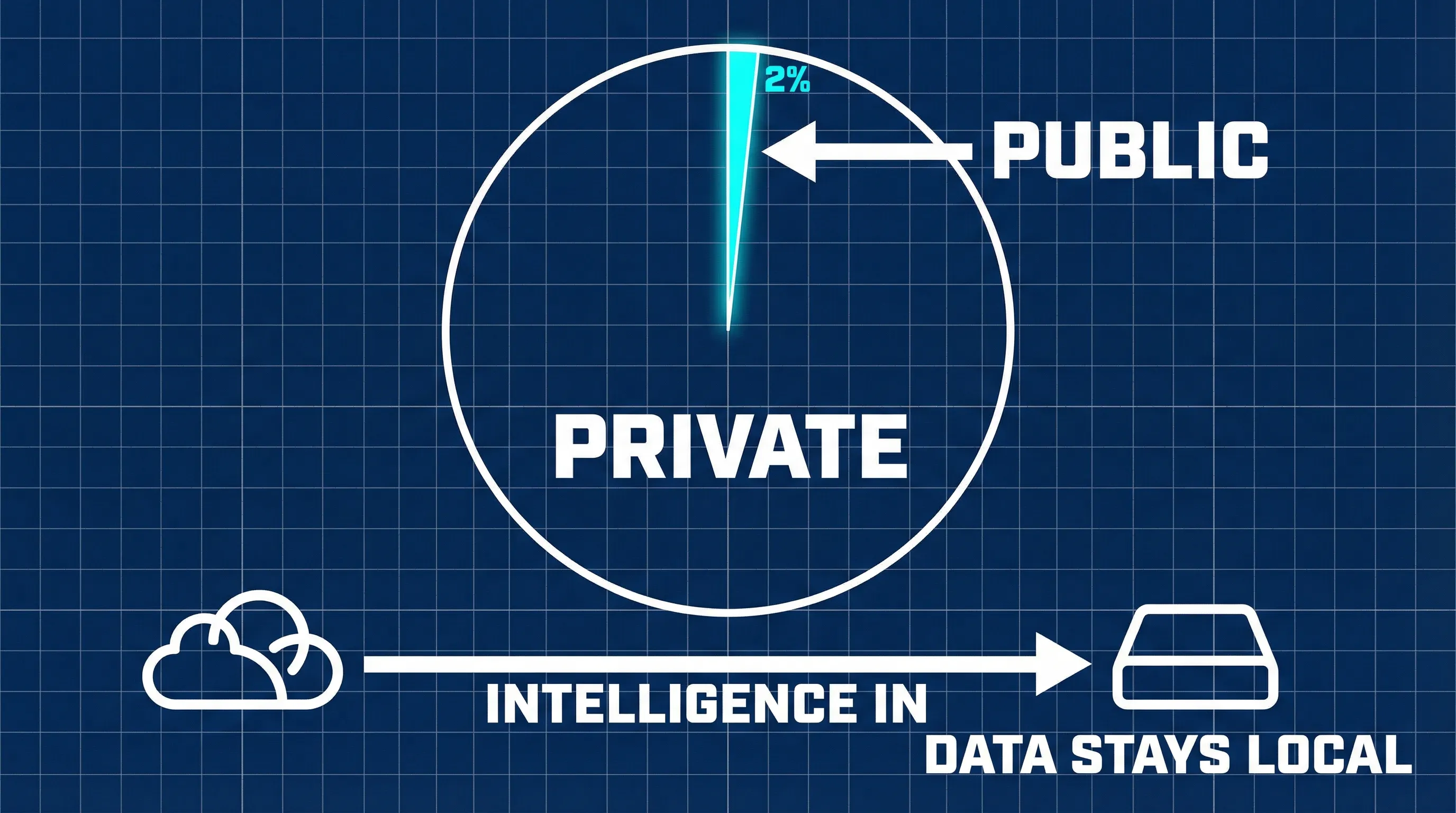
Tian Hongfei points out that large model training has already hit a “data wall” – all publicly available data in the world has been used up. Meanwhile, 98% of data is private and cannot be used by large models.
Within that 98%, some resides in enterprise databases – the domain that Larry Ellison (founder of Oracle) focuses on. The rest is personal data – chat logs, gaming data, various unstructured information scattered across Facebook, LinkedIn, WeChat, and other platforms, making it extremely difficult to leverage.
Jedi Lu proposed what he considers a more ideal model:
“I hire a high-IQ agent to work locally on my machine. When the job’s done, it leaves.”
Under this model, data doesn’t need to be uploaded to the cloud. The cloud provides intelligence; the local device provides data. Intelligence comes in to process, and leaves when it’s done. Claude Code’s local execution mode is a perfect example of this collaboration – it creates virtual environments locally, processes local data, and writes results back locally.
Tian Hongfei said he discussed this very idea 25 years ago in his MIT grid computing thesis: “The question was whether to download the program to your local machine to do the work and then leave, or to send your data to the cloud for processing. Data can be enormous, and you’d need encryption, homomorphic encryption, synthetic data – all very costly. Downloading the program locally is obviously simpler.”
I Don’t Want a Model Smarter Than Me
Tian Hongfei said: “I don’t actually want to build a super-intelligent large model. I just want the model that’s closest to each individual person. I don’t want this model to be smarter than me – I want it to be more like me, as close to me as possible. If I like to say ‘right, right,’ then it should say ‘right, right’ too.”
This is his understanding of a digital twin.
He wears a Limitless device every day, capturing audio 24 hours a day. Combined with Gmail, Hotmail accounts from over 20 years ago, and school email – all historical data and future data brought together and learned through large models – it’s possible to create an Agent that is “more like me.”
The use cases are concrete: when writing emails to clients, use OpenAI to compose a polished, professional email. When writing to friends, use the personal digital twin to mimic your own tone.
He shared a more emotional scenario. On a flight home from CES, the person sitting next to him was an engineer from Boston Dynamics. When Tian Hongfei shared this idea, the engineer said his elderly mother spends all day chatting with Siri. “If you could let her store all those conversations in that box, it would carry a lifetime of memories.”
Tian Hongfei has a similar regret of his own. His late father had many stories to tell, but when Tian was young, his father was too busy working. By the time his father retired and wanted to share those stories, Tian was often away from home. “Now that I want to ask him about those old stories, it’s no longer possible.”
DeepMind Paper: Superintelligence May Emerge from the Edge
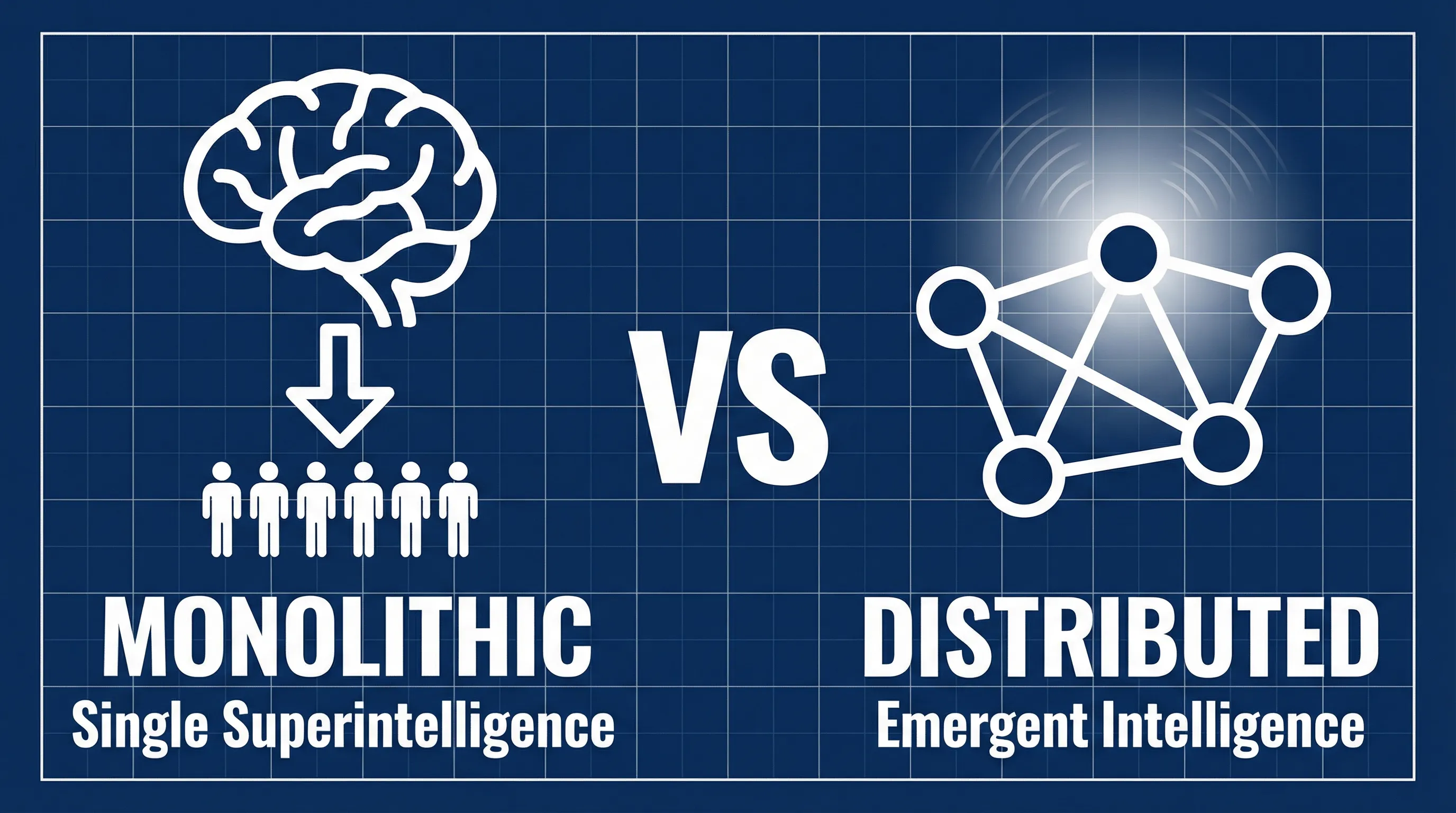
Tian Hongfei referenced a paper published by DeepMind on December 19, 2025. The core argument is: while everyone’s attention is focused on single-agent intelligence (what the paper calls “monosodic”), superintelligence may actually emerge from multiple sub-agents collaborating together.
“Superintelligence emerges from the collaboration of multiple less-intelligent agents.”
The paper also argues that collaboration between distributed agents requires alignment and value orientation. This is fundamentally a safety issue.
Tian Hongfei believes this path aligns more closely with how human society has developed: “Human society is built on interactions between people, collectively working through market economics to achieve common goals.”
He admits he has a “rebellious streak” – from MIT grid computing research, to a Bitcoin startup in 2012, to edge intelligence now, he has always been working on distributed, decentralized technology.
On safety, he said: “Good intelligence and bad intelligence balance each other out. At that point, we no longer need to worry about a single superintelligence emerging to dominate all of humanity.”
Tesla’s Small Model Strategy
Tian Hongfei mentioned that Tesla’s XAI team is working on a 100,000 human simulator project, using low-power chips to run small models collaborating together. This is a completely different approach from the pursuit of ever-larger parameter counts.
Their view is: small models can iterate faster, and through collaboration between small models, higher intelligence can emerge.
There are over 4 million Teslas in North America, all of which could potentially become edge computing nodes in the future. The chip roadmap is AI4 (current) -> AI5 (improved FSD) -> AI6 (powering Optimus robots) -> AI7 (space computing).
Tian Hongfei cited an interview with a Tesla engineer. Elon Musk’s directive to the team was: “Things that humans do better – absolutely do not let humans do them.” What they’re pursuing is this: in the time it takes a human to blink, the machine has already completed millions of transactions. Humanoid robots can operate at 8 times human speed.
Jedi Lu added that Musk’s logic is simple: as long as it’s 8 times faster than a human, the business model works. “It doesn’t need to be much more capable than a human. Maybe a bit dumber, that’s fine – it’s 8 times faster.”
The Stock Market Is Already an Agent Swarm Game
Jedi Lu pointed out that a network of collaborating agents already exists – the stock trading market. Currently, 60% of trading volume comes from high-frequency trading and quantitative trading.
His advice: individual retail investors should stop trying to battle agents. “In the future, humans should just invest – take medium to long-term positions. You simply cannot beat these AIs in short-term trading.”
Tian Hongfei mentioned a company that puts all large models into a trading competition. He initially thought they were just playing around, but after reading their blog, he realized it was a serious AI research company. Their argument is: market competition is the hardest problem, and it provides a zero-shot model training environment.
Jedi Lu said that if it works in finance, e-commerce could be next. Everyone using agents for distributed transaction processing would create a swarm effect.
Intelligent Network Replacing the Internet
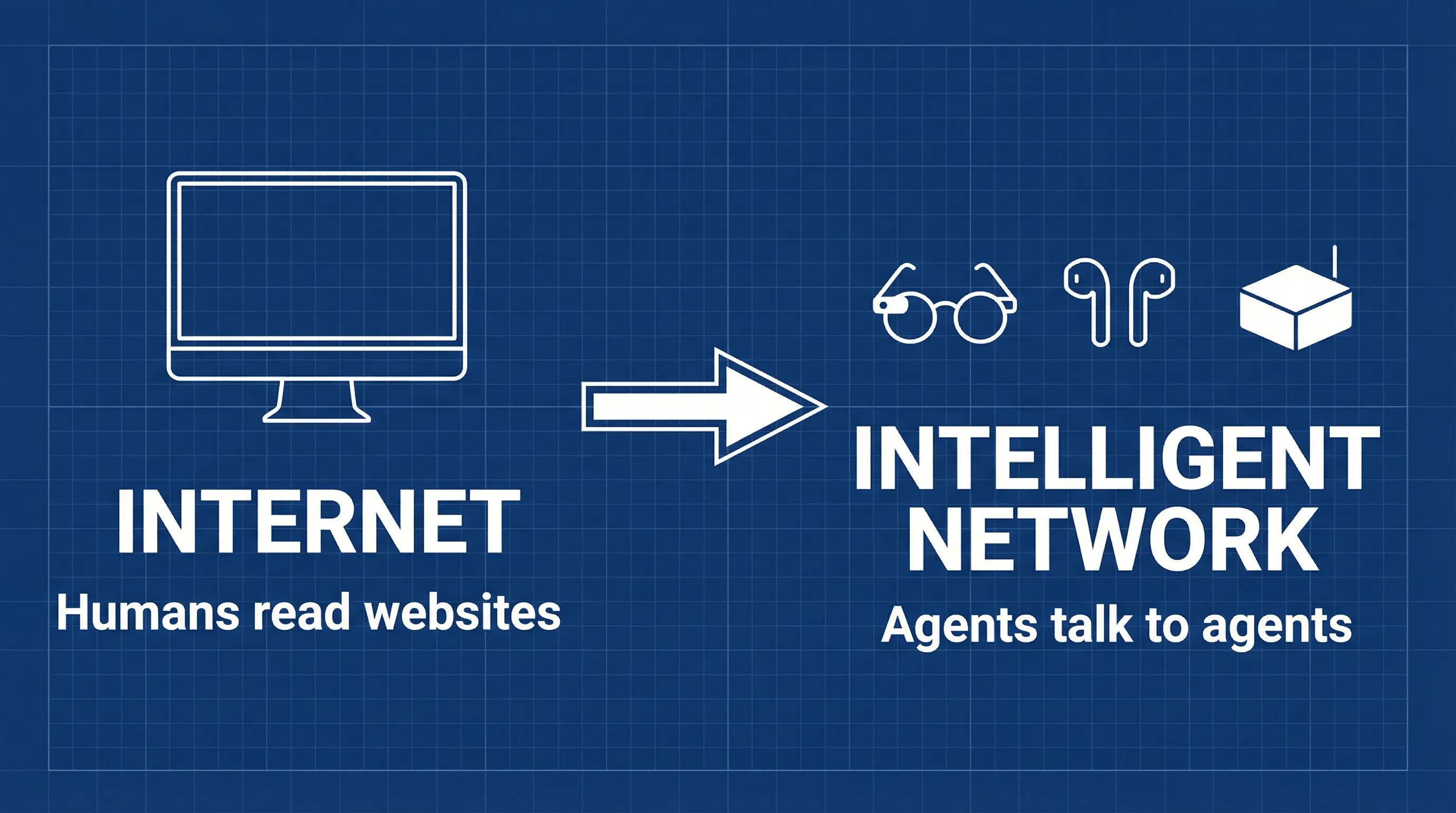
Tian Hongfei’s vision is: in the future, the internet won’t be called the Internet anymore – it should be called the Intelligent Network.
Wearable devices (glasses, earphones, rings) will replace much of the screen time currently consumed by phones. Personal data will be processed on edge devices (such as OlarisOne). Cloud GPUs will only be called upon when stronger reasoning capabilities are needed.
His envisioned form of AGI is: every person has their own agent, agents collaborate with each other through market mechanisms, and higher-level intelligence emerges across various industries.
“We may see higher-level intelligence emerge in the right industries.”
Jedi Lu referenced Elon Musk’s perspective: “Since the speed of light has a limit, there won’t be a single superintelligence that monopolizes everything.” If everyone can reach the speed of light, it’s a balanced force.
The way we communicate will also change. Today’s websites are designed for humans – for visual consumption. If agents communicate with each other, all they need is a set of APIs or MCP protocols. “Communication efficiency would be enormously high – everything could improve by ten or a hundred times.”
Editor’s Analysis
Guest’s Position
Tian Hongfei is an edge intelligence entrepreneur, and Olaris is building edge computing devices. His views that “data should be processed locally” and “distributed intelligence is safer” are highly aligned with his business interests. This doesn’t mean his views are wrong, but it’s important to be aware of this context.
Selectivity in the Arguments
Limitations of the Apple example: Apple is indeed the gold standard for privacy protection, but it’s also the most closed ecosystem. Using Apple to prove that “privacy and business success can coexist” is valid, but you can’t directly extrapolate that open-source edge devices can replicate this model.
The DeepMind paper: The “December 19, 2025 DeepMind paper on distributed intelligence” mentioned in the interview needs verification to determine whether the original text truly supports the interpretation of “superintelligence emerging from the edge.” Academic paper conclusions are typically more conservative than popular interpretations.
Tesla chip roadmap: The specific specs and timelines for AI5/AI6/AI7 primarily come from Musk’s public statements and have not yet been backed by formal product releases.
Counterarguments
Supporters of centralized AI would push back:
- OpenAI and Anthropic’s scaled models do lead on most benchmarks
- The computational limitations of edge devices are determined by the laws of physics and are difficult to bridge
- “Distributed emergent intelligence” is currently more of a theoretical discussion, lacking empirical evidence
On privacy: There is also the argument that for most users, the convenience of cloud services far outweighs the privacy risks. The cost of enforcing GDPR in Europe is enormous, and many small businesses have exited the European market as a result.
Core Recommendations
Tian Hongfei’s core recommendations from the interview:
- Evaluate services by their business model: Companies that sell hardware are more likely to protect your privacy than companies that sell advertising
- Keep data local: Let intelligence come in to do the work, and leave when it’s done. Don’t upload all your data to the cloud
- Don’t chase the smartest AI: Pursuing an AI that’s most like you may have more practical value
- Invest in edge devices: Whether you’re an individual or a small business, owning your own computing power is becoming increasingly important
Source: Indigo Talk EP 41 - Will Superintelligence Emerge from the Edge? / Personal Computing in the AI Era Guest: Tian Hongfei (Co-founder of Olaris) Transcription and editing: Claude Code video-to-article skill
If you found this helpful, consider buying me a coffee to support more content like this.
Buy me a coffee