Jason Fried: Build for Yourself, Keep Costs Low, and Stay Small
Guest: Jason Fried — Co-founder & CEO of Basecamp/37signals, 25+ years in business Source: Founders Podcast | Duration: 2:21:22 Full transcript: Complete transcript with speaker identification
Introduction
Jason Fried founded 37signals at age 25. Twenty-seven years later, the company has never taken outside funding, never gone public, and has been profitable every single year. The current team of 62 runs two core products — Basecamp (project management) and HEY (email) — serving hundreds of thousands of paying customers. Together with co-founder David Heinemeier Hansson, Fried has authored Rework, It Doesn’t Have to Be Crazy at Work, and Getting Real, making him arguably the most prominent voice in Silicon Valley’s “anti-growth” counter-narrative.
This conversation covers the full map of Fried’s business philosophy: why your costs are your only real competition, why two-person teams outperform large ones, why he draws more product inspiration from Navajo rugs and Concept 2 rowing machines than from competitor analysis, and why he believes modern smart devices are experiencing a “great regression.” He also speaks candidly about how psychedelic experiences changed his understanding of intuition and decision-making.
Your Only Competition Is Your Costs
Fried’s entrepreneurial origin story begins with a very specific scene: at 15, he built a FileMaker Pro database to track the tapes and CDs he’d lent to friends — because they never returned them. He designed a nice interface, packaged it up, uploaded it to AOL, and included a text file saying “if you like it, send me $20.” A few weeks later, an envelope arrived from Germany — red and blue airmail stripes, old-school — with a crisp $20 bill inside. “That was the moment it all clicked for me” — build for yourself, and somewhere in the world there are people just like you who will pay for it.
From that starting point, Fried’s business philosophy reduces to a simple equation: earn more than you spend, and you can keep going. The real adversary isn’t other products in the market — it’s your own operating costs.
“A business is very simple. You got to make more than you spend. Your competition is your cost.”
What competitors do is beyond your control — their pricing, product direction, and market strategies are their business. The only variable you can control is how much you spend. This isn’t a Fried original. David Senra points out that from Sam Walton to Andrew Carnegie to early-stage Steve Jobs at Apple, history’s most successful entrepreneurs all shared a near-obsessive focus on costs.
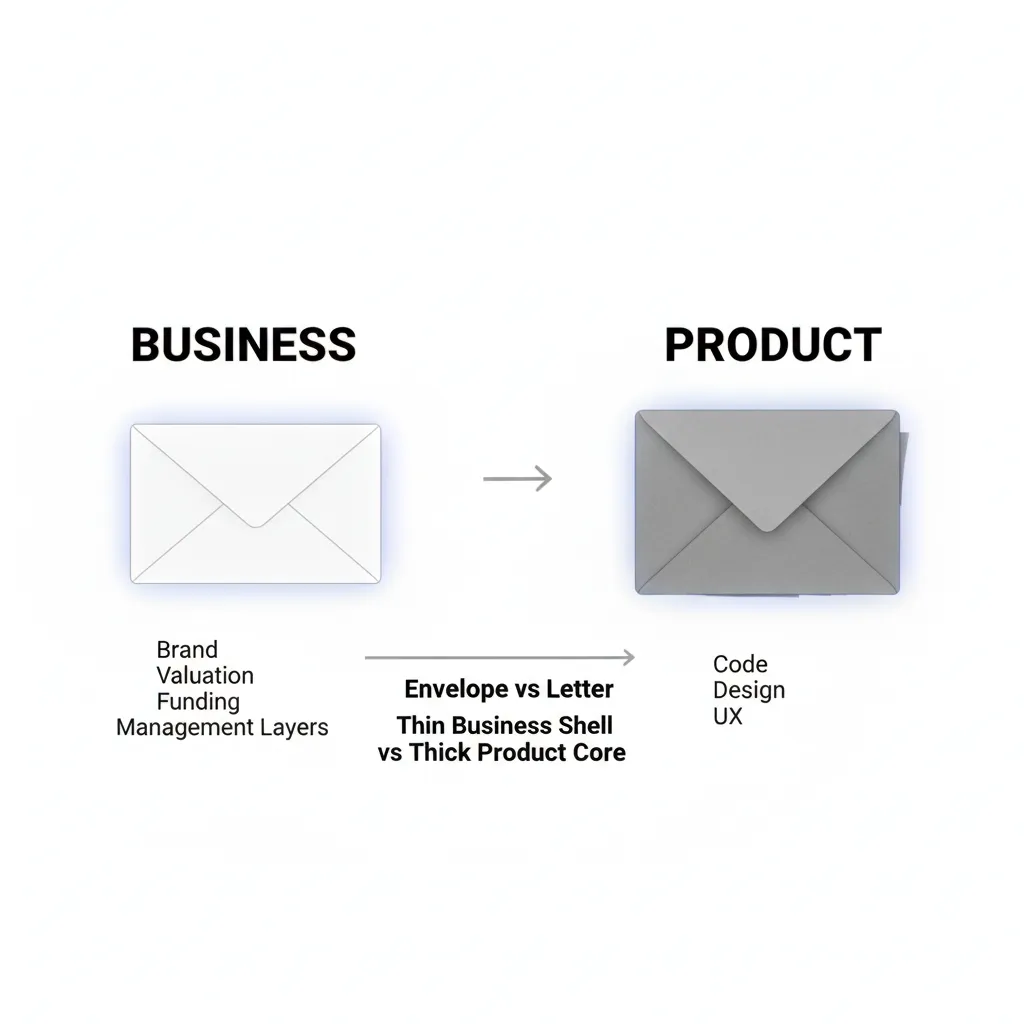
Fried pushes this logic to its extreme with a metaphor: the envelope and the letter. The business is the envelope — the shell that carries the product. The product is the letter — the thing with actual content. He believes most entrepreneurs get the priorities backwards, pouring energy into the envelope: branding, valuations, funding rounds, management hierarchies. Some are even “playing entrepreneur” — endlessly registering companies, naming them, designing logos, fundraising, negotiating valuations, while the envelope contains nothing of substance.
“The idea of a business being a financial instrument is anathema to me. The thing that matters should be big, and the rest of it should be as thin as possible.”
He uses a physics metaphor: the more massive the object, the more energy required to change its direction. A “thick” company — many management layers, many processes, many intermediaries — is too far removed from customers. What he wants is an “ultra-thin” shell: customers can email the founder directly, product teams have just two people, the decision chain barely exists.
37signals practices exactly this: an ultra-thin business shell around an ultra-thick product core. No middle management, no board of directors, no external investors. Last year they migrated off AWS to self-hosted data centers, saving an estimated $10 million according to David Heinemeier Hansson. Many think it’s not worth the engineering investment just to save that amount. Fried’s response: this is our own money, earned through customer revenue — of course we’re going to be careful with it.
He also said something few founders would: “I wouldn’t trade my business for anybody’s. Not a single person. That would be a downgrade.” Not because Basecamp is bigger than Amazon, but because he’s built a company that fits him perfectly — the way he wants to work, the products he wants to build, the customers he wants to serve. Swap any of it, and it wouldn’t fit.
A 62-Person Team and Two-Person Groups
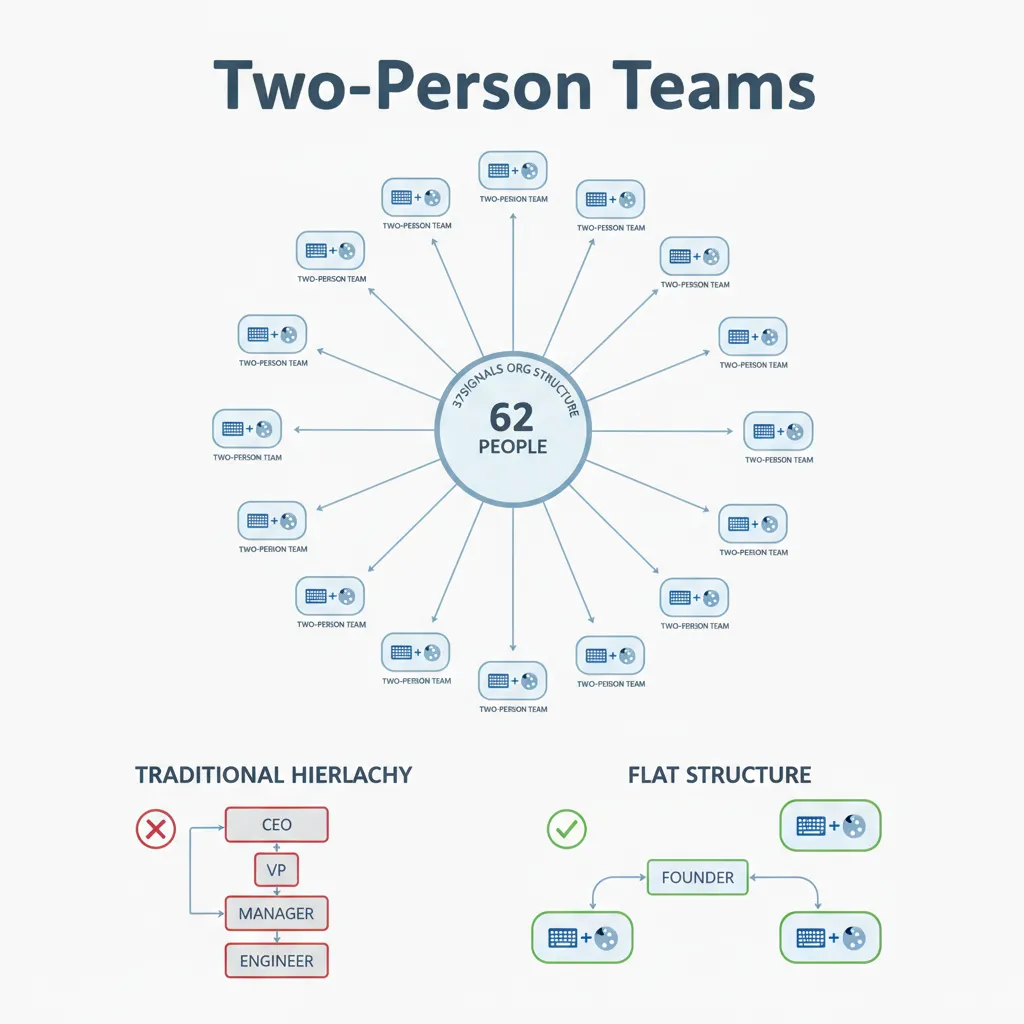
37signals currently has 62 people; the historical peak was around 80. Fried says that expansion was a lesson — after adding engineering managers and a COO, he found information transfer had become a “telephone game,” losing precision at every layer.
“I don’t think companies really have communication problems. They have miscommunication problems.”
His solution is two-person groups: one programmer and one designer, partnered to ship a feature. This configuration forces the team to only build what two people can handle, naturally limiting product complexity.
The COO role was tried twice, each time for about three years; the conclusion was “there wasn’t enough work for them.” The engineering manager role lasted about a year. Fried’s method for evaluating these positions comes down to one question: “Knowing what I know now, would I hire them again?” He believes this question encompasses performance, attitude, and cultural fit in a single frame. For management roles, he rephrases: if I could do it over, would I create this position? The answer was no.
He acknowledges this flat structure only works at certain scales. But at 62 people, the founders can communicate directly with the people doing the work — no information-lossy middle layers to pass through. He cites UPS founder Jim Casey as an example: Casey discovered that executives only told him what he wanted to hear — the expensive hires had become yes-men. So he stopped meeting with executives and had his driver pull over whenever they spotted a brown UPS truck, getting out to chat directly with delivery drivers.
Fried does the same. When users sign up for Basecamp, the first thing they see is a letter he wrote, with his signature and personal email address. “I want my customers to email me. I don’t want to hide from anybody. There’s no AI, there’s no assistant. Just write me.” He says he replies to about 200 customer emails a day. Some consider this an “irresponsible” use of a CEO’s time. His response: it may be the best thing a CEO can do.
Squirrel Navigation: No Five-Year Plans
Fried is repeatedly asked “what does success look like in five years.” His answer is always: don’t know, don’t care.
He compares 37signals’ approach to a squirrel crossing a field: roughly know the direction, run a bit, stop to look around, run some more. No need to arrive at a precise, predetermined destination. 99% of the company’s projects are completed within six weeks, most much shorter. Occasionally there’s a large project (like migrating off AWS), but that’s the exception in 27 years.
“You know more about things the closer they are to you. I don’t know what’s going to happen five Mondays from now, but I probably have a better idea of what might happen tomorrow.”
The underlying logic is small-unit decision-making. A day is a small unit. A simple decision is a small unit. Get a small unit wrong and the cost is low — tomorrow it’s behind you. But large decisions gone wrong can take months to digest. Some will say you’ll miss big opportunities. Fried’s response is his signature two words: “So what?” — as long as he can keep doing what he loves, passing on big opportunities is fine.
David Senra resonated strongly, sharing a similar reflection: “All a great life is, is just a string of great days.” Senra did the math: Fried works 40 hours a week, sustained over 27 years — roughly 54,000 hours. “You say you don’t grind, but how many people have spent 54,000 hours on the same thing?” Fried paused, then said: “I just lay one brick at a time, and then I look back and the wall is already tall.”
Fried also uses a rocket entering orbit as a metaphor for his ideal business trajectory. The early stage of a startup does require a hard push — break through gravity, get off the ground. But after the breakout, you don’t need to keep accelerating. The better state is entering a stable orbit, cruising within a comfortable range — “a little higher here, a little lower there.” Silicon Valley’s celebrated “hockey stick” growth curve holds zero appeal for him.
A Software Company on the Galapagos Islands
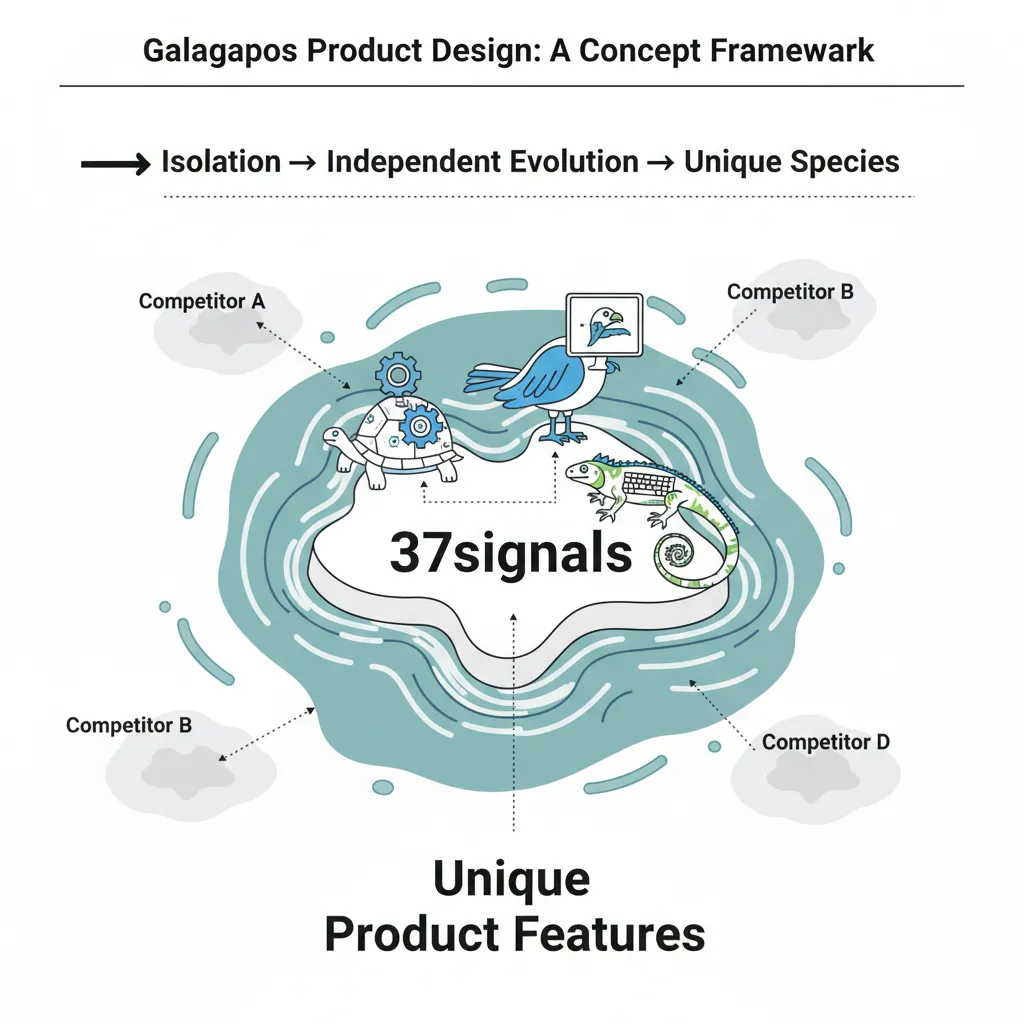
Fried rarely pays attention to what competitors are doing. He believes tracking peers is a slippery slope — you unconsciously copy their designs and features until all products look the same. He compares 37signals to the Galapagos Islands: evolving independently in isolation, producing unique species.
“I think of us as the Galapagos. An insular group focused on solving a problem our own way without paying too much attention to what everyone else is doing.”
His sources of inspiration come almost entirely from outside software. The Concept 2 rowing machine is a product he references repeatedly as “perfect” — under $1,000, a black-and-white LCD screen, five rubber buttons, runs on C or D batteries, no plugging in or touchscreens. “A paperclip and a Concept 2 rowing machine — it’s hard to improve on either of them.”
In a gallery in a small Wisconsin town, he discovered Navajo rugs and noticed that the geometric patterns contained obvious “mistakes” — a stitch off, a triangle slightly irregular. The gallery owner told him: the Navajo don’t see these as mistakes; they’re just “a moment in time” — like stumbling on a hike; you don’t go back to the start and redo it.
“The Navajo don’t see those as mistakes. They’re just a moment in time.”
This story profoundly shaped Fried’s product philosophy. His product demo videos are single-take, unedited — if he misspeak, he misspeaks. Landing pages are long letters he writes by hand, signed with his name and email. He believes companies hiding behind PR and lawyers is a form of “thickness” — and what he pursues is extreme thinness and transparency.
HEY’s pre-launch page was a “love letter” he wrote — long before the product was finished, he first articulated why email is a beautiful thing. “That letter isn’t a product spec; it’s a love letter,” he says.
Fat Safety Margins
Fried coined a term on the spot during the conversation: blubber (whale fat/fat reserves). He believes businesses need enough fat to weather storms, rather than pursuing 6% body fat-style leanness.
“We take risks. We don’t put ourselves at risk.”
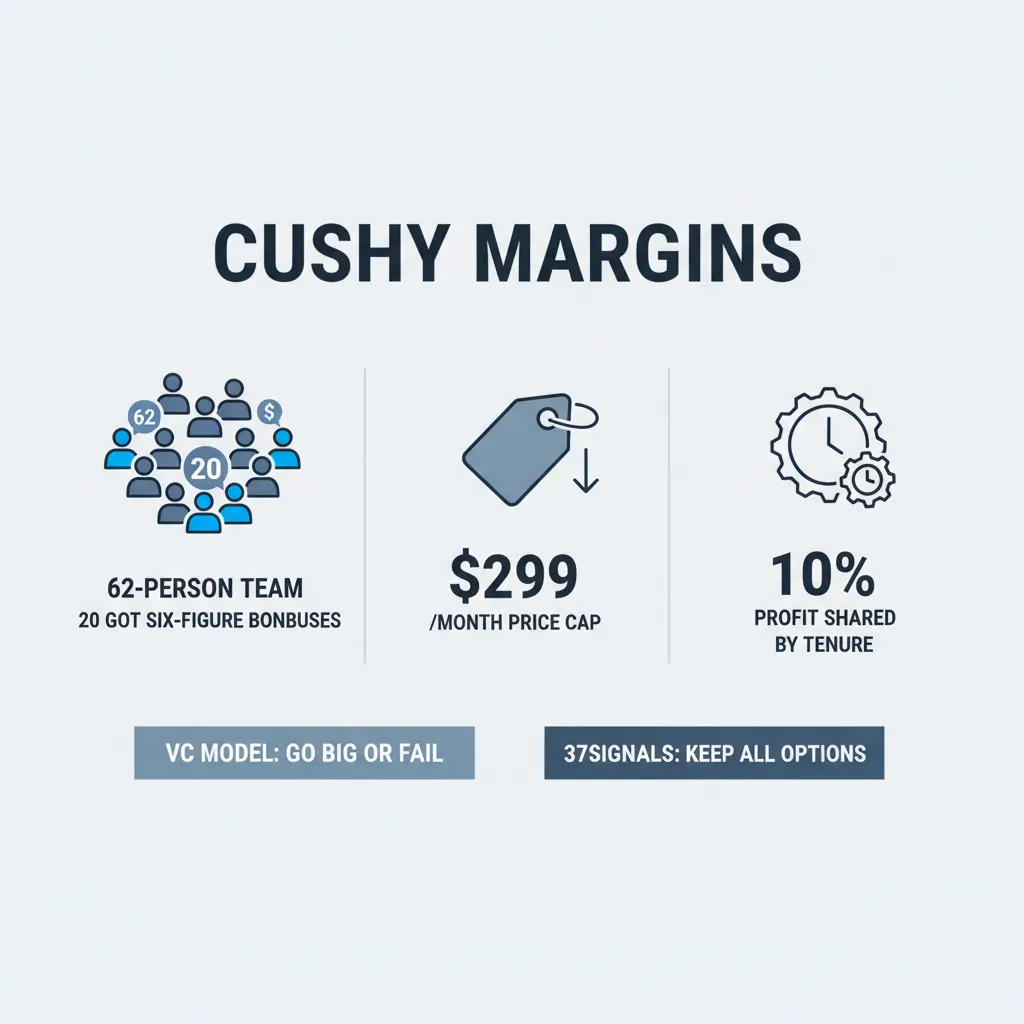
On the financial structure specifically, 37signals is an LLC (limited liability company) — year-end profits must be distributed to members. Fried, David Heinemeier Hansson, and two other shareholders receive distributions, while 10% of profits are distributed to all employees by tenure — not by title, not by salary, purely by how long they’ve been at the company. A customer support rep with 10 years gets the same profit-sharing amount as a principal engineer with 10 years. In 2024, 20 out of 62 people received six-figure bonuses.
“This is real cash on an annual basis. No options, no RSUs, no stock.”
Basecamp’s pricing strategy also serves durability: any customer pays a maximum of $299/month, regardless of team size. This means no “whale” customers — each customer carries roughly equal weight, and losing any single one won’t cause material damage.
Fried believes the essence of venture capital is trading options for speed. Once you take money, you’re left with one outcome: go big or fail. Meanwhile, 37signals retains all options — they could IPO (don’t want to), raise money (don’t want to), sell to PE (don’t want to), or keep going (want to). “That is gold to me is optionality.”
Time Is the Only Filter You Can Trust
Fried doesn’t believe in five-year plans, but he believes in fifty years of time-tested validation. One of his core tenets: time is the best filter — for businesses, ideas, books, and people.
“Time is the best filter. It’s the only filter I trust for businesses, for ideas, for books.”
He quotes advice Jeff Bezos gave 37signals early on: “Focus on the things about your business that don’t change.” Bezos used Amazon as the example: in ten years, no one will say “I wish Amazon’s customer service were worse,” “I wish shipping were slower,” or “I wish prices were higher.” Those are core essentials — areas where investment returns never become obsolete.
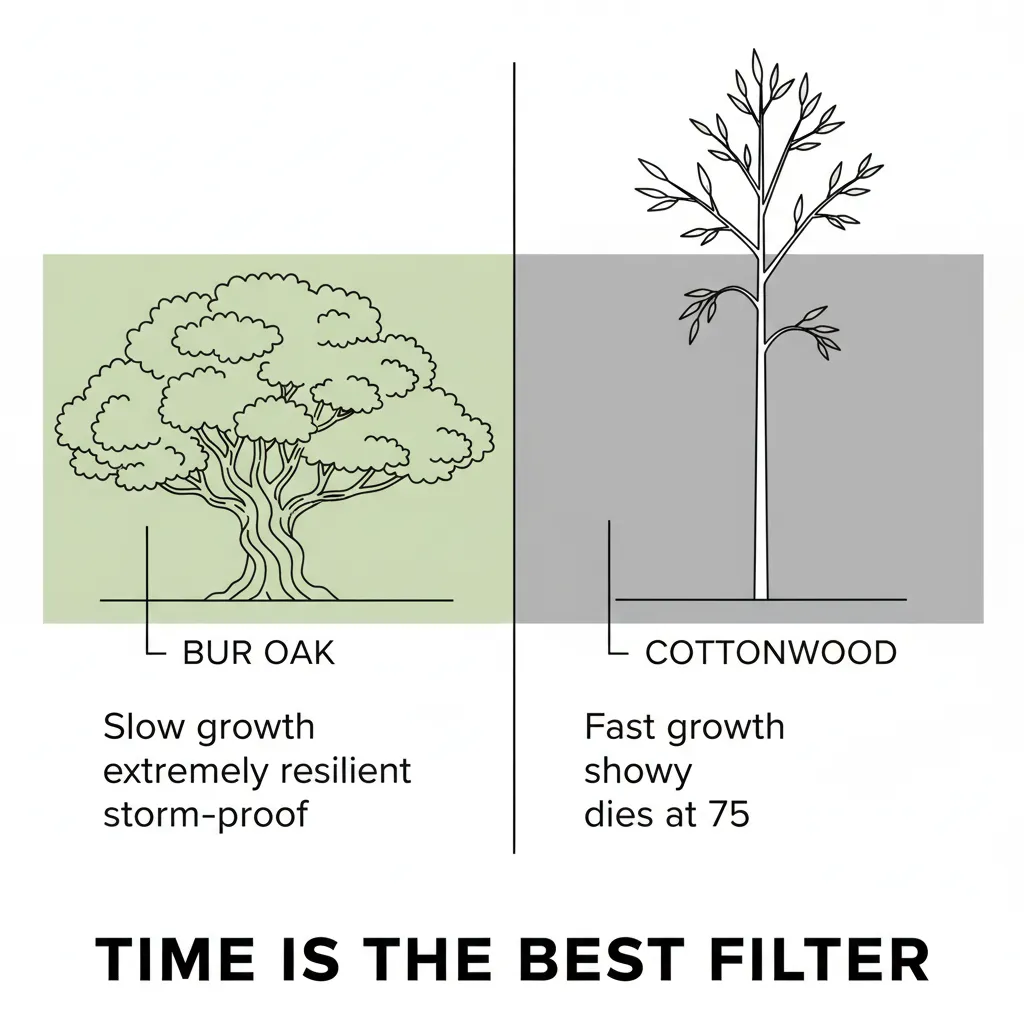
Fried uses the bur oak as a metaphor for 37signals: slow-growing but supremely tough, able to withstand all manner of storms. By contrast, the cottonwood grows fast and conspicuously — you can hear it rustling in the wind, it scatters fluff everywhere in spring — but it dies in about 75 years, and when it falls, it makes a spectacular mess. “I don’t need to be flashy. I don’t need to leave traces everywhere I’ve been.”
The tech industry periodically produces “XX killers” — Slack killers, Basecamp killers, email killers. Fried has watched for 27 years; most “killers” disappear first. “People are like, how do you compete? Well, we just stay around longer than everybody else.”
David Senra added Charlie Munger’s perspective: you need to build “deserve trust” relationships with high-quality people, and the only way to judge whether someone is high-quality is time. Many of Munger and Buffett’s closest friends are people they’ve known from their twenties and thirties into their seventies and eighties.
Psychedelics, Intuition, and “Unrepeatable Experiences”
The most unexpected segment of the conversation is Fried discussing the impact of psychedelics (mushrooms) on his life. He’s done it three times — not recreationally, but because his favorite thing in life is “having an insight” — and psychedelics delivered an “avalanche of insights.”
He describes a peculiar experience: while contemplating an idea, he suddenly realized the idea was a three-dimensional object that he could rotate to see its back side. “The front of things are fronts. The back of things are real.” He says he doesn’t deliberately apply this to daily decisions, but it persists in his cognitive toolkit as a new “lens” — “I’d rather have a few more lenses available to me, if I can.”
During the third experience, a turning point occurred. He’d told his guide beforehand that a particular song had produced a profoundly moving experience the previous time, and he wanted to hear it again. The song played. Nothing happened. Then he burst out laughing, suddenly understanding: you cannot have the same experience twice.
“You cannot have the same experience twice. It’s not even possible to relive something. That thing happened then and this is now. They’re detached, they’re separate, they can never be the same.”
He carries this realization into daily life — his children are now 11 and 7. “I will never again have the experience of being with an 11-year-old. Once he’s 12, that’s a different thing entirely.”
David Senra asked him to define success. Fried believes Steve Jobs said it best: “Did I make something I’m proud of?” His own version is slightly different: “Would I want to do this again?” If the answer is yes, that’s success. Nothing to do with money, nothing to do with scale, nothing to do with what others think.
Fried closed with thoughts on intuition. He describes himself as “a completely gut- and instinct-driven entrepreneur” who never looks at spreadsheets to make product decisions. But he also acknowledges intuition isn’t innate — it’s honed through continually making decisions: “The more decisions you make, the more intuition you’re refining.” Eventually you end up with a smooth sphere that feels right in your hand. This requires two prerequisites: enough time, and enough independence for intuition to be used rather than overruled.
The Great Regression: How Smart Devices Got Dumb
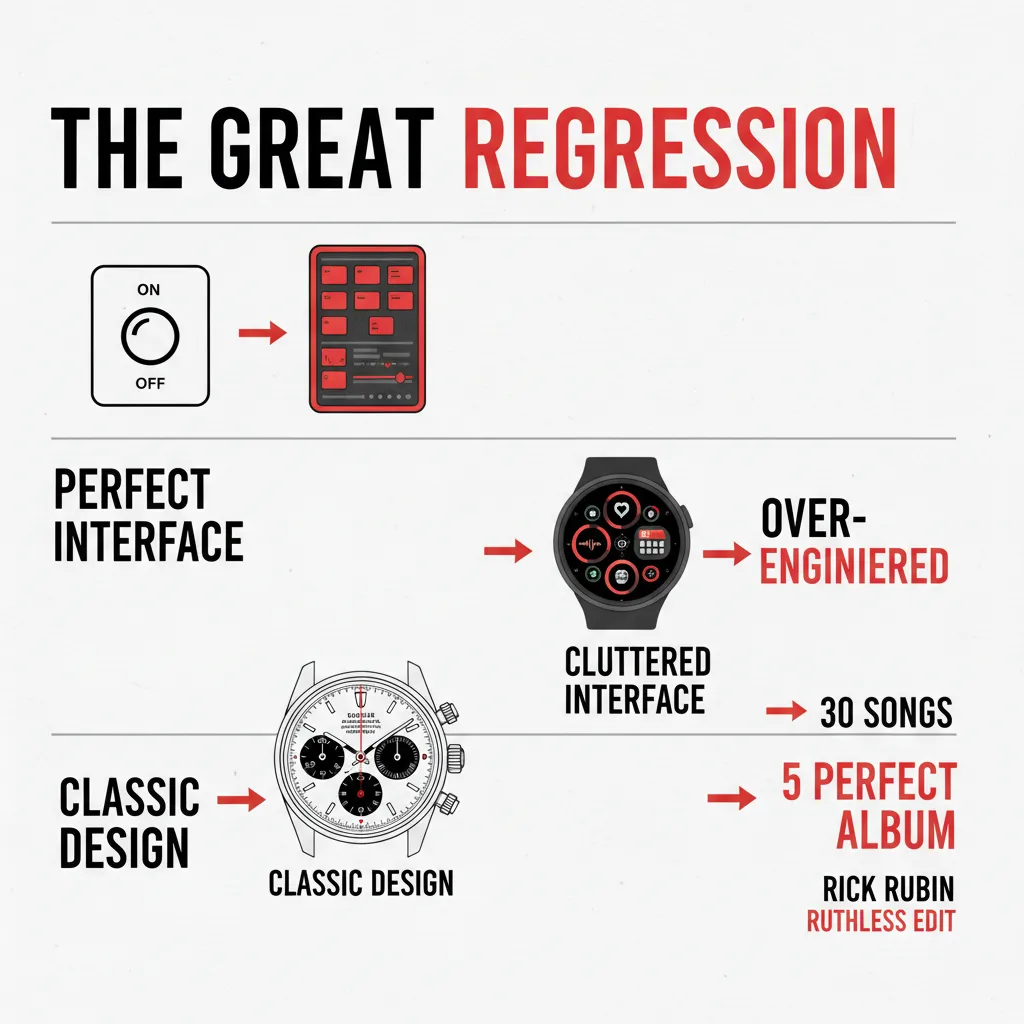
Fried’s parents visited California, and he rented them a newly built house. The home was packed with “smart” devices, and the experience was a disaster. The thermostat was a massive touchscreen panel loaded with weather forecasts and nested menus. The alarm panel resembled an iPad. The dishwasher required downloading an app and registering before first use. The TV didn’t turn on — it booted up, taking 12 seconds before displaying a menu.
“The best interface ever was like the switch. On, off, beautiful. I feel like the light switch is a lost art.”
He calls this “the great regression.” As someone who’s spent 27 years building software, he’s no Luddite, but he argues that adding features doesn’t equal improving the product. The automotive industry has already begun reverting from touchscreens to physical buttons — because users can’t get tactile feedback from a glass panel while driving.
This observation is entirely consistent with his product philosophy. He invokes Rick Rubin’s concept of “ruthless editing”: you record 30 songs, pick the 5 you absolutely can’t let go of. “Those 5 songs are probably a perfect album. Then consider the 6th, the 7th — but did adding them actually make it better?”
Jerry Seinfeld’s dosage theory also comes up: 45 minutes of stand-up comedy feels brilliant; 1 hour 15 minutes and the audience starts feeling it’s enough. “He should have stopped at 45.” — knowing when to stop is the hardest skill.
Fried points to the 1963 first-generation Rolex Daytona: that’s creativity in its purest form, with every subsequent generation adding rather than improving. After the Malibu wildfire, a burned-out Porsche 911 sat roadside — the body was charred, but the silhouette was instantly recognizable. Other burned cars next to it were completely unidentifiable. “That’s the staying power of timeless design.”
This vigilance against “over-complication” extends to his thinking about selling the company. He mentions the autobiography of Trader Joe’s founder: a lifetime poured into a completely differentiated grocery store, sold in a moment of fear, followed by decades of trying investments, real estate, and consulting — but the final paragraph of the autobiography confesses: “I have to be honest with myself. I regret selling.” The week the book was published, he passed away. Fried says he knows friends in similar situations — after selling their company, they assumed they could do it again, only to find the second time couldn’t reach the same heights, leaving them unable to even appreciate what they’d already achieved.
Bob Dylan said something similar in a 60 Minutes interview: he recited lyrics he’d written as a young man, then said, “I used to be able to write things like that. Some kind of magic was there. I don’t know how I did it. I know I can’t do it again. But I can do other things.” Fried sees this as maturity — acknowledging that past achievements can’t be replicated, while refusing to let that irreplicability become regret.
Editor’s Analysis
The Guest’s Position
Jason Fried’s advice comes from a very specific success path: SaaS software, extremely low marginal costs, and the first-mover advantage of starting in 1999. The project management tool market isn’t winner-take-all — no network effects needed, no need to burn cash for customer acquisition. This is what allows his “no funding, no growth, decide by gut” strategy to sustain for 27 years. His public statements are highly aligned with 37signals’ brand positioning — “small and beautiful” is both his belief and his business selling point. This doesn’t mean he’s insincere, but it’s worth recognizing that his interests and his narrative are aligned.
Selectivity in the Argument
The conversation extensively uses cases supporting the “small and beautiful” narrative (the Concept 2 rowing machine, Vinnie’s sandwich shop, Navajo rugs) but barely discusses industries that require scale to succeed. Jeff Bezos is cited as an ally (“focus on the things that don’t change”), but Amazon is the textbook case of extreme growth strategy — Bezos’ quote was explaining why Amazon should keep expanding categories and reducing prices, not arguing that “enough is enough.”
The “intuition over data” claim also needs context. Fried’s intuition is the compression of 25 years of industry experience — a first-time founder rejecting data in the same way likely won’t get the same results. When intuition is right, we remember; founders whose intuition was wrong have already disappeared.
Counterpoints
- Scale has its legitimate reasons. Stripe made payment infrastructure accessible to developers worldwide through scale; Shopify enabled small merchants to set up online stores through going public and expanding. These forms of value can’t be created by a 62-person team.
- Fundraising isn’t just “selling options.” For resource-constrained founders, raising capital may be the only way to enter the market. The low-competition environment of Fried’s 1999 launch no longer exists.
- The $299/month price cap means deliberately ceding the enterprise market. In the project management space, competitors like Asana and Monday.com use enterprise pricing to fund more product development. This isn’t necessarily bad, but it’s a choice rather than an inevitability.
Facts to Verify
- Microsoft’s early days having “28 out of 30 people as programmers” — specific ratio needs cross-referencing
- Exact savings from leaving AWS — DHH’s original source
- Trader Joe’s founder’s autobiography published the same week as his death — timeline needs confirmation
- Bob Dylan’s 60 Minutes interview about “not being able to write songs like that anymore” — exact wording needs verification
Key Takeaways
- Treat your costs as your only competition. You can’t control the market, but you can control how much you spend. “As long as you make more than you spend, you can keep going.”
- Two-person groups, six-week cycles. The smaller the team, the lower the communication overhead. Six weeks is the sweet spot — long enough to build something meaningful, short enough to avoid losing your way.
- Look for inspiration outside your industry. Watching competitors leads to copying; observing nature and physical products sparks genuine creativity.
- Keep fat reserves. High margins, cash reserves, an evenly distributed customer base — these aren’t conservatism; they’re what lets you survive storms.
- Test all decisions with “if I could do it over, would I do it again?” Applies to people, positions, product features, and business direction alike.
Based on Jason Fried: Build for Yourself, Keep Costs Low and Stay Small
If you found this helpful, consider buying me a coffee to support more content like this.
Buy me a coffee