Jeetu Patel: AI Is a Necessity for Human Survival, Not a Luxury
Guest: Jeetu Patel, Cisco Chief Product Officer and President, managing a 30K-person product team, former Box CPO Host: Lenny Rachitsky | Duration: 87 minutes Source: YouTube | Lenny’s Podcast Full transcript: link
Declining Birth Rates and AI as the Only Alternative
Cisco recently hosted an AI summit that put Jensen Huang, Sam Altman, Marc Andreessen, Fei-Fei Li, the Intel CEO, AWS executives, and Mike Krieger on stage. Twelve hours of continuous conversation, and no one left early. From that marathon, Jeetu Patel distilled three conclusions.
First, capabilities overhang is real. Models can do far more than enterprises are actually using. Coding is the clearest success story — Cisco is about to ship its first product written 100% by AI. But outside of coding, enterprise adoption is far harder than anyone imagined.
Second, the hard problems are finally surfacing. Not “can AI do this?” but “how exactly do we apply it to each specific business scenario?” That requires deep domain understanding. General-purpose tools can’t solve it.
Third, and the most underappreciated in his view: global birth rates are falling, creating a demographic crisis.
“Survival of humanity depends on a successful AI. If you have 60% of your population in a demographic where you don’t have enough people to take care of them, that could cause a lot of human suffering.”
This echoes Marc Andreessen’s recent podcast argument — AI is arriving “just in time,” because soon there won’t be enough people to do the work that must be done. Jeetu’s point: most AI discourse circles around “will AI take our jobs?” The real question is: without AI, who takes care of a rapidly aging population?
This is a compelling argument, and an exceptionally convenient narrative for Cisco. As a core AI infrastructure vendor, Jeetu elevates AI from “enterprise efficiency tool” to “human survival necessity.” Under that framing, any skepticism about the scale of AI investment becomes unseemly.
What Cisco Actually Does in AI Infrastructure
Most people hear Cisco and think Webex or routers. Jeetu explained why Cisco is the invisible backbone of the AI era.
The logic chain: AI training requires GPUs → GPUs require networking → the scale of that networking keeps growing. A model that once trained on a single GPU scaled to 8 GPUs per server, then to a rack of servers, then to a cluster of racks. Now, two data centers 800 kilometers apart need to operate as a single unified cluster, every GPU fully synchronized.
“Connected together” is the operative phrase. NVIDIA makes the GPUs; we connect them.
Cisco provides networking, optics, security, observability, and data platforms. Jeetu frames AI’s three bottlenecks as:
- Infrastructure constraints — The world lacks sufficient power, compute, and network bandwidth to meet AI demand
- Trust deficit — Hallucination is a feature when writing poetry; it’s a disaster in production systems. Models are non-deterministic, and enterprises won’t deploy what they can’t trust
- Data gap — Public internet data is nearly exhausted. Future differentiation comes from enterprise private data, synthetic data, and machine-generated data
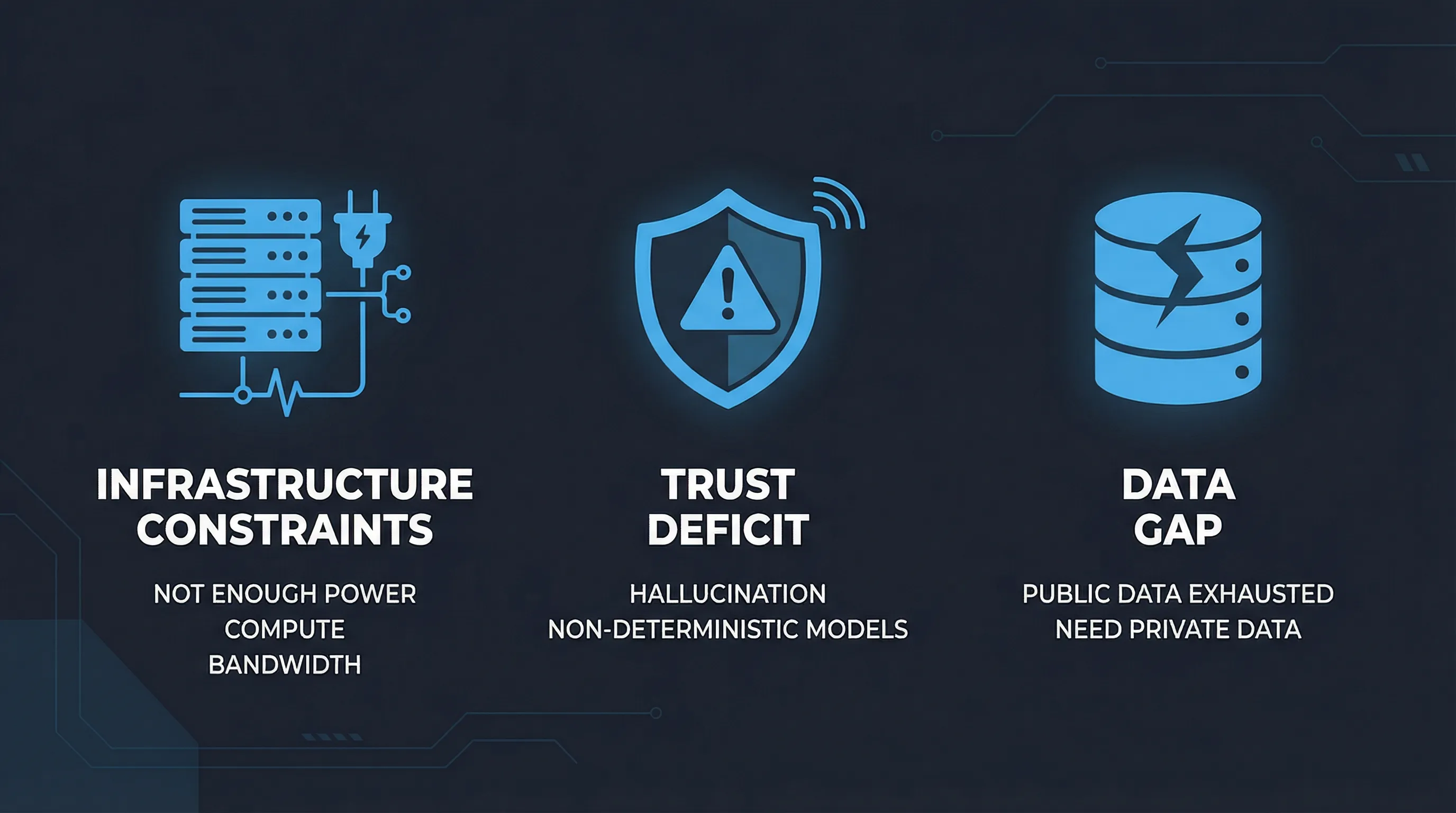
Cisco has direct commercial interests in bottlenecks one and three. That’s not a coincidence.
Transforming a 90,000-Person Traditional Enterprise into an AI-First Company
When Kevin Weil (former OpenAI CPO) introduced Jeetu to Lenny, his assessment was that Jeetu had transformed Cisco from an “older, slower, more traditional enterprise” into an AI-forward company. Cisco has 90,000 employees; 43,000 of them watched the internal AI summit live.
Jeetu did three things.
First, define what is non-negotiable. In large companies, ask enough people and someone will always say no. That’s the pocket veto. Large companies don’t fail to experiment — they succeed at experiments and then refuse to go all in, always wanting to hedge. Cisco chose not to hedge.
“We didn’t hedge on AI. We said we’re gonna go all in.”
But going all in requires convincing employees it works in their favor. Jeetu’s strategy: tell everyone that not using AI is what will cost them their jobs; using AI amplifies their value.
Second, shift from holding company to platform company. Cisco had acquired 251 companies, leaving a chaotic product line. Everyone wanted to be a GM, building their own sales, marketing, product, and engineering teams, running their own fiefdoms. Jeetu ended that. The new principle: loosely coupled, but tightly integrated. Customers don’t have to buy everything at once, but if they buy two products, those products must work together like magic.
Third, open the ecosystem. Accept that competitors are also partners. If a customer chose Vendor A alongside Cisco, Cisco has an obligation to help that customer succeed on Vendor A’s products too — because the flow-through rate from customer success is high.
The underlying logic is consistent across all three: innovation in large companies is not a capability problem, it’s a choice problem. Every day, every hour, every minute, you’re making a choice.
“Innovation is a choice. Every day you come into work and you can choose to be thinking about being creative or you can choose to not be creative. It’s a binary choice you can make every minute of every day.”
AI Is Not a Tool, It’s a New Teammate
Jeetu shared Cisco’s real experience using OpenAI Codex. For the first three months, the team was “screwing around.” The inflection point came from an OpenAI engineer embedded with the team:
“Stop trying to think of this as a tool. Think of this as a teammate that got added to your team and your framing will change.”
The implications of this cognitive shift go far beyond coding. If AI is society’s “new teammate,” every sector — housing, agriculture, transportation, healthcare — becomes eligible for redesign with this new collaborator.
Jeetu reinforced this with a story from a conversation with Ray Kurzweil. When Kurzweil was discussing the possibility of indefinite lifespans, someone asked about housing, agriculture, and transportation. Kurzweil’s response: most people can only imagine exponential growth along a single dimension, but exponential growth happens simultaneously across multiple dimensions. If humans could truly live indefinitely, they’d also invent 3-day crop cycles and 5,000-floor skyscrapers.
Jeetu’s inference: current understanding of AI is still at the level of “productivity tool and data aggregator” — a ten-thousandth of what’s visible above the waterline. AI will eventually produce original insights that don’t exist in the human knowledge base, and extend cognitive capability into the physical world.
He added an important qualifier:
“How an AI identifies its own success and its own ambition will really matter. It is in service of humans. It is not to go out and build a society by itself.”
Defying the Management Textbook: “Criticize in Public, Build Trust in Private”
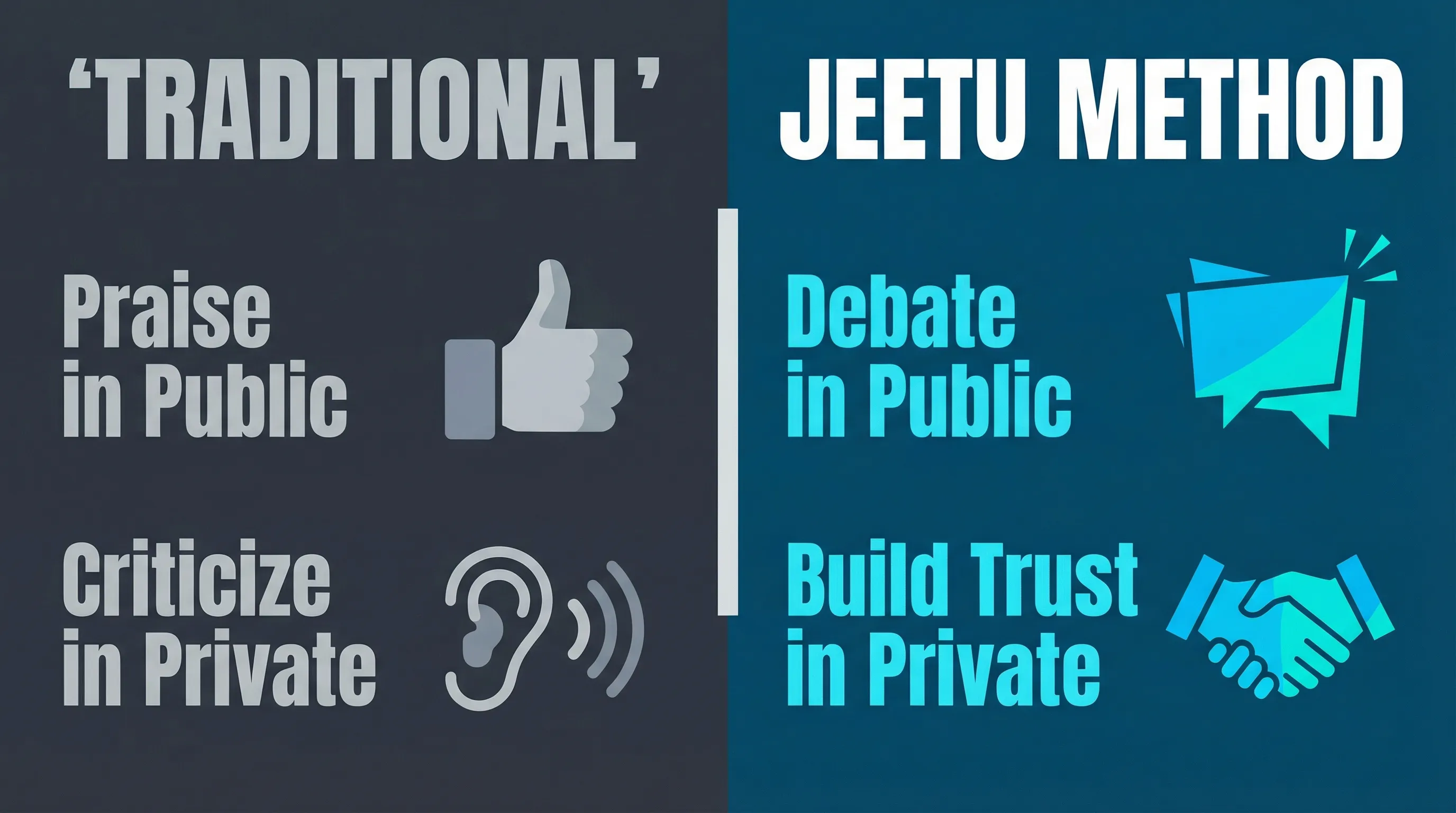
Jeetu manages 30,000 people. His management philosophy directly challenges a core tenet of every management book ever written.
Every management book says: praise in public, criticize in private. Jeetu says he fundamentally disagrees.
“What you have to do is establish enough trust among the team so that you are comfortable critiquing and debating in public. But when you’re in private, take that moment to build the trust.”
His logic: if you only say positive things publicly and every dashboard is green, but business growth is 1.5%, something is broken. Treat people like adults — when something is wrong, say it directly, with care in tone but without avoidance.
This isn’t personal style preference. It’s a method validated at Cisco’s scale. The prerequisite: invest in building trust in private first, ensuring everyone knows you’re in their corner. Once trust is established, public debate isn’t an attack — it’s problem-solving.
CEO Chuck Robbins handed him a complementary principle:
“If you don’t care about who gets the credit, you just go a lot farther in life.”
When media once gave Jeetu disproportionate credit while overlooking Chuck, Jeetu reached out to apologize. Chuck’s reaction: complete indifference. Jeetu says the self-assurance he observed in Chuck — knowing your strengths, knowing your weaknesses, building a team to cover the gaps — is the most important thing he learned from him.
Six Elements of Building a Great Company: Timing > Market > Team > Product > Brand > Distribution
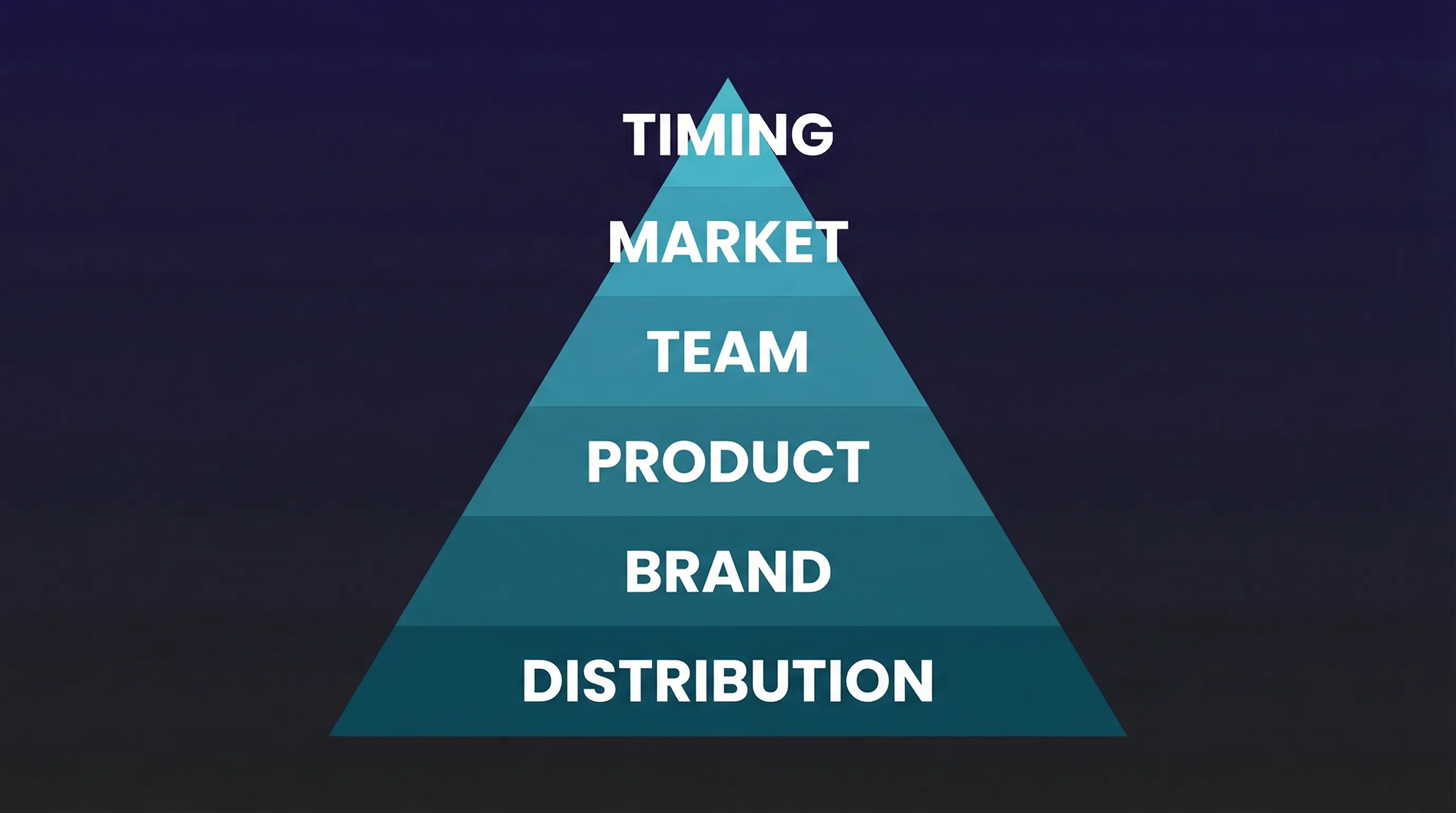
Jeetu shared a six-element framework, ranked by importance, each necessary but not sufficient:
1. Timing — The most important factor, and the one you control least. Many companies built excellent products in the right market at the wrong time and failed. Steve Jobs shelving the iPad to ship the iPhone first is the canonical timing call.
2. Market — Must be large enough, and attackable incrementally. “If you have a great market and a mediocre team, the market will pull you up. If you have a terrible market and a great team, the market will drag you down. The market always wins.”
3. Team — Not about mutual affection, but complementarity. Jeetu has a long-time partner he won’t take a job without — because she excels at everything he doesn’t. “Both offers have to come through, or neither does. It’s a bundled deal.”
4. Product — The soul of the company. Jeetu put it bluntly: “Shipping mediocre product to market is unethical.”
5. Brand — A mentor warned him: “Never join a company that has lost its brand magic, because it’s nearly impossible to revive. You can fix product. Brand, once dead, stays dead.”
6. Distribution — Build it and they won’t automatically come. You need a scalable distribution mechanism.
A heuristic for distinguishing megatrends from hype cycles: if you need a PhD to understand what it does, it’s probably not a megatrend. By definition, megatrends affect large populations. Ask ChatGPT a question and get an answer — that’s intuitive. Web3? He cites it as the counter-example: “I could never figure out the use case, even if I tried until the day I die.”
The Infrastructure Fate: All the Blame, None of the Glory
Jeetu moved from the application layer (Box) to the infrastructure layer (Cisco) and absorbed a hard lesson:
“You always get the blame… Great infrastructure companies, the application companies get the glory when they’re running on that infrastructure.”
No one calls to say “thank you, my network worked perfectly today.” But when it goes down, the phone rings immediately.
That morning he had met with a healthcare organization. They were direct: “When infrastructure doesn’t work, people die. Someone can’t get dialysis. Someone can’t have surgery.”
This shapes a special mindset required of infrastructure companies: orienting success around the ecosystem, not around themselves. No room for self-promotion. Jeetu says he understood this intellectually for years, but it was only deep inside Cisco’s daily operations that he truly felt the weight of that mental shift.
This closes a perfect loop with Chuck Robbins’ philosophy of not caring about credit — people who build infrastructure are, by nature, practicing the discipline of not needing it.
Editorial Analysis
Positional Bias
Jeetu Patel’s title is Cisco Chief Product Officer and President. Cisco is a core AI infrastructure vendor whose revenue directly benefits from the scale of AI investment. When he says “survival of humanity depends on a successful AI,” this is simultaneously a compelling demographic argument and a narrative that perfectly serves Cisco’s commercial interests.
Specifically:
- “AI is a human survival necessity” → implies AI infrastructure investment shouldn’t be questioned
- “Three bottlenecks: infrastructure, trust, data” → Cisco has direct business in infrastructure and data
- “Megatrends are unstoppable” → implies increasing investment over waiting and watching
This doesn’t make his arguments wrong — birth rates are genuinely falling globally, and AI may genuinely offset the labor gap. But readers should recognize that this narrative is logically indistinguishable from “keep buying Cisco infrastructure at scale.”
Claims Worth Discounting
“Cisco is about to ship its first product written 100% by AI” — No product scale, complexity, or quality metrics disclosed. An AI-written internal tool and an AI-written customer-facing critical product are entirely different claims.
The demographic crisis → AI necessity chain — There’s a missing link: can AI actually solve elder care? Current AI excels at information processing; elder care requires physical-world labor. Robotics is nowhere near mature enough to replace caregivers.
The description of Cisco’s transformation — Entirely from internal perspective (Jeetu and Chuck Robbins). No independent third-party validation — no customer satisfaction data, market share changes, or quantified comparisons of product release velocity.
Genuine Insight
“Large companies don’t fail to experiment — they succeed at experiments and then refuse to go all in” — A precise observation. Most analysis of large-company innovation focuses on “fear of trying.” Jeetu identifies the real problem as “fear of betting after you’ve already proven it works.”
The ordering of timing > market > team in the six-element framework — Counter-intuitive but well-supported. Silicon Valley narrative typically puts team at the top; Jeetu’s ordering is more consistent with what business history actually shows.
“Criticize in public, build trust in private” — Defies the textbook, but internally coherent. The prerequisite — that trust is already established — is a critical constraint that makes or breaks this approach in practice.
The megatrend vs. hype cycle heuristic — “Requires a PhD to understand = probably not a megatrend.” Concise, practical, actionable.
“Think of AI as a teammate, not a tool” — Cognitive reframes often matter more than the technology itself. This insight, learned from an embedded OpenAI engineer, may be the single most universally applicable takeaway from the entire interview.
The Force of Personal Narrative
Jeetu’s personal story gives his management philosophy irreplaceable persuasive weight. An immigrant from India who worked at Sizzler steakhouse for $2.25 an hour (below minimum wage), who overcame a stutter by waiting tables. Whose father was a Madoff-type fraudster who abused his mother. Who raised himself alongside her, until her deathbed words stopped him: “I didn’t know you loved me this much.”
That story directly spawned one of his management principles: don’t be stingy with words. If the person closest to you doesn’t know how you feel — how would a colleague or team member?
“Stamina trumps intellect. You can become smart if you have curiosity and hunger and staying power. You can’t teach hunger.”
Jeetu’s Core Positions
- Declining birth rates are an urgent crisis; AI is currently the only scalable response
- Three AI infrastructure bottlenecks: insufficient compute/bandwidth, enterprise trust deficit, high-quality data exhaustion
- The real barrier to large-company innovation isn’t fear of experimentation — it’s fear of going all in after the experiment succeeds
- Megatrend vs. hype distinction: ordinary people can understand it intuitively = megatrend
- Management philosophy: debate in public (only after trust is built), invest in relationships in private
- Six elements of great companies: timing > market > team > product > brand > distribution
- Infrastructure company mindset: orient around ecosystem success, accept all blame and no glory
Source: Lenny’s Podcast — Jeetu Patel | Transcribed: 2026-02-26
If you found this helpful, consider buying me a coffee to support more content like this.
Buy me a coffee