Alpha Schools: Can AI Really Double the Speed of Learning?
Guest: Joe Lamont — CEO of ESW Capital/Trilogy, founder of Alpha Schools Source: Moonshots #233 | Duration: 94 min Full Transcript: Complete transcript with speaker identification
Introduction
Joe Lamont is the founder and CEO of ESW Capital and Trilogy, having amassed a billion-dollar fortune through acquiring and systematizing software companies. Three years ago, he made a surprising move — investing over $40 million and personally taking on the role of principal at a K-12 school.
That school is called Alpha Schools.
Co-founder Mackenzie Price holds a psychology degree from Stanford and spent 17 years in the corporate world. What drove her toward education was deeply personal: she watched her own children begin to lose their love of learning.
Alpha Schools’ core claim is bold: replace traditional classroom lectures with AI tutoring, compress a full day’s academics from 6 hours down to 2, and use the remaining time for workshops, sports, and life skills. They claim this approach has boosted student learning speed by 200%.
In this episode of Moonshots, Peter Diamandis and co-host Salim Ismail engaged in a nearly two-hour deep conversation with the Alpha team. The discussion covered crisis-level education data, the scientific foundations of mastery-based learning, AI-monitored closed-loop learning systems, and a roadmap to scale from 25-student micro-schools to a billion learners.
But beyond the excitement, there are questions worth pursuing — how exactly is that 200% improvement calculated? Can a private school model address educational equity? Where are the ethical boundaries of AI monitoring every moment of a child’s learning behavior?
“We’ve known for 40 years how kids could learn two, five, or 10 times faster. Unfortunately, it doesn’t work in a teacher in front of a classroom model.”
— Joe Lamont
The Education System Has Failed
Peter Diamandis opened the show with a set of disturbing data points.
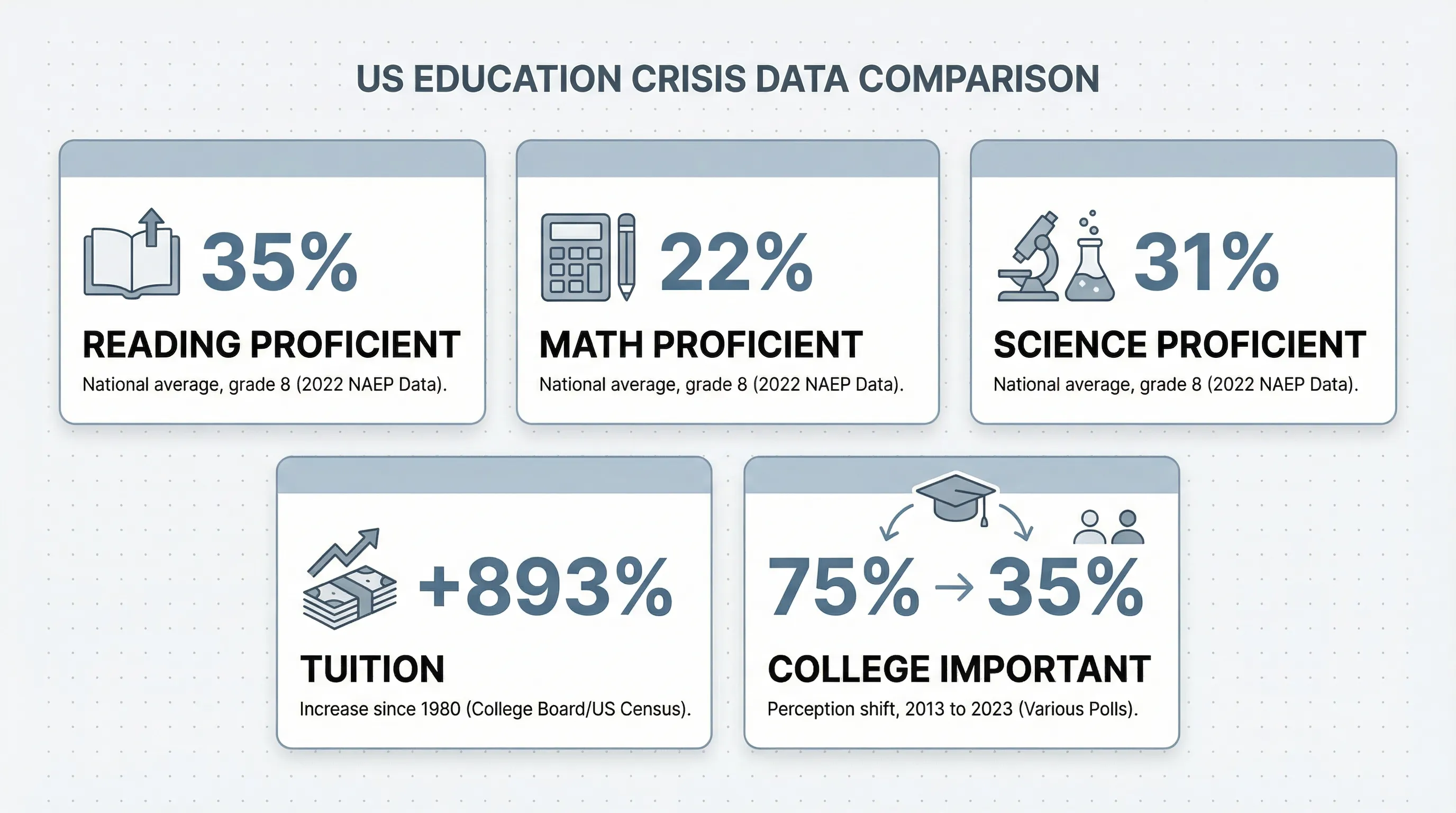
According to NAEP (National Assessment of Educational Progress) data, only 35% of 12th graders reach reading proficiency — down from 40% in 1992. Math is worse, with only 22% meeting standards. Science stands at 31%.
Joe Lamont added an even sharper statistic: half of high school graduates have math skills equivalent to a 99th-percentile third grader.
“Half of seniors in high school today graduate knowing as much math as a 99th percentile third grader.”
— Joe Lamont
The university side is also crumbling. In 2010, 75% of Americans believed college was important for their children; that number has dropped to 35%. Meanwhile, tuition has increased 893% since 1980 — in an era when nearly everything else is getting cheaper.
Peter noted the most ironic data point of all: college graduates experience the longest unemployment duration of any group. When a four-year degree is both expensive and unable to guarantee employment, the system’s sustainability becomes questionable.
These data points form the starting premise for Alpha Schools: if traditional education has already failed in terms of outcomes, is it possible to redesign a school from first principles?
40 Years of Learning Science, Trapped in Classrooms
Joe Lamont argues that the solution isn’t actually a new discovery.
In 1984, educational psychologist Benjamin Bloom published his landmark Two Sigma paper, with a core finding: if every student received one-on-one tutoring, all students could reach the top 2% of academic performance. Not geniuses, not a select group — everyone.
Over the past 40 years, more than 10,000 learning science papers have validated similar conclusions: under the right conditions, children can learn 2 to 10 times faster.
The problem is that these research findings couldn’t be implemented within the traditional classroom model. The cost of one-on-one tutoring was prohibitive for any school system. A single teacher facing 30 students can only advance at the average pace — wasting time for fast learners and leaving slow learners behind.
“Teacher in front of the classroom is the worst way to teach kids.”
— Joe Lamont, quoting learning scientists
Joe noted that when he immersed himself in learning science three years ago, one shocking discovery was that this knowledge had barely been adopted in educational practice. One reason is generational inertia — each generation of parents tends to want their children educated the same way they were, because that’s their only frame of reference.
Alpha Schools’ bet is this: AI tutoring finally makes Bloom’s Two Sigma possible at scale. Every student can receive personalized one-on-one instruction at a fraction of the cost of human tutoring.
A Day at Alpha Schools
Mackenzie Price described a daily routine radically different from traditional schools.
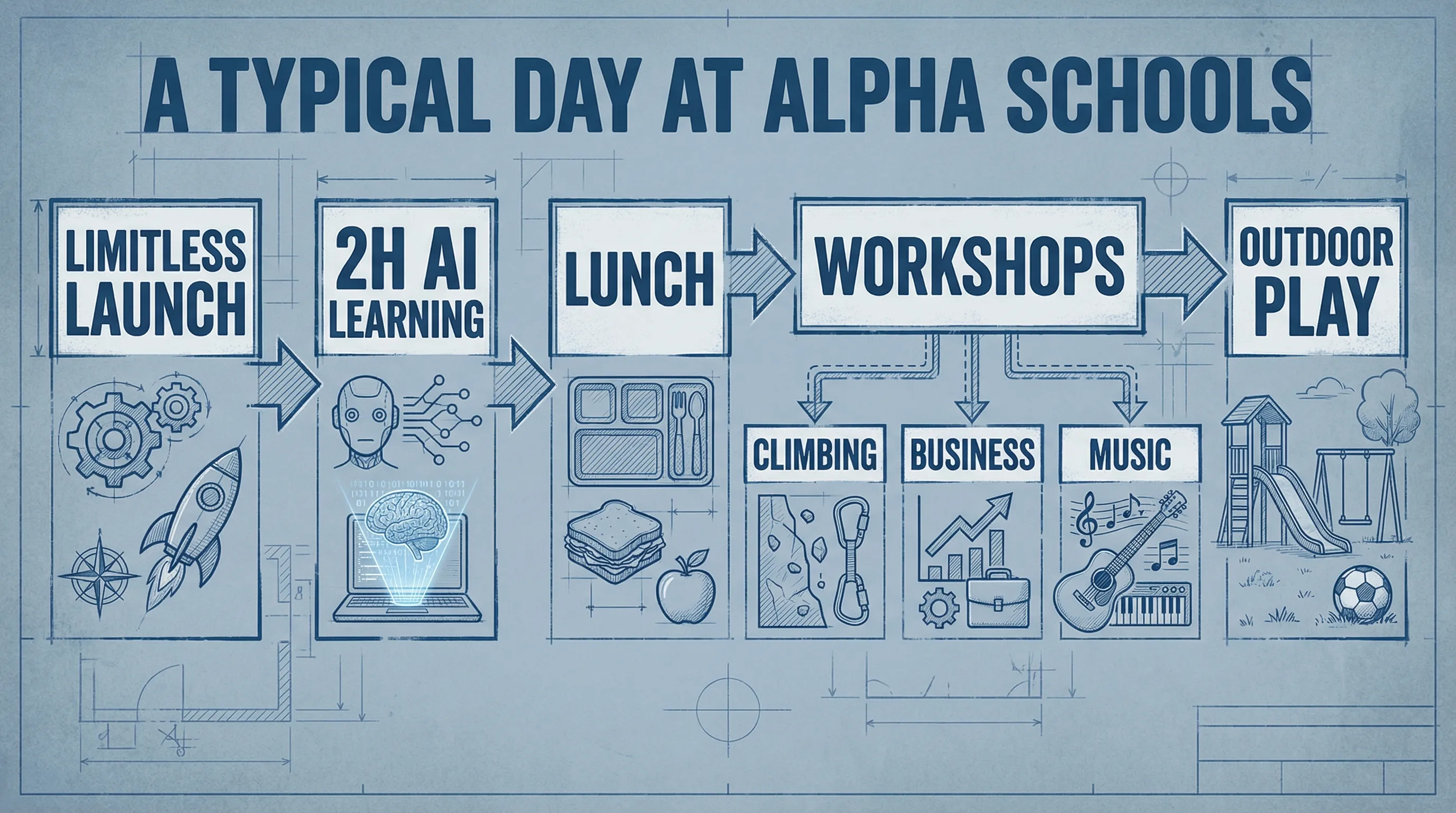
In the morning, students arrive and participate in Limitless Launch — a Tony Robbins-style group activity combining physical challenges with growth mindset training. Then comes the 2-hour core learning session, the only time of day students use computers. They learn on AI tutoring platforms with breaks every 30 minutes.
After lunch, academics are done. The entire afternoon is devoted to workshops: 5-year-olds learn rock climbing or swim in the deep end; high schoolers build real businesses; middle schoolers form rock bands while simultaneously learning brand marketing and music production. Students also get 1.5 hours of unstructured outdoor free play every day. There is no homework.
The school environment doesn’t resemble a traditional classroom either. Mackenzie described it as closer to a WeWork: some kids stand at standing desks, others lounge on beanbags, and some study in tents — because they’ve proven they can meet their learning goals in those settings.
“Two thirds of the Alpha High students sent an email and said, we don’t want to take summer break. Can you keep the school open?”
— Joe Lamont
Joe reported that over 90% of students say they like school in weekly surveys. Even more surprising, 40-60% say they’d rather go to school than go on vacation. Two-thirds of Alpha High students even emailed the school asking to keep it open during summer break.
This stands in stark contrast to traditional schools. Joe pointed to a cognitive mismatch: in the business world, everyone believes in building organizations people love working at; but in education, “you’re not supposed to like school” seems to be the default assumption.
From Lecturer to Guide: A Complete Reinvention of the Teacher Role
Joe Lamont reexamined the teaching profession through an HR lens.
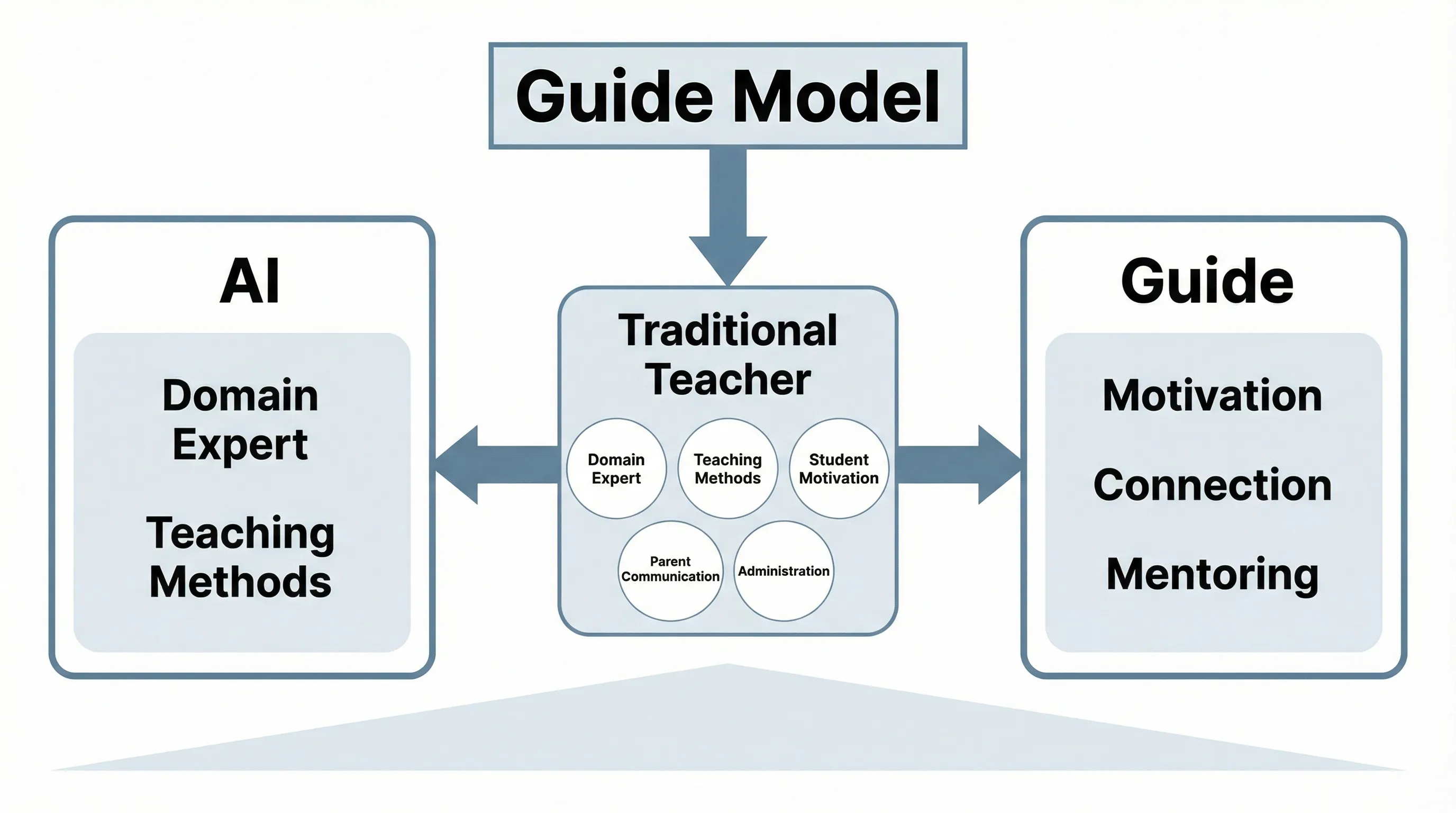
Traditional teachers need to simultaneously possess five skills: domain expertise (7th-grade science), teaching methods (how to convey knowledge to children), student motivation (connecting with and inspiring students), parent communication, and administrative management.
He argued that any HR expert would call this an impossible job description — five entirely different skill sets concentrated in one person. And education’s solution? Underpay them.
“What we’ve decided the way we solve that problem is to underpay them.”
— Joe Lamont
Alpha Schools’ approach is to unbundle the role. The AI tutoring system handles the first two items (domain knowledge and teaching methods), and the freed-up role is redefined as a Guide — focused on motivation, connection, and mentoring.
Guides come from diverse backgrounds: roughly half from traditional teaching, the other half from sports coaching, corporate leadership, and other fields. Their common thread is a talent for inspiring young people. Among them is a 2020 Florida Principal of the Year who, after 14 years in the traditional system, was drawn back to the front lines by Alpha.
Alpha’s starting salary for Guides is six figures. Joe noted that Alpha has received 80,000 applications for Guide positions.
At the kindergarten level, Alpha maintains a 5-6:1 student-to-Guide ratio. Joe acknowledged that AI isn’t good enough yet at helping 4-year-olds learn to read, still requiring human reading specialists. He estimated AI needs roughly 18 more months to handle this function.
Psychologist Dr. Yeager developed Alpha’s Guide training program, centered on the mentor mindset: simultaneously maintaining high standards and high support for students.
Mastery Learning: It’s Not “You’re Not Smart Enough,” It’s “You Need 5 More Hours”
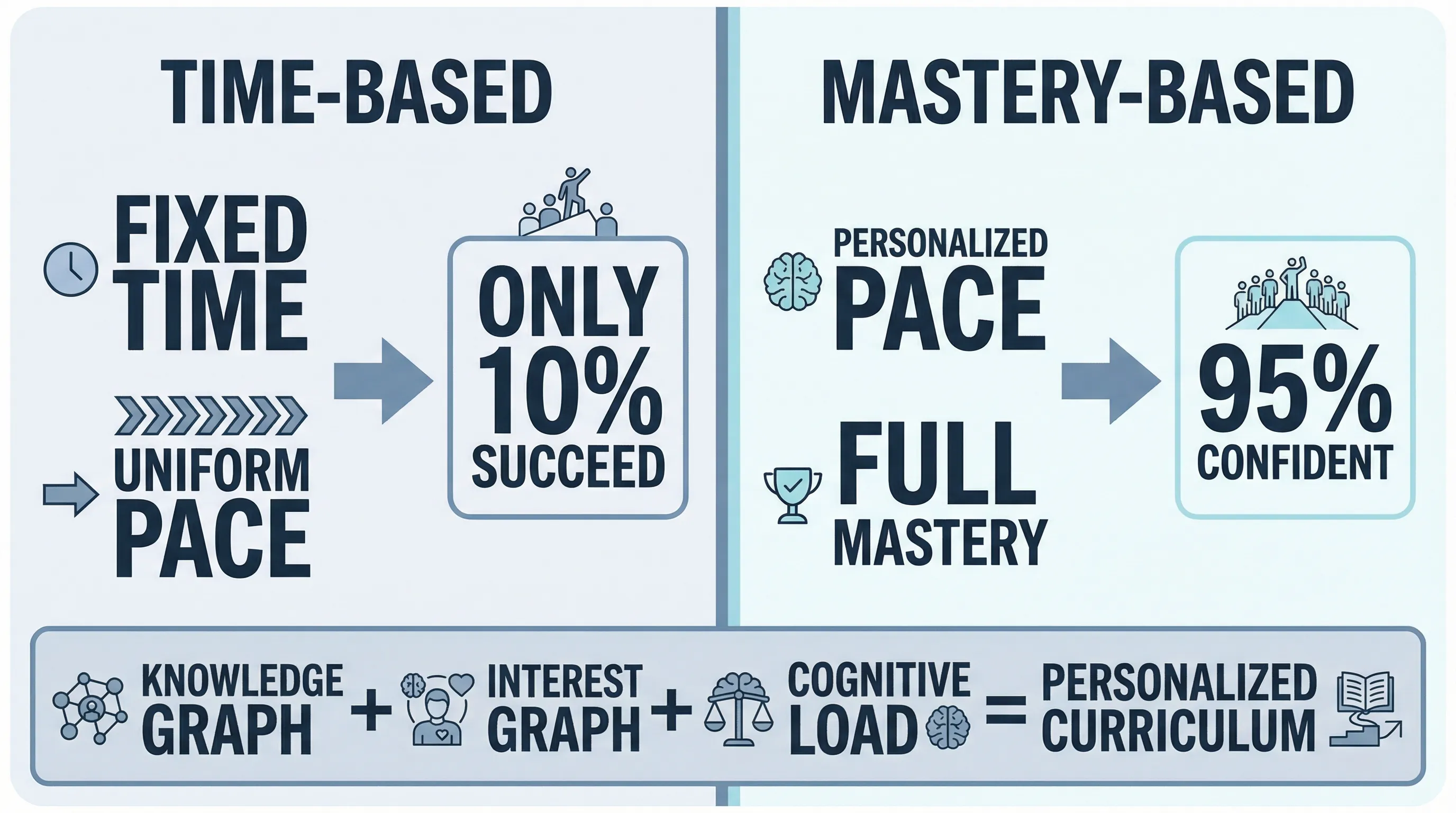
Joe Lamont argues that the core flaw of traditional schooling is its time-based structure — all students spend the same amount of time on the same material, wasting time for fast learners and leaving slow learners behind.
Alpha uses a mastery-based system: students must fully master current-level material before advancing to the next level. It’s not “you scored 70%, move on” but rather “you haven’t mastered this yet, keep practicing.”
This shift transforms students’ self-perception. In the traditional system, academic performance is primarily determined by two factors: IQ and conscientiousness from the Big Five personality traits — meaning only about 10% of children can naturally excel. Under the mastery system, 95% of Alpha students believe they can score perfectly on standardized tests.
“In a mastery based system, everybody can. It’s not about IQ, it’s about effort.”
— Joe Lamont
Alpha’s learning platform tells students: you’re 17 hours away from mastering this concept, or 5 hours. Learning shifts from “I’m not smart enough” to quantifiable time investment.
Under the hood, the AI generates personalized curricula based on three dimensions: a knowledge graph (what you know and don’t know), an interest graph (are you more into Taylor Swift or robots?), and cognitive load theory (your working memory capacity and how many repetitions you need to form long-term memories). The system maintains 80-85% accuracy — too easy means no learning; below 66%, students disengage.
Regarding learning style differences (visual vs. auditory), Joe cited learning science findings: dual-channel encoding (simultaneous visual and auditory input) works best, regardless of individual preferences.
On the screen time controversy, Alpha’s position is to distinguish between “good screen time” and “bad screen time.” Joe was blunt:
“If you give kids ChatGPT in a school, 90% of them use it to cheat.”
— Joe Lamont
Alpha’s solution is to disable all chat functions (including ChatGPT) during morning study time, while encouraging AI tool use during afternoon workshops. In Joe’s words: “If you’re using chat in the morning, you’re probably cheating, but if you’re not using it in the afternoon, you’re probably failing.”
The Data Feedback Loop: Training an Education System with “Reinforcement Learning”
Alpha Schools’ learning monitoring system may be the most technically sophisticated part of the entire model.
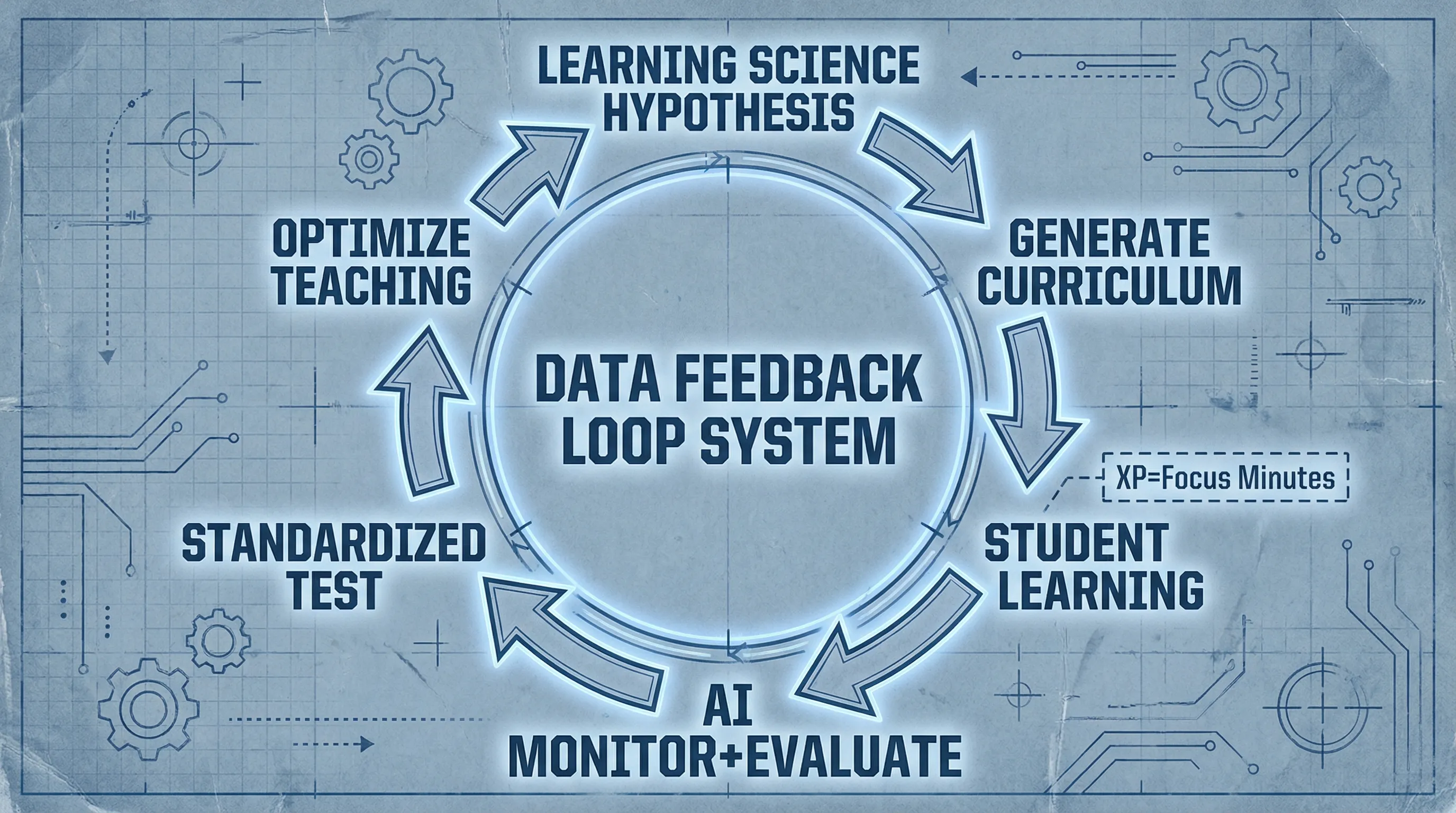
Every minute of student learning behavior is monitored and evaluated by AI. Alpha’s unit of measurement is XP (Experience Points): 1 XP = 1 minute of focused learning. The AI judges in real time whether students are learning effectively, switching to other screens, or zoning out.
Joe admitted that three years ago, they used humans reviewing video footage at night to label data — much like Tesla’s early approach of using human annotation of driving data to train Autopilot. That labeled data trained the automated models now in use.
More critically, there’s a closed loop. Alpha’s learning science team proposes a teaching hypothesis, generates course content, students complete the courses, the system measures learning outcomes, and the teaching method is optimized based on standardized test scores.
Joe gave a concrete example: in August 2025, he promised parents the new math curriculum would improve learning efficiency by 20%. After 8 weeks, grades 4-12 exceeded expectations, but K-3 had problems — too much choice freedom for younger students, who got lost in the options. The team adjusted, and 8 weeks later, K-3 data was back on track.
“We’re the only ones in the world with a closed loop data cycle. It’s reinforcement learning for kids.”
— Joe Lamont
Joe’s ultimate vision is a million-student randomized controlled trial — what he calls pharmaceutical-grade testing. He believes one of education’s biggest problems is that policies are rolled out to 55 million students without any rigorous clinical validation.
From 25 Students to 1 Billion: The Micro-School Expansion Logic
Alpha Schools’ expansion strategy is neither traditional franchising nor chain-store replication.
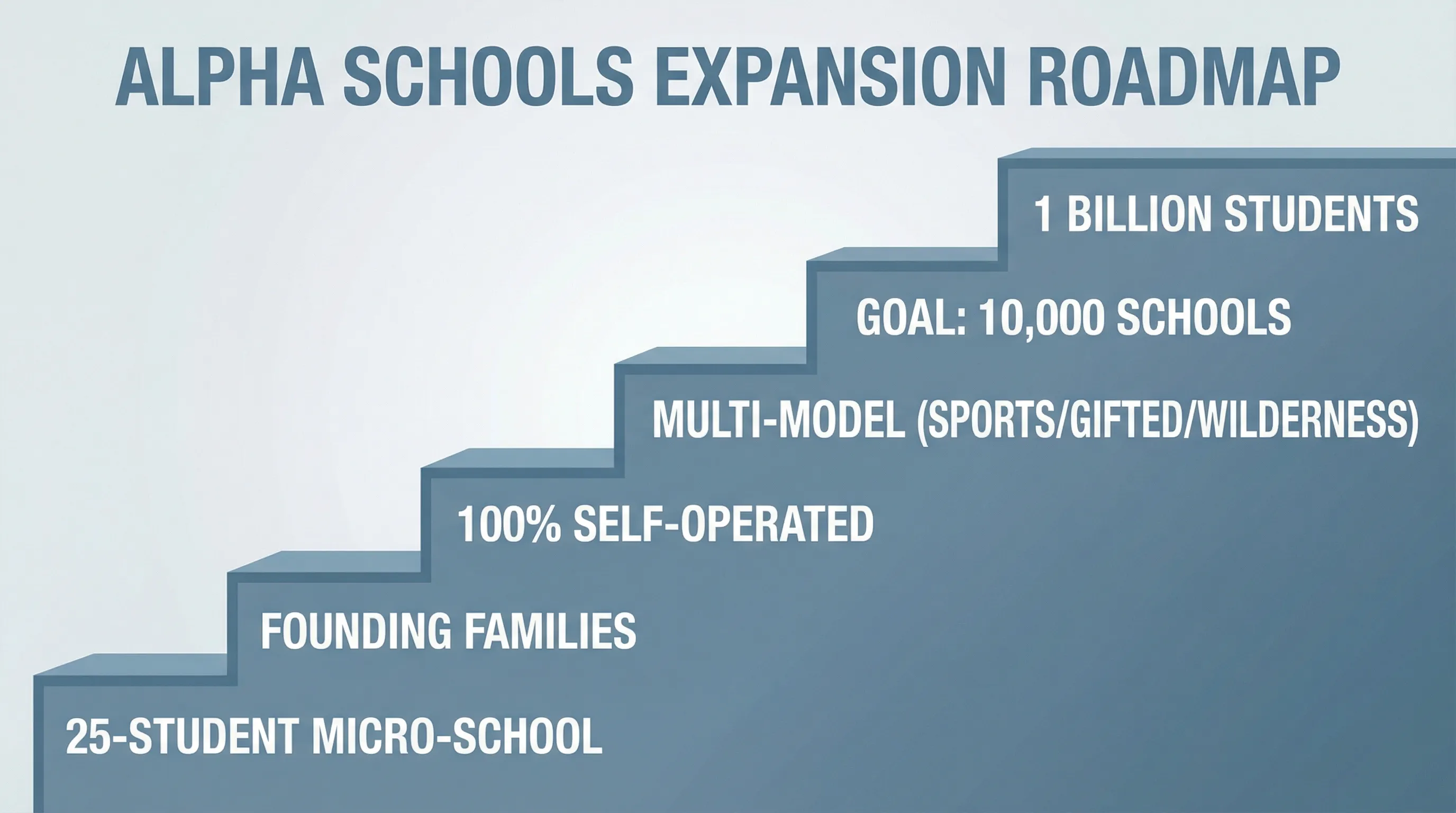
Each new school starts with 25 students, requiring a city’s first wave of “founding families” willing to take the leap. Joe admitted this is the hardest part: once a school has 100 students, everyone wants in; but nobody wants to be among the first 20.
“Nobody wants to be the first 20.”
— Joe Lamont
He summarized two conditions that drive parents’ decisions: a recommendation from a parent they trust, and seeing a child at the school accomplish something their own child cannot.
Alpha is currently 100% company-operated with no franchising. They opened 13 new schools this year. But Joe’s long-term plan is to build 10,000 schools over 20 years. He’s clear that building schools alone can’t reach the goal — how do you reach 1 billion children, especially those outside the Alpha system?
His strategy is to partner with the world’s top game designers and major influencers to bundle “motivation components” with “learning components.” This product is planned for a 2026 launch.
On the public education front, Mackenzie applied for charter school licenses in 10 states and was rejected 9 times. Joe quoted one school board member:
“I was put on this earth to stop people like you.”
— School board member
Alpha has thus abandoned the charter school route for now. The U.S. Secretary of Education visited Alpha, but public education reform may be a second-decade initiative. Education ministers in other countries are also taking a wait-and-see approach — Joe finds this understandable, but hopes pharmaceutical-grade data evidence will break the deadlock.
Meanwhile, Alpha has begun spinning off multiple models: Texas Sports Academy (using Texas education vouchers, parents pay $300/month), gifted-and-talented schools (designed for academically passionate kids, 5x learning speed), wilderness schools, and Montessori schools. The core platform is Time Back — once AI compresses academics to 2 hours, what to do with the afternoon becomes an infinite canvas.
Editor’s Analysis
Guest Positioning
Every participant in this episode has a direct stake in Alpha Schools. Joe Lamont is the largest investor ($40M+) and principal; Mackenzie Price is the co-founder; Peter Diamandis is the founder of Abundance360, of which Mackenzie is a member. The show is also sponsored by Blitzi, an AI software development tool company — the entire episode’s tone naturally favors an optimistic AI narrative.
This doesn’t mean their views are wrong, but listeners should be aware: this episode is essentially a carefully orchestrated product pitch rather than a balanced discussion of AI in education.
Selective Argumentation
“200% learning speed improvement” is the headline claim, yet no explanation is given for how this number is calculated. Is it a time-based comparison (6 hours to 2 hours = 3x)? An achievement-based comparison? Compared to what baseline? Before-and-after comparison of the same group, or cross-sectional comparison of different groups? No details are provided.
“Over 90% of students like school” comes from Alpha’s own weekly surveys, which are subject to social desirability bias — students know they’re being surveyed, especially in an environment that strongly emphasizes a “love school” culture.
“College graduates have the longest unemployment duration” contradicts mainstream labor statistics (BLS). The Bureau of Labor Statistics consistently shows college graduates have significantly lower unemployment rates than non-graduates. Peter may have cited data from a specific time period or using a specific definition, but no source was provided.
Freshman SAT scores of 1410-1500+ deserve scrutiny — the SAT is typically taken in junior or senior year, so “freshman SAT scores” likely refer to practice tests rather than official exams.
The Missing Counterarguments
The episode features virtually no rebuttal from the traditional education establishment. Joe mentioned school board resistance but reduced it to an “immune system response” rather than engaging seriously with the opposition.
The following questions went largely unexamined throughout the episode:
- Selection effect: Families that can afford private school tuition and actively seek alternative education inherently have more educational resources. How much of Alpha students’ excellent performance is attributable to AI, and how much to family background?
- Ethics of AI monitoring children around the clock: The XP system means every minute of a child’s learning behavior is recorded and evaluated. How is this data stored? Who has access? What are the long-term effects on children’s mental health?
- Social limitations of micro-schools: Schools of 25-50 students naturally have narrow social circles. Alpha claims “more socialization” but provides no measurement data on social competency.
- Equity: The stated goal is 1 billion children, but the current model is a premium private school. Texas Sports Academy at $300/month lowers the barrier, but remains out of reach for most families globally.
Claims Requiring Verification
- 35% reading proficiency / 22% math proficiency: Should come from NAEP; specific year and figures need confirmation against the latest report
- 893% tuition increase: Source and methodology need verification (inflation-adjusted or not?)
- “College graduates have the longest unemployment”: Highly questionable, contradicts mainstream BLS data
- 80,000 Guide applicants: Self-reported by Alpha, no independent verification
- $40M+ investment: Joe’s own statement, financial data not publicly available
Key Takeaways
For parents: Whether or not you choose Alpha, the mastery-based learning philosophy deserves attention — letting children learn at their own pace, driven not by grade rankings but by genuine knowledge mastery.
For educators: The Guide model represents a direction worth considering — when AI can handle knowledge delivery and personalized curriculum generation, a teacher’s core value may lie in motivation, connection, and mentoring.
For entrepreneurs: Alpha’s case suggests the real opportunity in education may not be “a better classroom” but rather “what to do with the freed-up time” — when academics take only 2 hours, the afternoon workshops, sports, and entrepreneurship projects become the differentiator.
For everyone: Stay interested, but stay critical. This experiment is worth following, but until independent, large-scale data validation from third parties is available, Alpha Schools’ claims remain an exciting hypothesis, not a proven fact.
Based on Moonshots #233
If you found this helpful, consider buying me a coffee to support more content like this.
Buy me a coffee