When Everyone Can Command an AI Army, What Skill Matters Most?
💡 A great analysis worth sharing. Here’s the original content.
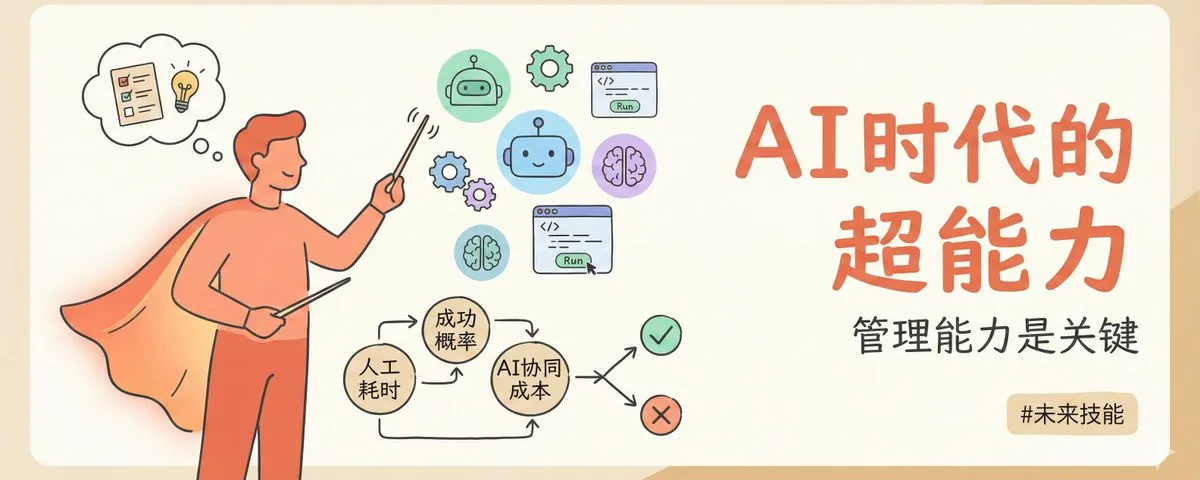
I’ve noticed something: people who are good at using Coding Agents share a common trait — they’re skilled at defining problems, decomposing them, and evaluating results. These people usually have technical management experience.
What surprised me is that many non-technical product managers and executives are also doing well with Agent-based programming. They can’t handle the technical details yet, but their output is already quite impressive.
What do they have in common? Management experience. They’re not technical experts, but they’ve accumulated rich experience in their respective fields. They can skillfully define problems, specify deliverables, and spot when something’s off. The frameworks they’ve built through work directly become their prompts.
There are already many AI Agents available today, and there will only be more in the future. The question is: what skills do we need to master these Agents?
Management ability is undoubtedly the key. We used to manage people; in the future, we’ll also manage Agents.
1. Should You Delegate to AI?
Doing everything yourself or delegating everything to AI are both extremes.
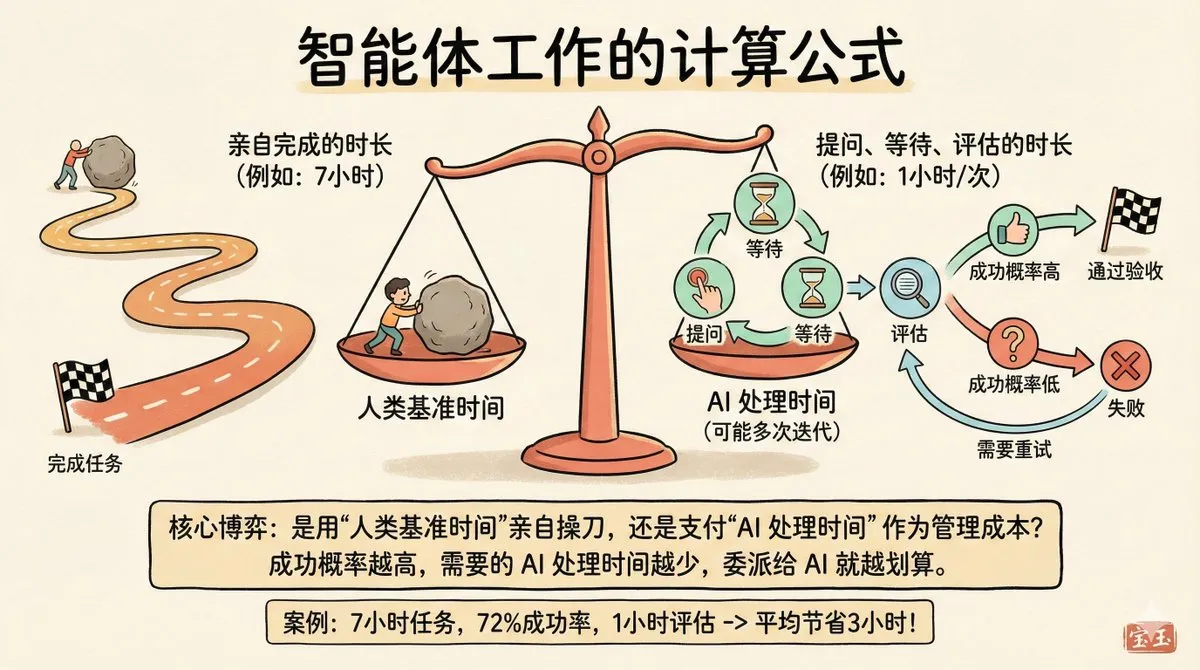
How do you make a scientific judgment? Wharton professor Ethan Mollick proposed a formula in “Management as AI superpower” based on three variables:
- Human time baseline: How long would this task take you?
- Success probability: The chance AI produces an acceptable result on the first try
- AI collaboration cost: Total time for writing prompts, waiting, and reviewing results
Note that many people only count generation time, forgetting the time for writing prompts and reviewing output.
For example: a task takes you 1 hour, AI produces results in minutes, but reviewing takes 30 minutes. Delegation only pays off when AI’s success rate is very high. Otherwise, generation plus review takes longer than doing it yourself.
But what if the task takes you 10 hours? Then it’s worth spending a few hours going back and forth with AI — provided AI can produce acceptable results.
2. How to Improve Success Rate?
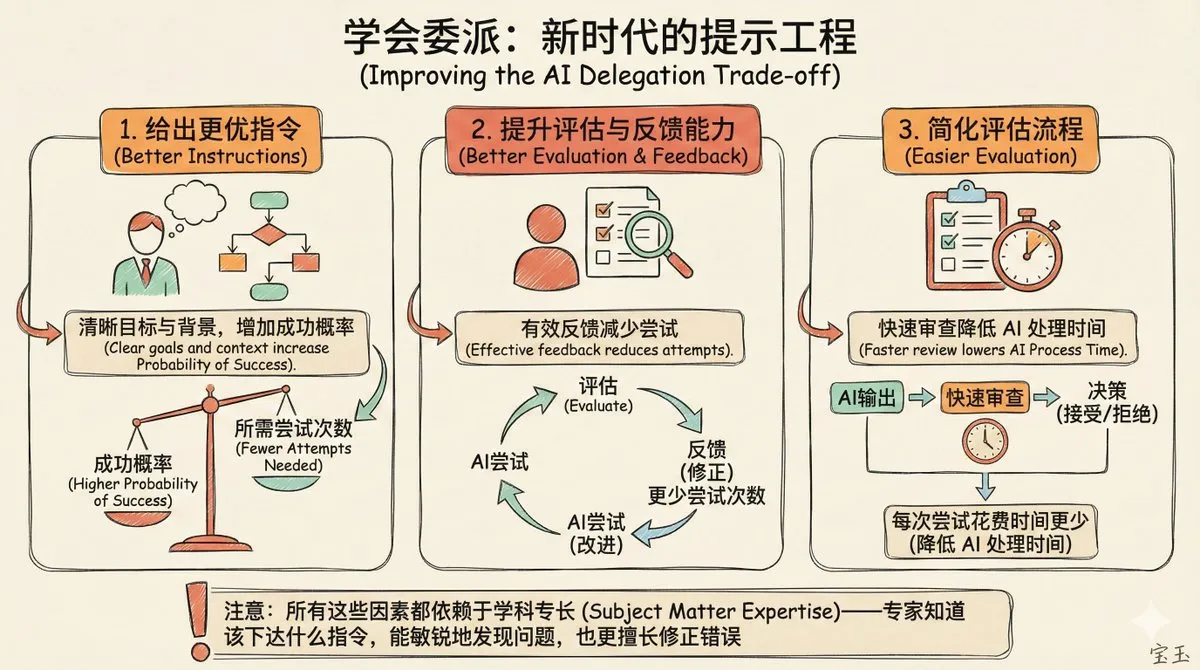
Among the three variables, success rate is the most critical controllable factor. Professor Mollick suggests three directions:
Better instructions — Clear goals, defined boundaries, specific completion criteria. AI, like people, performs more reliably with clearer instructions.
Better evaluation — The faster you can identify what’s wrong, the faster you can correct it.
Better feedback — Getting AI to fix things in one round of feedback beats going back and forth three or four times.
These three things share a common thread: they’re all related to domain expertise.
Many people assume the AI era doesn’t require learning domain knowledge — this is probably wrong. Experts know what to ask for, can spot what’s wrong, and know how to correct it. When people say AI isn’t as magical as claimed, it’s usually not that AI can’t perform — it’s that you don’t know what to ask for or whether the result is correct.
3. How to Better Delegate Tasks?
Many people complain AI is dumb, but they might not have learned how to delegate tasks. Delegating to AI is very similar to delegating to humans.
If you tell a subordinate “make me a fun game,” they’d be completely lost. But if you say “make an 80s-style adventure game, EGA pixel art, 15-minute playthrough, with 3 puzzle levels” — that’s executable.
This is fundamentally management knowledge that existed before AI. Software development has PRDs, film directors have shot lists, architects have design intent documents, and the US Marine Corps has the five-paragraph order.
Professor Mollick suggests that to get reliable work from AI, you need to think like a product manager or general contractor. A good instruction should include:
- Goal and motivation: What are you trying to achieve? Why?
- Authority boundaries: What can be improvised? What must not be changed?
- Acceptance criteria: What does “done” look like?
- Intermediate deliverables: Don’t wait for the final product — show me an outline or draft first
- Self-check list: Before submitting, verify these specific points
Acceptance criteria are especially important. When I ask AI to write code, I don’t just explain how to do it and what code to reference — I also specify how to test and verify. This way, the Agent doesn’t just finish and stop; it tirelessly validates over and over until it passes — saving me from manually testing and telling it what’s wrong.
For example, yesterday I had Codex implement a feature to publish drafts to a WeChat Official Account. I set up the API Key, gave it a document, and told it to test the publishing itself after implementation. A while later, I checked and it was done — no back-and-forth testing needed.
4. How to Build AI Management Skills?
A few suggestions:
Start with awareness
The most important thing about management isn’t specific standards — it’s realizing that not everything needs to be done personally; many things can be delegated. Previously, you might have needed a management position to practice this. Now you can delegate to AI anytime.
Collaborate more with AI
Even if you lack management experience, that’s okay. Tools like Claude Code’s Plan mode help force you to create proper specifications. Writing specs is a great way to exercise design thinking and clarify your thoughts — especially when AI helps you write them and you focus on reviewing and providing feedback.
Practice more
Management experience requires domain knowledge, and domain knowledge doesn’t appear from thin air — it requires extensive practice. Programming means building projects hands-on, video means hands-on editing, content creation means lots of writing. There are no shortcuts.
Final Thoughts
Execution used to be scarce. Knowing how to code, design, or write reports — those skills were valuable.
Now AI can execute more and more tasks. What’s becoming scarce is “knowing what to execute”: clearly defining problems, judging output quality, knowing what “done” means.
Management skills are becoming the superpower of the AI era.
Appendix
Management as AI superpower
- Original: https://www.oneusefulthing.org/p/management-as-ai-superpower
- Translation: https://baoyu.io/translations/2026/01/29/management-ai-superpower
Original author: Baoyu (@dotey) | Source: https://x.com/dotey/status/2017036647402017033
If you found this helpful, consider buying me a coffee to support more content like this.
Buy me a coffee