Naval Ravikant: Wealth Is What Earns While You Sleep — The Almanack 5th Anniversary
Guest: Naval Ravikant (Founder of AngelList, angel investor) Host: Eric Jorgenson Show: Smart Friends — The Almanack of Naval 5th Anniversary Special Duration: 3 hours 35 minutes, 53 chapters Source: YouTube Full Transcript: Speaker-labeled full transcript
Naval Ravikant is the founder of AngelList and an early investor in over 100 companies including Twitter, Uber, and Yammer. A long-form Twitter thread he published in 2018 was later compiled by Eric Jorgenson into The Almanack of Naval Ravikant, distributed for free and read by over a million people worldwide. Five years later, the two sat down for an entire day and recorded more than four hours of conversation.
This episode has no fresh business cases, no breaking tech announcements. What Naval is doing is something different: revisiting the premises of his original claims, now that the results are in. What exactly is wealth? Can judgment be learned? Is happiness a skill or a state? Will AI replace judgment, or only amplify information?
Here are the parts I found most worth paying attention to.
David Deutsch Gave Wealth a Deeper Definition
Naval’s most-quoted definition — “wealth is what earns while you sleep” — is the one he now says isn’t sufficient.
“My definition was very focused by my desire to make money. But David Deutsch’s definition is deeper and more philosophical, and it scales really nicely all the way from a civilization down to a single individual.”
David Deutsch (author of The Beginning of Infinity, quantum computation pioneer) defines wealth as the set of physical transformations that you can affect — that you can bring into existence. A backhoe is wealth because it lets you reshape terrain. A GPU cluster is wealth because it lets you run AI models. A reputation is wealth because it lets you influence others’ behavior.
The key insight: knowledge is the biggest multiplier, not capital. Naval says if you removed Elon Musk from SpaceX, that company’s wealth would evaporate — not be redistributed, but disappear. Because wealth isn’t in the factory, isn’t in the metal. It’s in the knowledge of how to transform the world. Marx got this completely wrong: value isn’t in capital. It’s in the people who know how to use it.
This also explains why Naval’s own earning power has grown steadily with age. He became well-known not for his startups, but for “thinking things through and articulating them in a certain way.” That’s knowledge — and knowledge compounds.
The practical implication: the core strategy for building wealth is expanding the range of physical transformations you can affect, whether through capital, code, media, brand, or simply higher knowledge density.
Specific Knowledge + Leverage + Time = The Compounding Formula
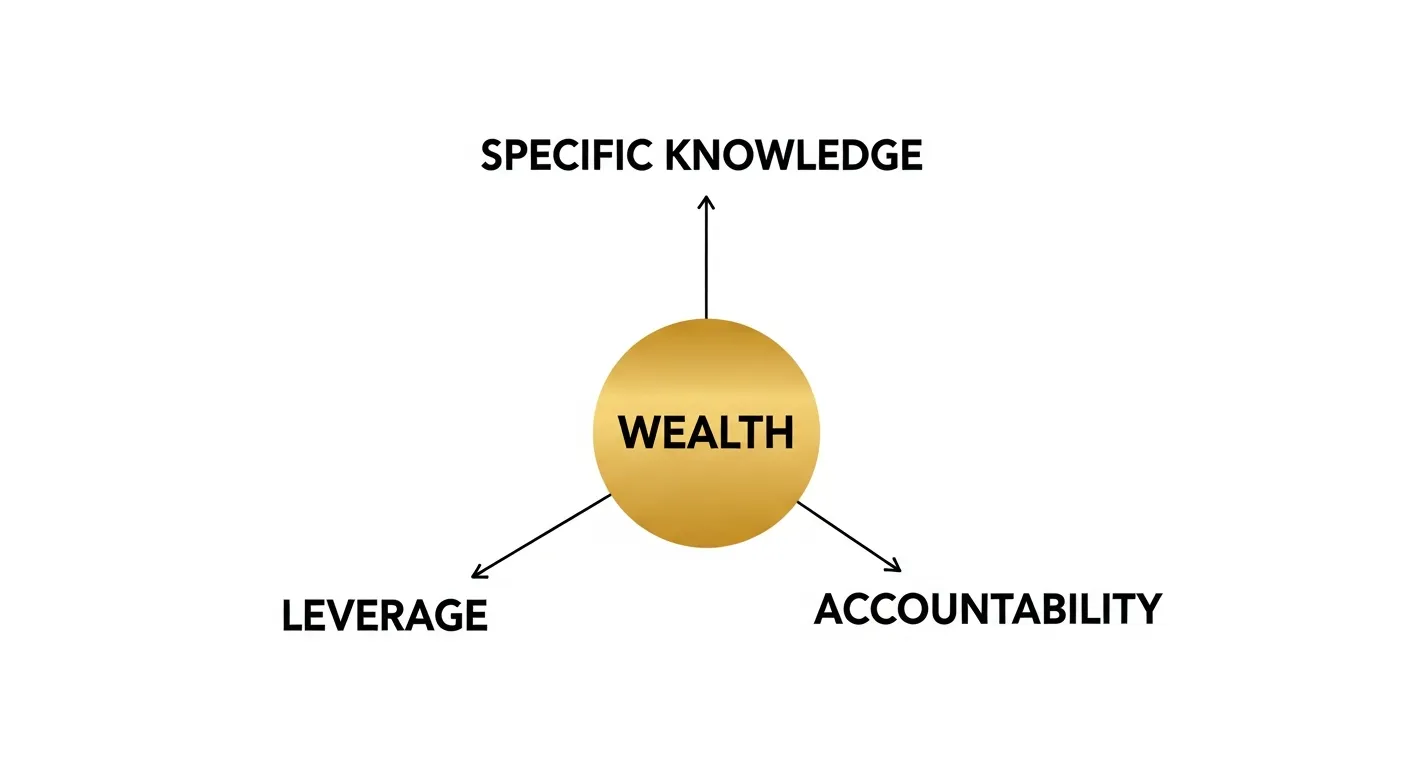
In the original Almanack, Naval emphasized three types of leverage: labor, capital, and the “permission-less leverage” of code and media. Five years later, he’s adding more granularity.
When Eric asked about the “highest leverage solution,” Naval’s answer was telling: he said he has always been optimizing for maximum output from minimum input — not just in business, but in health, relationships, and daily wellbeing. That’s not laziness; it’s a systematic pursuit of efficiency.
“Laziness is a form of leverage efficiency. I don’t want to be a drone just consuming myself. I want time to focus on health, spend time with my children, educate myself.”
Concrete asset types that can earn while you sleep: capital invested in businesses; code (a 3D printer working while you sleep); GPU clusters (computing while you sleep); organizations and processes (people operating in other time zones while you check on goals); intellectual property (an article circulating and paying dividends); a brand (your name working for you by itself).
He didn’t argue any single leverage type is best. The more fundamental point: specific knowledge has to come first, or leverage has nothing to amplify. Specific knowledge is what you’ve accumulated by following genuine curiosity — hard for others to replicate because to you it doesn’t feel like work.
Judgment Comes from Taste, Not the Accumulation of Experience
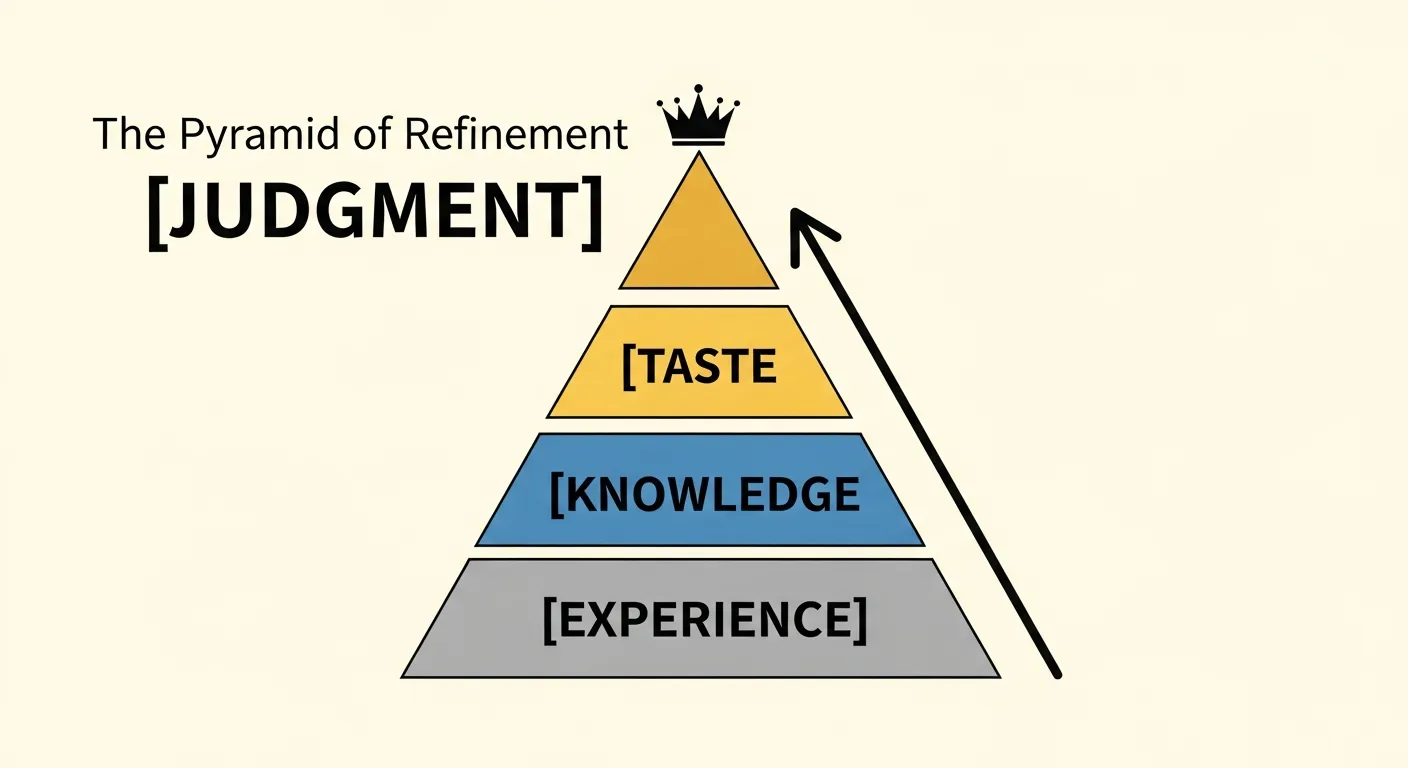
This is the most systematically developed section of the episode, and the most counterintuitive.
Naval mapped out the learning progression: start with specific experiences, build to more general knowledge, tie that to values, and improve judgment. In the age of infinite leverage, judgment is the most valuable thing. Direction matters more than execution. He used an Apple CEO example: managing a trillion-dollar company, a CEO who’s right 80% of the time versus one who’s right 85% of the time is worth billions more per year — because you’re steering a trillion-dollar ship, and direction outweighs any single execution.
“Judgment comes through experience and reflection. There comes a point where your judgment is so good that you cannot even articulate it. That’s when it’s called taste.”
Taste is judgment’s highest form. Rick Rubin has taste about music. Steve Jobs had taste about products. Leading AI researchers have taste about which experiments are worth running — they can’t fully explain it, but their intuitions are statistically right.
Naval described three stages of judgment development: stage one, you reason through every decision using logic; stage two, your subconscious begins to enter, and processing speeds up; stage three, your whole body responds — no reasoning needed, this is taste. At that point, he says, you’ve “completed” that domain, even though it will continue to improve.
The practical implication: if you want to develop judgment in any domain, the shortest path is making concrete decisions repeatedly, then honestly reflecting on outcomes — not “accumulating experience” generically, but deliberately asking after each decision: why did I judge this way, and what did the result prove or disprove?
AI Is the Ultimate Information Retrieval Lever, but It Has No Judgment
Eric asked directly: “Does AI have judgment?”
Naval’s answer was simple: no.
“AI has incredible information retrieval capability. It can cross-correlate all human knowledge, and for solved problems it can give you the conventional correct answer, which will be correct in most cases. But for anything creative, genuinely new, or requiring judgment at the edge — AI won’t give you that.”
He frames AI as the “ultimate leverage information retrieval tool”: for legal questions it can read all the texts and return current interpretation; for medical questions it gives you textbook answers. But in a highly specific situation, or doing something nobody has done before, AI can only return the average answer.
The clearest distinction Naval makes: AI gives everyone “the AI answer,” so the AI answer itself has no alpha. Edge comes from two places: being an earlier and more skilled user of AI than others (diminishing advantage); and building genuine specific capabilities in the domains AI can’t reach — creativity, judgment, edge cases.
His widely-cited quip: it’s not that AI will replace software engineers — it’s that AI will let software engineers replace everyone else. The relevant trait isn’t writing code; it’s being a structured, logical systems thinker who can use AI to solve more and more categories of problems. Mark Zuckerberg paying $100 million packages to recruit top ML engineers is the proof.
For most people, the practical advice is: use AI for problems that have already been solved, and redirect the freed effort toward the work that requires genuine judgment. Run both in parallel, not as opposites.
Happiness Is a Mental Skill, Not Luck or a Stable State
This is probably the section where Naval talked most candidly, and most at length.
He began by admitting this topic is hard for him to discuss, then shared what he called his “latest thinking” (with his own parenthetical note that it could change): happiness might not exist as a thing.
“Happiness is a construct of the mind. It’s an idea. You have a thought that says ‘I’m happy now,’ and when that thought disappears, there’s nothing there. The self is itself just a thought.”
This comes from the Buddhist “no-self” tradition, but Naval expresses it in contemporary terms: when you identify with the “happy thought,” you create a “me that is happy”; when the thought disappears, the happiness disappears too. When the “unhappy thought” arrives, you create a “me that is unhappy.” The whole structure is assembled from a series of thoughts coming and going.
Chronic unhappiness is a form of ego trip, not a genuine state. Acute unhappiness is real and useful — pain demands a response. But chronic unhappiness is something else: you want to feel more important, you want to feel persistent, you have an identity that requires unhappiness to maintain itself. “The more you think about yourself, the less happy you’re going to be.”
His practical conclusion: what he now pursues isn’t happiness but a state of “being okay with things as they are.” The conditions that get him there: fewer desires, consciously chosen; doing things for reasons larger than himself; not thinking too much about himself.
He also cited Schopenhauer: boredom reveals the emptiness of existence — when all your desires are momentarily satisfied and you’re just sitting there, boredom arrives immediately, because existence itself is somewhat empty. The pessimistic reading is that existence is meaningless. The optimistic reading is that your mind has become addicted to stimulation. The purpose of meditation isn’t enlightenment — it’s developing self-observation, which lets you catch your mind doing things not in your long-term interest, and reset.
Forgiveness Is Reinterpreting the Past, Not Forgetting It
This appeared in a discussion of pain and anger, and Naval gave it a very concrete operational definition.
“Forgiveness is not saying what happened was okay. Forgiveness is you reinterpreting what happened. You say: maybe it wasn’t entirely their fault. Or: it was their fault, but I’m genuinely forgiving them anyway — so that it stops occupying my mind.”
The motivation is entirely self-interested: anger spikes cortisol, activates adrenal glands, ages you, makes you feel terrible. The traditional vices and sins carry the punishment directly on the person experiencing them. Forgiveness is about clearing your own mental space, not about the other person.
This is consistent with his broader argument about unhappiness: many things we think are happening in the external world are actually being constructed internally. Anger doesn’t need an external event to sustain itself — it only needs you to keep identifying with the angry thought.
The Awakened Have Become Visible for the First Time
Naval says he has personally verified close to a dozen people he considers genuinely enlightened.
In the past, you would encounter roughly a thousand people in your lifetime — the odds of finding “the current living Buddha” were nearly zero. The internet changed this: there are now dozens of these people on YouTube and Twitter. Naval has even hired some of them as personal coaches.
His description of enlightenment is deliberately de-romanticized:
“The word enlightenment is terrible. It implies you end up in some perfect state where you’re always happy. It’s not that at all. It’s just that you disappear, and something is left there operating.”
He posed a comparison: would you rather face an enlightened Terminator or an ego-wrapped one? The ego-wrapped one is easier to manipulate — it has guilt, self-doubt, anger, and reduced efficiency. The enlightened one is the true Terminator. His point: eliminating the self doesn’t weaken you. It makes you more effective. Your goals will change, but your effectiveness increases.
“No one chooses to go back to being less happy.” — his exact words.
He also noted enlightenment’s binary nature: there’s no progress bar, no 50% enlightened. It’s binary. He maintains a “seekers list” on Twitter — people who are genuinely exploring, not necessarily enlightened, but authentic searchers.
Your Goal in Life Is to Find the People and Work That Need You Most
This may be the most underrated insight in the entire episode.
Naval begins with an evolutionary argument: in the past, you lived in a tribe of a few hundred people, and the cost of rejection was enormous — reputation was entirely local, you had to fit in. Now it’s the exact opposite.
“It’s a search function now. You can fly anywhere in the world. You can enter almost any career. You can spend time with almost any set of people. The opportunity is infinite — and that’s terrifying.”
Then he proposes a framework: there’s an exploration phase and an investment phase. You cannot skip either one.
All the benefits in life come from compounding, and compounding requires investment. But if you never explore, you invest in the wrong thing. Many people spend three weeks finding a job and stay in it for five years — too little exploration, too much investment. Others explore until age 50 without committing — too much exploration, too little investment.
Find the person, business, or project that needs you most, then invest deeply. This isn’t just career advice — it’s a general framework for location, relationships, and domains of knowledge. In the exploration phase, rejection isn’t failure; it’s like a bad Google search result. Hit back and search again.
He added a criterion for finding the right thing: look for work that feels like play to you and looks like work to others. When you find it, invest. When you start investing, don’t pull out too early — compounding takes time.
Truth Makes the Interior Grow Quiet
This is the most poetic section of the episode, and the most concise.
“The closer you get to truth, the more silent you become inside. That’s deliberately chosen — because when you know what is true, you suffer less and spend less time ruminating about falsehoods.”
Most thoughts running through your mind, Naval says, are about uncertain or false things. Buddhists would say the most fundamental falsehood is the notion of the self — a poorly-defined, partially physical, partially mental construct that seems to persist across thoughts. When you look for it carefully, it’s very hard to locate.
The more true-or-false questions you resolve, the less mental noise. All the way to genuinely wise people — fully silent inside, because they’ve seen through the illusion of the self.
Practical suggestion: meditation isn’t about achieving enlightenment. It’s about developing the capacity to observe yourself. Notice when your mind is doing things that aren’t in your long-term interest. Then ask: is this true? Is this really worth suffering over?
He also said something that stayed with me: “I can manufacture love at any time.” Being in love — with a person, with a mission, with an idea — is better than being loved. Because being in love is something you can actively choose, while being loved depends on external conditions you can’t control. “Everyone needs to find something they love more than themselves — their family, their mission, their religion. Otherwise, it’s going to be a miserable life.”
Editor’s Analysis
Positional Bias
Naval is a beneficiary of wealth and free markets, and his defense of wealth creation is considerably more developed than his discussion of wealth distribution. His estimate that roughly 40% of US GDP is government-controlled, with an implied argument that this is too much, is itself a positional claim. His happiness philosophy draws heavily from Buddhism and Stoicism — frameworks that have meaningful scope conditions: they fit most naturally for people whose basic material needs are already met. Naval himself acknowledged “having money does help,” but this caveat sometimes disappears in his broader claims.
Selective Argumentation
On “AI lacks judgment”: Naval’s framing is accurate for the current state of the technology, but he projects current conditions forward without engaging with how the boundary might shift as model capabilities improve. What he said about AI in 2018, in 2025, and what is true today are three different things.
His claim that “only the individual ascends — enlightenment doesn’t happen in relationship” was specifically flagged by Eric as a point of genuine disagreement. Naval didn’t substantively respond to the challenge and moved to other topics.
Counterpoints Worth Noting
On knowledge as the multiplier: This framework is persuasive at the elite level, but critics — from left-leaning economists to institutional economists — would argue that knowledge transformation depends on infrastructure, social trust, and legal systems that are collective products. Naval’s framework underweights the contribution of institutional conditions.
On happiness as a learnable skill: Cognitive behavioral therapy and positive psychology broadly support this direction. But neuroscience research shows some happiness baselines are influenced by genetics and neural architecture — not purely learnable. For people with clinical depression, “think less about yourself” is far from sufficient.
On the binary nature of enlightenment: Naval himself acknowledges he isn’t enlightened. His conclusions are based on observing about a dozen people — a sample size that doesn’t support universal claims about the nature of awakening.
Facts to Verify
- David Deutsch’s original definition of wealth — which book? Is Naval’s rendering accurate? — Need to check against Deutsch’s text
- Naval’s “seekers list” on Twitter — is it currently publicly accessible? He says it’s open, but no link was provided
- “The more you think about yourself, the less happy you’ll be” — is this supported by behavioral science research?
Naval’s core recommendations:
- Your earning power grows from accumulated knowledge; knowledge is a more fundamental form of wealth than capital
- In the age of infinite leverage, judgment — and its highest form, taste — is the most valuable skill
- Use AI for problems that already have answers; direct the freed energy toward judgment and creation
- Explore widely, then invest deeply; you cannot skip either phase
- Happiness isn’t a state delivered by external conditions; it’s a mental skill that can be practiced
- Forgiveness is about clearing your own mental space, not the other person
- Relax. Do it merrily, go gently. Victory is assured.
This article is based on the Smart Friends Almanack 5th Anniversary Special. The complete speaker-labeled transcript is linked at the top.
If you found this helpful, consider buying me a coffee to support more content like this.
Buy me a coffee