Perplexity Computer Review: 19 Models in One System — AI Agents Enter the Orchestration Era
On February 25, 2026, Perplexity released something called Computer.
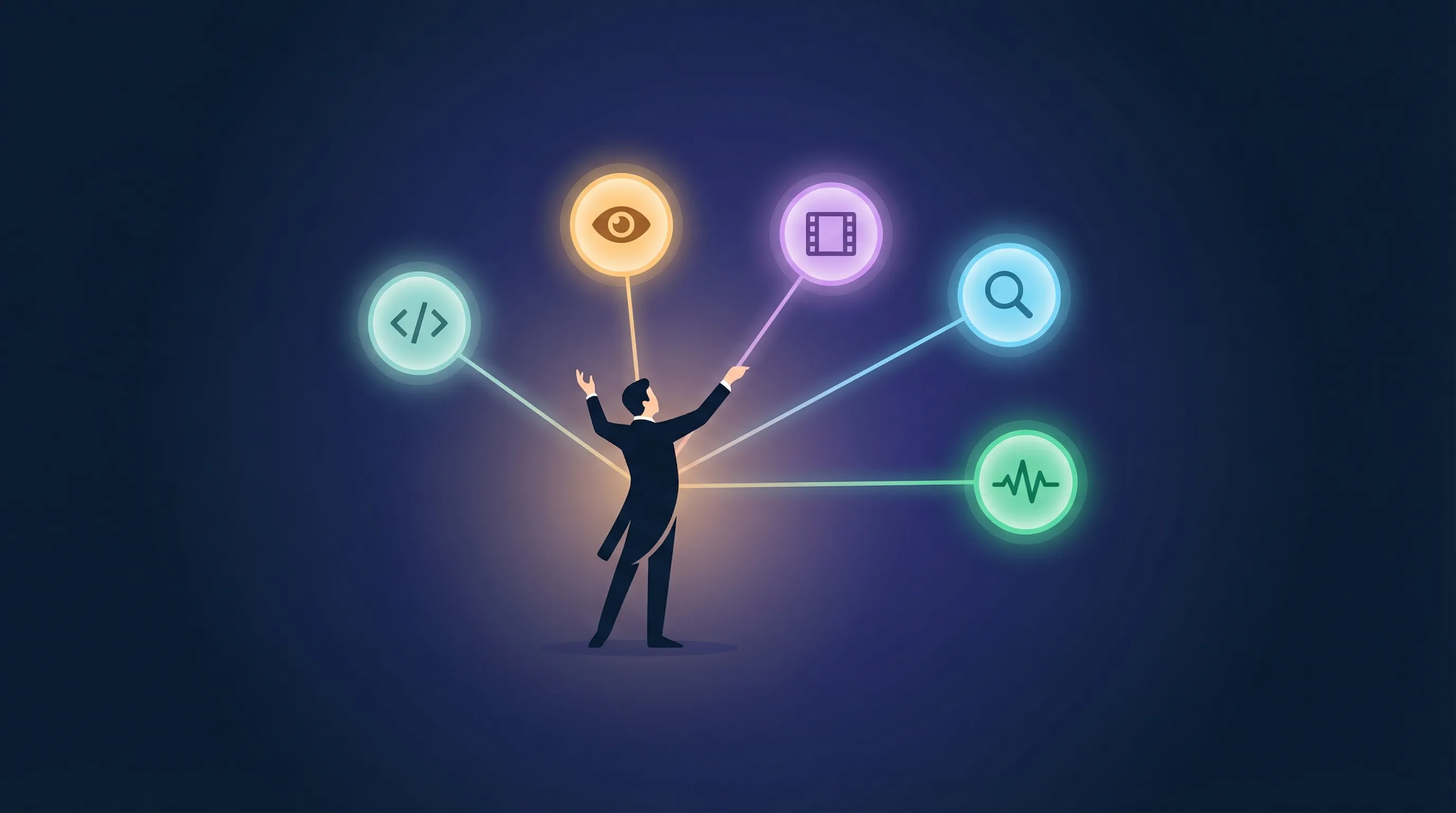
Not another chatbot. Not a search feature iteration. It orchestrates 19 AI models simultaneously — Claude Opus 4.6 for reasoning, Gemini for deep research, Nano Banana for image generation, Veo 3.1 for video, Grok for lightweight tasks, and GPT-5.2 for long-context and full web search.
CEO Aravind Srinivas quoted Steve Jobs: “Musicians play their instruments. I play the orchestra.”
That metaphor captures Perplexity Computer’s positioning precisely — not making instruments, but conducting them.
What Perplexity Computer Actually Is
To understand Computer, you need Perplexity’s three-stage progression: Chat → Agent → Computer.
Chat answers questions. Agent (the former Comet Assistant) completes individual tasks. Computer takes over entire workflows. You describe a goal, it breaks it into subtasks, spins up specialized sub-agents, executes them in parallel, and only pauses when human approval is needed — publishing a site, pushing code, sending emails, that kind of irreversible action.
Key features:
- Multi-model orchestration: 19+ models assigned by capability, no single-model dependency
- Persistent memory: Retains context across sessions, no need to re-explain project background
- Sandboxed execution: Each task runs in an isolated environment with a real file system and browser
- Human checkpoints: Pauses before sensitive operations, follows least-privilege principles
- Long-running workflows: Can persist for weeks or even months
Pricing: Max subscribers ($167/month) get first access with 10,000 monthly credits and a 20,000 bonus credit grant at launch. Pro and Enterprise access coming later.
Side-by-Side: Five Companies, Five Different Bets
Perplexity isn’t the only company building AI agents. Putting the major players together, the landscape becomes clear:
| Dimension | Perplexity Computer | Claude (Computer Use + Code + Cowork) | ChatGPT Atlas | Google Gemini | Microsoft Copilot Studio |
|---|---|---|---|---|---|
| Model strategy | 19+ models orchestrated per task | Single model family (Opus/Sonnet/Haiku), deeply optimized | Single model (GPT-5.2), generalist | Single model family (Gemini 3), strongest multimodal | Multi-model access, enterprise RPA framework |
| Execution environment | Cloud sandbox (file system + browser) | Desktop + terminal + browser + enterprise SaaS | Browser (Atlas) + API | Mobile + cloud + search | Enterprise workflows + Office 365 |
| Core advantage | Model-agnostic, best model for each task | Developer ecosystem (MCP) + code execution + enterprise plugins | 800M user base + browser entry point | Strongest multimodal benchmarks + mobile exclusivity | Existing enterprise clients + compliance |
| Security | Sandbox isolation + human checkpoints + least privilege | Permission system + audit logs + RSP v3.0 | User control + manual agent mode activation | Google security framework | Enterprise compliance + Azure AD |
| Pricing | Credits-based ($167/mo Max) | API usage-based + Pro $20/mo + enterprise custom | Plus $20/mo + Pro $200/mo | Free tier + Gemini Advanced | Enterprise licensing |
| Target users | Individuals and teams needing cross-tool automation | Developers + knowledge workers + enterprises | Mass consumers + browser users | Mobile-first users + search users | Enterprise IT departments |
But tables only show “what.” The more interesting question is “why” — each company is betting on something fundamentally different.
Each Company’s Bet
Perplexity: The Only One Without Its Own Model
This is the most counterintuitive play. Every competitor is furiously training their own foundation models — Anthropic has Claude, OpenAI has GPT, Google has Gemini, Microsoft piggybacks on OpenAI. Only Perplexity says: I don’t need my own model.
Their bet: Models will commoditize. The orchestration layer is where the value lives.
As Srinivas argues, no single model is optimal for every task. Rather than betting on one model winning, build the platform that always uses the best one. If Claude Opus 4.6 is today’s best reasoner, use it. If something better comes along tomorrow, swap it in.
The risk is equally obvious: if a model provider cuts off API access or jacks up prices, Perplexity’s entire product sits on someone else’s foundation.
Anthropic: Three-Layer Product Matrix + Ecosystem Moat
Anthropic had a busy week:
- Acquired Vercept (Feb 25) — strengthening Claude’s Computer Use capabilities, enabling AI to operate software like a human
- Cowork plugin expansion (Feb 24) — connecting to Google Drive, Gmail, DocuSign, FactSet, cutting directly into finance, legal, HR
- Sonnet 4.6 release (last week) — upgrades across coding, Computer Use, and long reasoning
The three-layer matrix is now clear: API (direct developer access), Claude Code (developer tooling), Cowork (knowledge workers). Combined with the MCP (Model Context Protocol) ecosystem, Anthropic’s bet is: Lock in developers with protocol standards, lock in enterprises with vertical plugins.
A stark contrast to Perplexity’s “I use everyone’s models” — Anthropic’s strategy is “everyone uses my model.”
OpenAI: Distribution Is the Ultimate Moat
ChatGPT Atlas, launched in October 2025, is essentially a browser with ChatGPT built in, supporting agent mode for AI to book appointments, place orders, and act on your behalf across the web. The product form isn’t revolutionary, but OpenAI’s advantage has never been product innovation.
800 million users + browser entry point = distribution advantage.
When you control the browser, you control how users access information. Atlas doesn’t need to be more powerful than Computer — it just needs to be more convenient. Most users won’t compare “19-model orchestration” versus “single model” architecture. They care about whether it works and whether it’s already on their machine.
Google: Strongest Benchmarks + Mobile Exclusivity
Google’s Gemini 3 leads multimodal benchmarks. More critically, Google owns Android — the world’s largest mobile platform. On the very same day (February 26), Google announced that Gemini agents can now autonomously order Uber rides and DoorDash food on Android — running directly on Pixel 10 and Galaxy S26.
This is a distribution channel no competitor can replicate. Google’s bet: Be the best AI on the device where users spend the most time.
Microsoft: The Enterprise RPA Upgrade Play
Microsoft’s Copilot Studio takes an entirely different path. It doesn’t chase consumer-market excitement but serves as an enterprise agent-building platform — letting companies build custom agents using models of their choice (OpenAI, Google, Anthropic, and xAI all supported), embedded in Office 365, Azure, Teams, and Dynamics.
The bet: Enterprises don’t need the “smartest” AI. They need the most compliant one. When your customers are banks and hospitals, governance and audits matter more than benchmark scores.
My Observations
After using various AI agent tools for most of the past year, a few thoughts:
Multi-model orchestration vs. model lock-in — too early to call. Perplexity’s “best model for every task” sounds logical, but in practice, switching between models introduces inconsistencies — different models can interpret the same concept with subtle differences. Anthropic’s single model family has a natural consistency advantage.
Per-credit billing is a signal worth watching. Perplexity may be the first consumer-facing company to introduce something akin to per-token billing. Users now need to think about “how many credits did this task cost” instead of “how many conversations do I have left this month.” This will change user behavior — you’ll start optimizing prompts to save credits.
19 models = 19 attack surfaces. This is a real security concern. Each additional model expands the system’s attack surface. Perplexity has not published independent security audits — a notable gap for a system that claims to run autonomously for months.
The real battleground may not be technical. Looking at this AI agent wave, the winner might not be determined by who has the most elegant architecture, but by who binds fastest to users’ daily workflows. From this angle, Microsoft’s enterprise distribution and Google’s mobile penetration may matter more than architectural differences.
The Orchestration Era Has Arrived
If 2025 was the “proof of concept” year for AI agents, 2026 is becoming the “orchestration” year.
No longer “one AI does everything” but “multiple AIs collaborate.” Perplexity Computer pushes this to the extreme — 19 models, one conductor. But Anthropic orchestrates through MCP ecosystem, OpenAI distributes through a browser, Google penetrates through mobile, and Microsoft locks in through enterprise toolchains.
For regular users, a pragmatic suggestion: Don’t pick sides yet. These platforms’ core capabilities are still evolving rapidly, and today’s advantage could be neutralized tomorrow. The best current strategy is to choose tools based on your specific workflow — if you need cross-tool automation, check out Perplexity Computer; if you’re a developer, Claude Code currently offers the best experience; if you’re in an enterprise environment, Microsoft has the most complete compliance story.
The era of conducting the orchestra has indeed arrived. But we’re still in the tuning phase.
If you found this helpful, consider buying me a coffee to support more content like this.
Buy me a coffee