100 Million Copies of a Lie: The Self-Help Industry's Fraud, and the Truths Hidden Inside
Sam Parr founded The Hustle (acquired by HubSpot) and Shaan Puri is a serial entrepreneur. Together they host My First Million — a podcast about business and entrepreneurship. In this episode, they discussed a book that sold 100 million copies and the complete fraud behind it.
Key highlights:
- Think and Grow Rich author Napoleon Hill was a con man — his claimed interview with Andrew Carnegie never happened
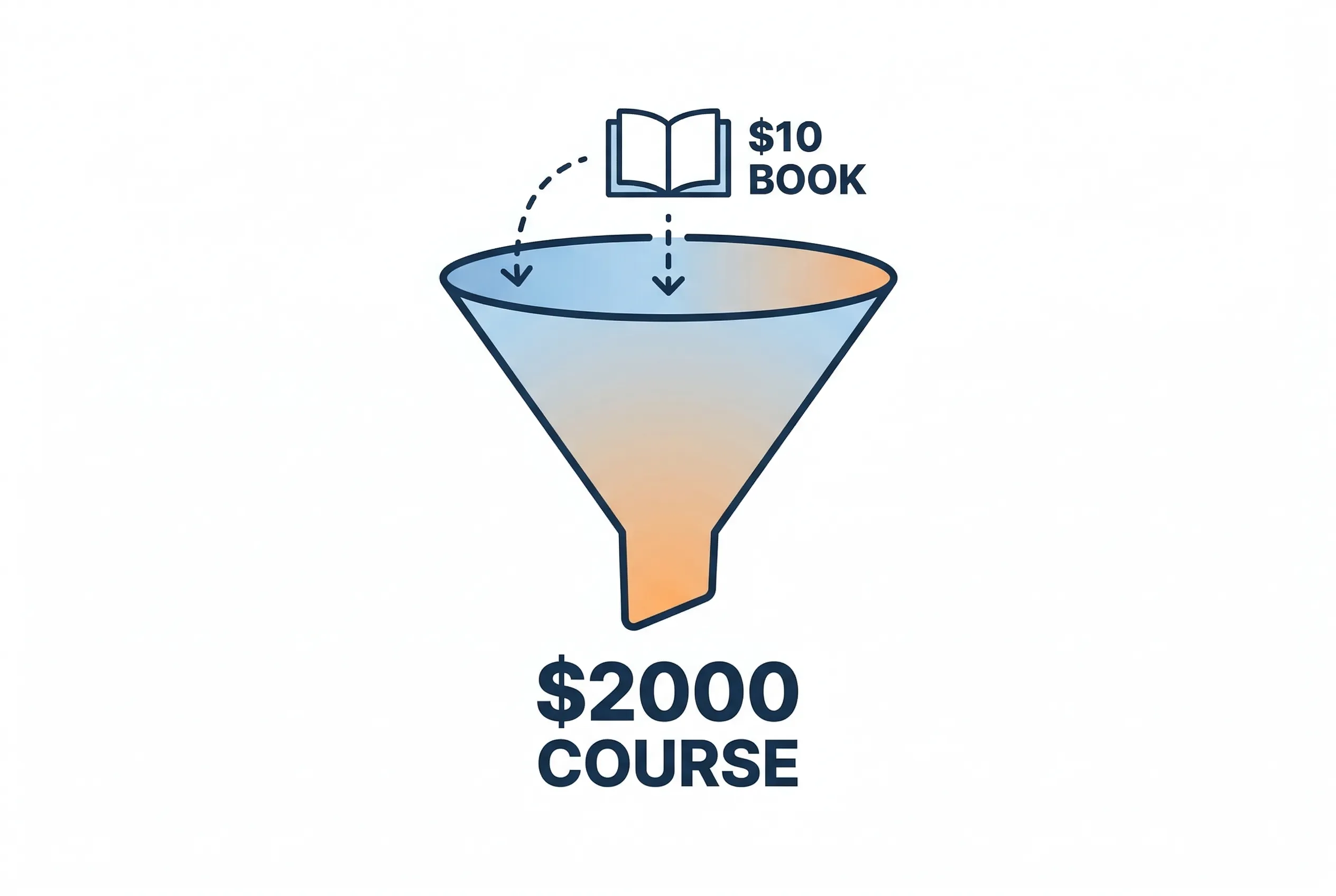
- The book’s “secret to success” was actually a marketing funnel leading to a 14-volume paid course
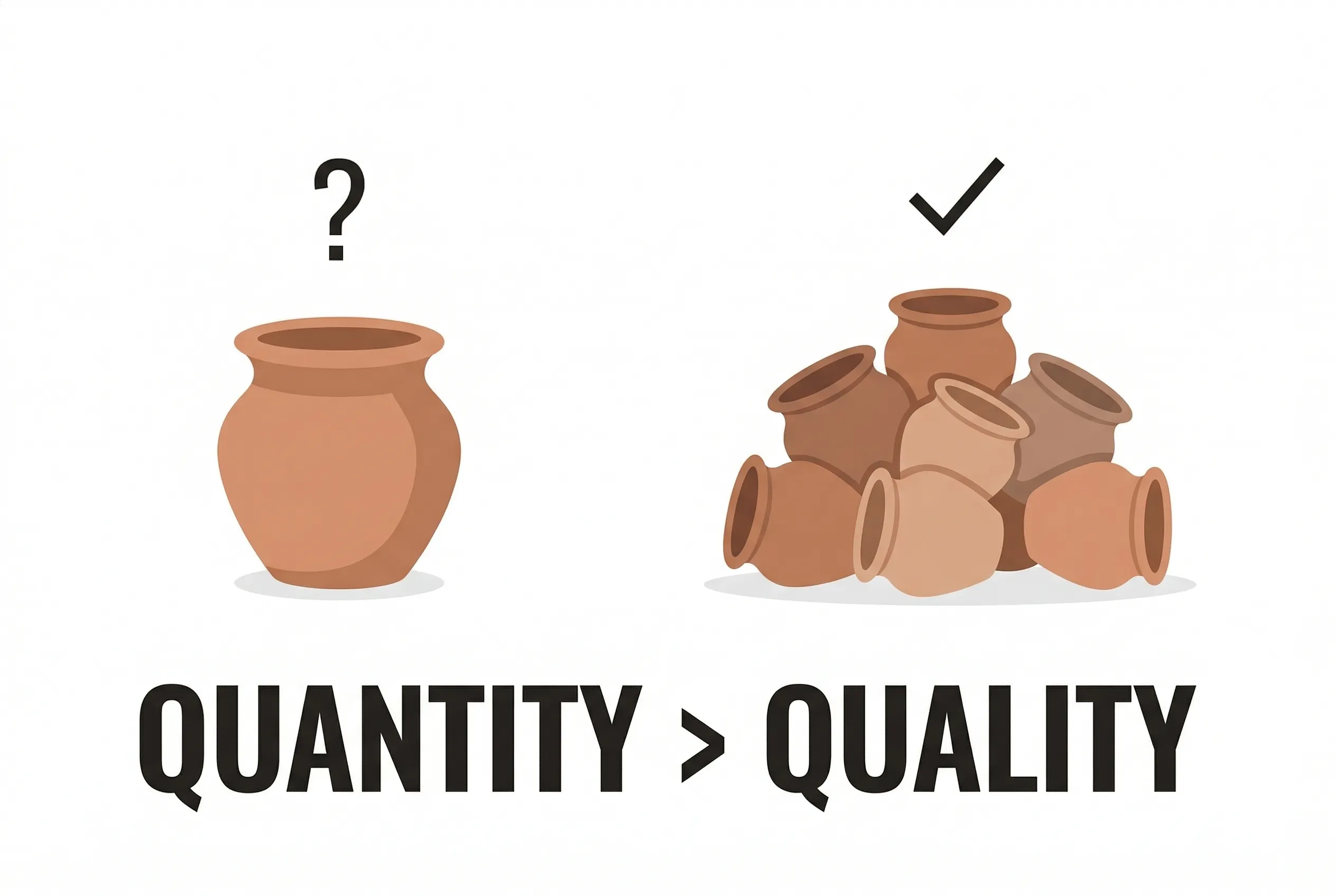
- Yet even a fraud can produce useful ideas — “quantity over quality” may be one of the few self-help principles that actually holds up
A Deliberately “Distressed” Classic
Sam has been re-reading old books, including Dale Carnegie’s How to Win Friends and Influence People. His reasoning: rules that survive decades are probably worth following.
But he did something he calls “stupid.”
Sam said: “I distressed the book. Like distressed jeans — I roughed it up, dog-eared pages, folded the first 30 pages. Made it look like an heirloom passed down through generations.”
Shaan asked: “You dog-eared pages you hadn’t even read?”
“I made the book look like it had already won friends and influenced people.”
This anecdote reveals something about the self-help industry: the core selling point isn’t content — it’s image. A book that looks well-worn is more persuasive than a pristine one. Which is exactly what they discuss next — in this industry, packaging sometimes matters more than truth.
100 Million Copies, All Built on Lies
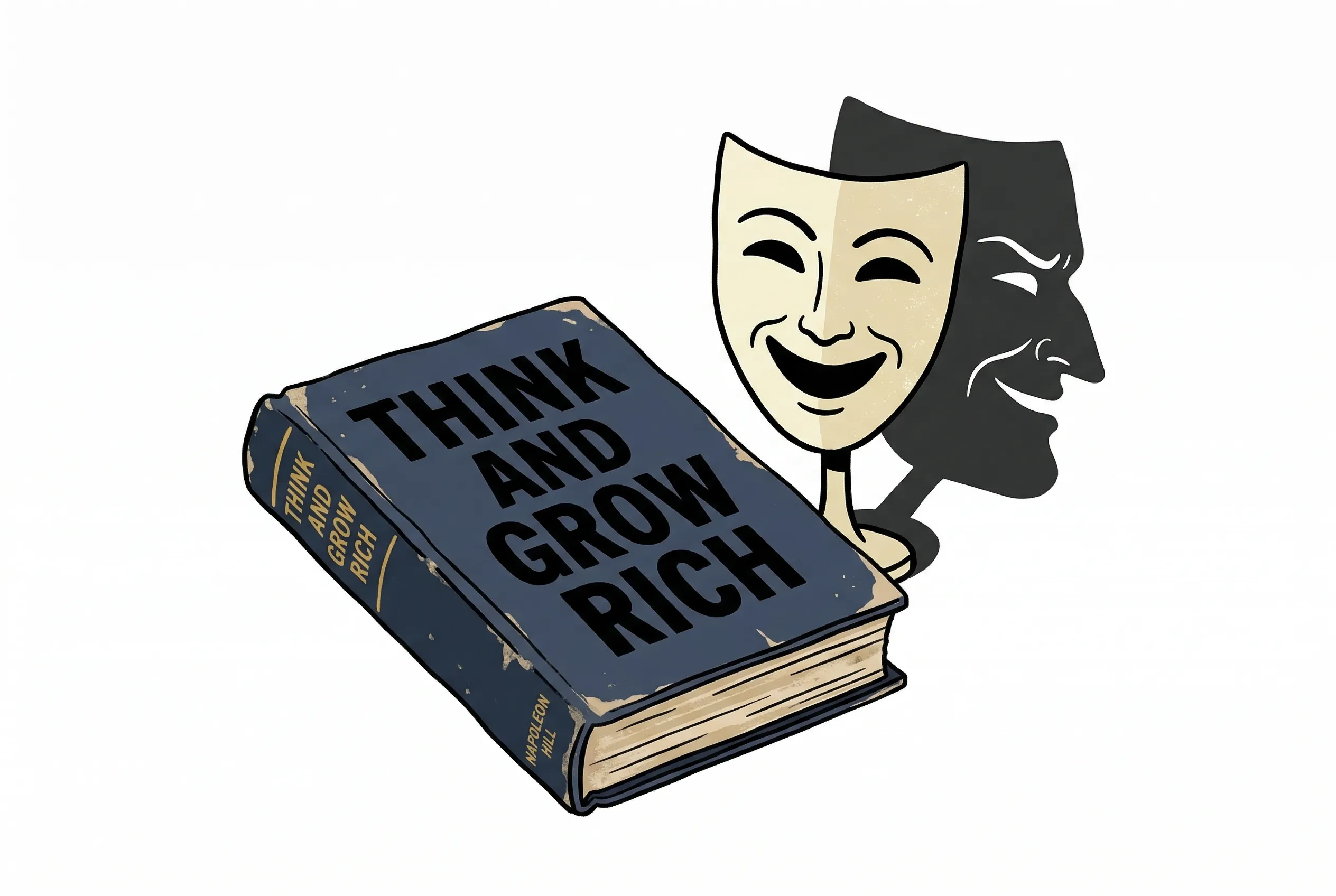
From Dale Carnegie, Sam shifted to another classic — Napoleon Hill’s Think and Grow Rich.
The book has sold approximately 100 million copies, making it one of the best-selling nonfiction books of all time. It still regularly appears on the New York Times bestseller list.
Sam explained the origin story: “Napoleon Hill was this poor kid from Appalachia who made his way to New York City. While writing for a magazine, he met Andrew Carnegie — the richest man in the world at the time, founder of Carnegie Steel. Carnegie supposedly commissioned him to interview 500 successful people and distill the secret to success into a book.”
The story is compelling. The problem? It was completely fabricated.
Sam noted that Napoleon Hill almost certainly never met Andrew Carnegie. The “commission” never happened. None of the business leaders he claimed to interview ever confirmed it. The book’s core premise — “I extracted the secret to success from the world’s most successful people” — was a carefully constructed lie.
Hill’s personal history was equally fabricated. He faced multiple fraud charges throughout his career and was ultimately convicted of financial fraud.
Yet the book sold 100 million copies.
“The Secret to Success” Was a Sales Funnel
The book repeatedly hints at a “secret to success.” Andrew Carnegie “dropped it into my pocket” — Hill’s words. But the entire book never explicitly reveals what it is.
Sam explained the trick: “Hill says he wrote another book that fully explains the secret. But he won’t even tell you the name — he says, ‘When you’re ready, it will find you.’”
That book was The Law of Success, a 14-volume paid course. Expensive.
In other words, Think and Grow Rich was a front-end acquisition product — a $10 book designed to funnel you into a $2,000 course.
Sam said: “This might be one of the earliest open loop marketing techniques ever. He created a gap in the book that forces you to buy his course. Then there were seminars too. His marketing prowess was amazing.”
Hill eventually turned this system into a seminar company. It was somewhat successful — until he was caught embezzling funds.
But Sam acknowledged something important: the book actually contains good stuff.
The Mastermind concept — gathering a group of smart people to regularly exchange ideas — was likely invented by Hill. Despite his life being a lie, this methodology has stood the test of time.
A con man’s book containing genuinely useful ideas. That itself is worth thinking about.
How Much of Self-Help Is Fake?
Napoleon Hill’s story raised a bigger question: what’s the actual fraud rate in the self-help industry?
Shaan said: “I can’t tell if the self-help industry actually has a higher percentage of fraud and fakery. But it feels that way.”
He asked directly: “Who do you know in the industry that you think is totally legitimate?”
They discussed several names. Tony Robbins is an interesting case — he’s acknowledged the industry’s fraud problem, yet he’s one of its biggest beneficiaries.
Sam then mentioned Jesse Itzler (Marquis Jet co-founder, Sara Blakely’s husband). Sam said he’s spent significant time with Itzler:
“Every time I’m around this guy, he exceeds expectations. He’s the real deal.”
Shaan used an interesting analogy: meeting someone is like looking at a curve with a Y-intercept — your initial expectation. Some people drop immediately because their real abilities don’t match their reputation. Jesse Itzler is the type who beats expectations every time.
This framework is actually practical: to judge whether a self-help guru is legitimate, don’t look at book sales — look at whether your assessment goes up or down after close contact.
One Success After 30 Failed Projects
The conversation shifted from self-help’s “fake” to the startup world’s “real.”
Sam brought up Pete Steinberger, an Austrian developer who created OpenClaw (an AI assistant), later acquired by OpenAI.
What interested Sam wasn’t the acquisition itself, but how many projects Pete had built before.
Sam said: “Do you know how many projects and little products this guy tried before the big win? The number is amazing.”
Shaan wasn’t surprised: “This is a pattern you’ll see over and over.”
Pete had previously run a company (PSPDFKit), and after selling it, felt empty. He went back to building — constantly writing code, creating tools, shipping products. He said he “vibe coded” OpenClaw and didn’t even read the code afterward.
This approach has obvious risks — Shaan noted security concerns and potential vulnerabilities. But Pete’s attitude: ship first, iterate toward a better version.
The core lesson isn’t about whether vibe coding is advisable. It’s more fundamental: do enough things, and your skill level rises, increasing the probability of creating something great.
“Like dating or anything else in life, you only need one to work.”
The Pottery Class Secret: Quantity Beats Quality
To further illustrate “quantity over quality,” Sam referenced a classic experiment — originally shared on the podcast by Vanta CEO Christina Cacioppo.
A university professor in Florida split a pottery class into two groups. One group was graded on quality — submit one best piece at semester’s end. The other on quantity — more pieces, higher grade, quality irrelevant.
End of semester: the quantity group produced better pottery.
Sam explained: “If you do things repeatedly, your skill level goes up, so your ability to make something great goes up. The quality group spent the whole semester theorizing and planning, and their final work was worse.”
This experiment became a classic reference in creative fields (the original may have involved photography rather than pottery, but the logic holds).
Sam then mentioned Christina Cacioppo herself. She taught herself to code, was an early investor in Replit (an online coding platform), and is now CEO of Vanta (a security compliance company) valued at approximately $5 billion, possibly approaching $10 billion.
Shaan asked: “Is she a billionaire now?”
Most likely yes. A self-taught programmer who tried many things and eventually built a company worth billions. Another case of quantity leading to quality.
Editorial Analysis
The Hosts’ Perspective
Sam Parr and Shaan Puri are both entrepreneurs. Their perspective naturally favors “action bias” — do more, try more projects, learn by doing. This explains why their take on Napoleon Hill is “the guy was a fraud, but the book has good stuff” rather than “the book should be pulled from shelves.”
Selectivity in Arguments
On Napoleon Hill: Hill’s fraud is well-documented historically. Multiple historians have confirmed his meeting with Andrew Carnegie almost certainly never happened, and he faced fraud charges throughout his career. This content is largely accurate.
On “quantity over quality”: The pottery experiment cited comes from David Bayles and Ted Orland’s Art & Fear. The original version involved photography, not pottery. It’s frequently cited to support “practice more,” but an important condition is often omitted — both groups had instruction and feedback. Repetition without feedback doesn’t necessarily improve quality.
On Pete Steinberger / OpenClaw: Sam framed Pete’s story as “30 failed projects before success.” But Pete’s previous company PSPDFKit was a successful company (acquired). This isn’t purely a zero-to-one story — it’s a previously successful entrepreneur succeeding again in a new domain. The bar is higher than it sounds.
Counterpoints
Self-help industry critics (like psychologist Timothy Wilson) argue the problem isn’t just individual fraudsters — it’s that the entire industry’s business model incentivizes oversimplification and overpromising. When a book claims it can make you “rich,” it’s already making a promise it can’t deliver.
On “quantity over quality” counterexamples: in high-stakes domains (medicine, aviation safety), quality must take precedence. This principle applies more to creative and entrepreneurial endeavors and shouldn’t be universally generalized.
Facts to Verify
- Whether Napoleon Hill was actually convicted of financial fraud — specific cases and dates need confirmation
- Exact sales figures for Think and Grow Rich (does 100 million include all editions and reprints?)
- Pete Steinberger / OpenClaw acquisition terms — podcast says “undisclosed sum”
- Whether Christina Cacioppo is a billionaire — Vanta’s valuation and her ownership stake need confirmation
Key Takeaways
Frauds can write useful books — Napoleon Hill’s life was a lie, but the Mastermind concept and some methodologies have genuinely stood the test of time. Content value and author integrity can be separated.
Quantity is the path to quality — 30 failed projects aren’t wasted, they’re training. The pottery experiment, Pete Steinberger’s startup journey, Christina Cacioppo’s self-taught coding — all point to the same conclusion: do enough things, and something great will emerge.
Judge people by their “Y-intercept” — Whether your assessment rises or falls after close contact is more reliable than any bestseller ranking.
Notes from Why the Self-Help Industry Is Built on Lies, My First Million podcast
If you found this helpful, consider buying me a coffee to support more content like this.
Buy me a coffee