How a 19-Year-Old Built an AI App to $50M ARR and Sold It
Guest: Zach Yadegari, Founder of Cal AI, age 19 Hosts: Sam Parr & Shaan Puri (My First Million podcast) Length: 68 minutes Source: YouTube
The last time Zach Yadegari appeared on My First Million, he was dialing in from his high school lunch break. A little over a year later, he’s 19, his company did $30M in revenue in 2025, hit $5.7M in January 2026 alone — over $50M annualized — and he just sold 100% of it to MyFitnessPal.
Cal AI is a mobile app that uses AI to identify food from photos and automatically log calories. It sounds simple — but it went from zero to tens of millions in annual revenue inside a category that MyFitnessPal had dominated for over a decade.
Rejected by Every Ivy, But He Didn’t Need Them Anyway
Zach applied to every Ivy League school. He got rejected by all of them. An entrepreneur running a business doing tens of millions in revenue wasn’t “outstanding enough” by admissions standards.
Sam mentioned he’d been vocally annoyed about this on Twitter — a teenage founder building a multi-million dollar company, and admissions officers looked at his transcript and said no.
Zach himself was remarkably unbothered. He ended up at the University of Miami, is a freshman, and openly admits he’s skipped a lot of classes this semester. He struggles to name anything he genuinely enjoys about university, though he does like Miami’s social scene — half entrepreneurs, half students, a mix he finds interesting.
When asked if the school had reached out asking for a donation, he laughed.
“You Don’t Have to Be a Genius — You Have to Be Bold”
Zach started coding at age 7 because he wanted to make his own games. By ninth grade, he’d built an “unblocked games” website that let students play games on school computers. It unexpectedly grew to 5 million users, made $60K a year from banner ads, and he sold it for $100K at 16.
Sam’s take on what makes Zach different isn’t raw programming talent:
“You don’t need to be world-class at any one thing. What’s actually valuable is the combination — good enough technical skills, plus good enough or better marketing instincts, plus the founder’s drive.”
Zach agrees. He describes his learning style using the 80/20 rule: learn the top 20% of any domain to get 80% of the results, then hire people who are better than you for the rest. Coding gave him the ability to manage technical teams — he doesn’t need to write every line himself, but he understands what engineers are actually saying.
Sam pulled up a video of 13-year-old Zach, filmed in his kitchen, declaring that he would make $1 million before graduating high school.
Zach’s response: “I always believed it deep down. I wanted it so badly that it had to be true.”
Shaan pushed him on whether he’d deliberately trained the confidence muscle. Zach was direct: it wasn’t any meditation practice — it was just trying, failing, surviving, and finding that each time you come out the other side, your confidence grows a little.
“Confidence isn’t innate. Every time you go through something hard and survive it, it gets a little stronger.”

Inside the Deal: His First Exit at 18
The deal closed in December, but the news only came out now — January and February are Cal AI’s peak months, and they didn’t want the acquisition announcement affecting business performance.
Zach says the most exciting moment was hearing the offer over the phone. But he immediately told himself: nothing is signed yet, hold it together. By the time the papers were actually signed and the money was in the account, the feeling was somehow less intense than that first phone call.
The acquisition moved faster than usual. Shaan shared some insider context on how deal negotiations typically work.
The first acquisition interest came from a private equity firm. The offer was low. Zach turned it down politely — not by saying “no” outright, but by countering with a number so far above their offer that the gap made itself obvious.
Then he hired bankers — M&A advisors. Shaan emphasized why this mattered:
“You’ll probably only sell a company once in your life. Bankers do this a dozen times a year. They know every play in the book.”
The bankers connected him with more potential buyers and engineered a competitive bidding process. MyFitnessPal’s parent company ultimately acquired 100% of the company. Zach kept his CEO title and has a stay-on period.
When pressed on how much he actually walked away with after taxes, Zach said he couldn’t share the number, but acknowledged it was “less than expected” — some federal taxes, some state taxes, and the structure of the deal itself.

From Influencer Marketing to $1M/Month in Ad Spend
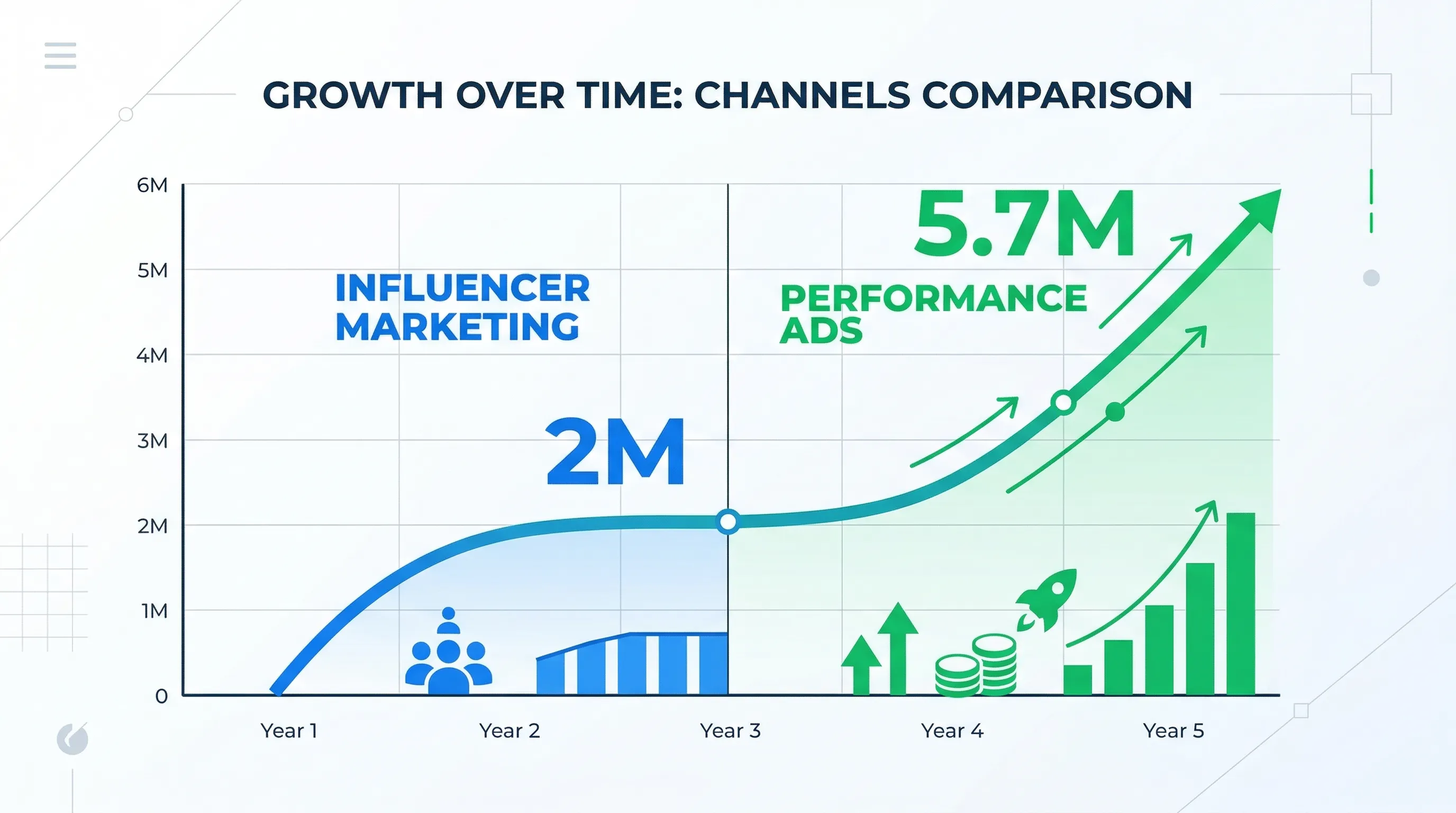
Cal AI’s early growth ran entirely on influencer marketing. Zach had covered this in detail on his previous podcast appearance — systematically reaching out to TikTok creators and getting them to post native-style videos using Cal AI. This approach took the app to $2M in monthly revenue.
Then it plateaued.
The breakthrough was performance advertising. They launched paid campaigns on Instagram, TikTok, and Facebook, and put serious time into learning how to optimize them. By January 2026, they were spending over $1M per month on ads — against $5.7M in monthly revenue, a solid ROAS.
The most interesting marketing move was partnering with Mr. Beast. Mr. Beast’s team was planning a video, Zach got access to a sponsorship slot through a connection, and flew out to be on set. The video became one of Mr. Beast’s best-performing recent releases.
But Zach was candid about the ROI: the sponsorship was expensive, and from a pure financial return standpoint it didn’t pencil out. He framed it as brand awareness spend, not performance marketing.
When Sam pressed for the number, Zach didn’t reveal the sponsorship cost — but hinted it was six figures. His reasoning: a single big brand placement rarely generates positive direct ROI, but if it creates lasting brand memory, it might still be worth considering. That said, he acknowledged that in hindsight, putting the same budget into performance ads probably would have returned more.
Expected Value Thinking: How a 19-Year-Old Decided to Sell
What impressed Shaan most about Zach wasn’t his coding ability or his marketing instincts — it was his decision-making quality.
Zach used an Expected Value (EV) framework to think through whether to sell. The logic goes like this:
Suppose there’s a 50% chance the company keeps growing significantly (say, doubles in value), and a 50% chance competition, regulation, or market shifts erode it. The expected value of holding is the probability-weighted average of both outcomes. If the certain amount you can capture now exceeds that expected value, you should sell.
For a 19-year-old first-time founder, the massive value of certainty — life-changing financial freedom — deserves far more weight than the mathematical EV alone. A billionaire might not care about an extra 20%. For Zach, this money was a 0-to-1 transformation.
Shaan used a poker analogy: great poker players don’t just think about the strength of their hand — they think about their stack size. When your “chips” are your entire net worth, even a positive-EV bet with high variance isn’t worth taking.
The Lamborghini Arc — A Teenager’s Detour
Sam asked directly: you went through a “douchebag phase.” What happened?
Here’s what happened: Zach and a few young founders rented a place together in Miami, the idea being to build companies side by side and share what they were learning. But they quickly realized that rent plus living expenses added up, and they needed income to cover the costs.
So they decided to build a course — teaching other people how to build apps. The business logic was reasonable: a group of young founders with real results, sharing their experience.
The problem was how they chose to promote it. They went the “controversy route” and filmed a promo video — Zach standing on a Lamborghini, throwing money in the air. The aesthetic was pure Andrew Tate.
Twitter exploded. The criticism was loud: a young founder who had been genuinely respected suddenly looked like he was running a “get-rich-quick course” hustle.
Zach reflected on this honestly. He said they were genuinely chasing a “hyper-controversial” brand to get attention, and badly underestimated the reputational cost. He used a phrase Shaan had given him — every founder has a “hero arc” and a “douchebag arc,” and most people spiral into the latter at some point.
The good news: the detour didn’t last long, and the core business wasn’t meaningfully damaged by it.
What’s Next: Aiming for a Billion
Zach says he has early ideas for his next project but isn’t sharing them — he was too loud last time, this time he wants to move quieter.
He has an idea validation framework built around two questions:
- Does a solution already exist for this problem? If so, the demand is real — you just need to build a meaningfully better version.
- Are users already paying to solve this problem? If they’re spending money on it now, willingness to pay is already proven.
Cal AI fit both perfectly — MyFitnessPal had already demonstrated that tens of millions of people would pay to track calories. Cal AI just needed to use AI to make that experience dramatically better.
He mentioned a few app ideas he finds promising:
- Semantic search for your social media followers: search your Instagram or X followers using natural language — filter by interests, profession, location.
- GrindClock: an “accountability partner” app, somewhere between an alarm clock and a journal.
But his filtering criteria have changed. When he built Cal AI, the goal was “make $1M before graduating high school.” Now his bar is one billion dollars. Not out of greed — he just figures that if the target isn’t big enough, the same time and energy isn’t worth spending.
Dinner with a Billionaire: What Happens to Founders When AGI Arrives?
The interview ended on an unexpected note. Zach mentioned that the night before, he’d had dinner with Steve Cohen — owner of the New York Mets and manager of roughly $50 billion in hedge fund assets — and they’d talked about the future of AI.
Cohen’s approach was pragmatic: don’t try to predict when AGI arrives. Just make sure the companies you’re invested in can “survive the next three years.” After that, reassess. Nobody knows what the world will look like, so the priority is to stay alive long enough to adapt.
Zach said he’s genuinely confused. Elon Musk says there’s no point saving for retirement because material abundance will become extreme. If that’s true, what’s the point of building companies, making money, competing at all?
Shaan offered an answer: even if AGI fully arrives, doing things will still matter. Not because the world needs you to do them, but because humans need a reason to get out of bed. Building things, solving problems, working with sharp people — the experience itself is the reward.
Zach added his own angle: even in a world where AI is overwhelmingly powerful, people with taste — who can tell what’s good from what isn’t — will still have value. AI can generate anything. But you still need someone to say “this version is right, that one isn’t.”
Editorial Analysis
The Guest’s Position
Zach’s current identity is that of a young founder fresh off an exit. That identity shapes a few things: he has reason to make the entrepreneurship narrative sound compelling (the acquisition just went public, and he’s at peak personal brand momentum), and he’s also promoting his own app-building course. Worth noting, however, is that on many key data points — exact acquisition price, after-tax amount, Mr. Beast sponsorship cost — he chose not to disclose. That kind of restraint is uncommon for a 19-year-old.
What the Interview Leaves Out
The interview presents a near-perfect founder narrative: teenage prodigy → underestimated → comeback → financial freedom. A few important details get soft-pedaled:
- Cal AI’s technical moat is never seriously examined. AI food recognition is a relatively mature technology with multiple competitors. Cal AI’s real edge was likely more on the marketing and distribution side than the technology side.
- The team is almost entirely absent from the conversation. A company doing $30M in revenue is not a one- or two-person operation, but the entire narrative centers on Zach individually.
- The acquisition price was not disclosed, but the headline implies $50M. That figure is actually an annualized revenue projection ($5.7M × 12), not the purchase price. The actual acquisition price could be higher or lower depending on the revenue multiple used.
The Other Side of the Argument
On the optimistic “AI app startup” narrative: Zach’s playbook — use AI to improve an existing category, ignite growth with influencer marketing, scale with performance ads — genuinely worked in 2024–2025. But this window may be closing. As AI tools become commoditized, competition in these categories will intensify sharply and customer acquisition costs will rise.
On the “young founder courseification” trend: Zach himself admits the Lamborghini arc was a mistake. Young founders packaging their stories into courses for sale has become a recognizable pattern in Silicon Valley and on Twitter. That’s not inherently bad — but buyers should separate “replicable methodology” from “non-replicable luck.”
Key Takeaways
- Skill combinations beat single-domain mastery. You don’t need to be the best programmer or the best marketer. Find the intersection of your abilities and be “good enough” at that crossroads.
- Hire a banker for your first exit. You’ll sell a company once in your life; they do it a dozen times a year. Their negotiation experience, buyer networks, and bidding process expertise are worth far more than the fee.
- Use an expected value framework for big decisions. Don’t just ask “how much can I make?” — ask “what happens if this goes wrong?” and “what does this certain amount actually mean for my life?” For a young founder, the certainty itself is often the most valuable thing about the first big payday.
Source: My First Million podcast, 2026. Hosts Sam Parr & Shaan Puri in conversation with Cal AI founder Zach Yadegari.
If you found this helpful, consider buying me a coffee to support more content like this.
Buy me a coffee